Español
 Русский
 Francés
 Português
 ภาษาไทย
 Indonesia
 Việt
Việt
 العربية
 Melayu


An Analysis Of The Production Process For Engineered Wood Veneer
An Analysis Of The Production Process For Engineered Wood Veneer
In the fields of home decoration, furniture manufacturing, and interior fit-outs, engineered wood veneer has emerged as a primary alternative to natural wood veneer. Unlike traditional natural veneer, engineered veneer utilizes modern wood modification technologies to overcome the limitations of natural wood—such as irregular grain, frequent defects, and resource scarcity. It offers numerous advantages, including uniform grain patterns, rich color options, high stability, cost-effectiveness, and environmental sustainability, making it perfectly suited for the demands of large-scale, high-quality modern building material production. A refined and standardized production process is essential to ensuring the superior quality of engineered veneer; specifically, the drying stage is critical for controlling stability and molding outcomes. Consequently, the intelligent application of veneer dryers directly determines the quality and service life of the finished product.
I. Core Characteristics And Application Value Of Engineered Wood Veneer
Engineered wood veneer—also known as modified or reconstituted veneer—is a decorative surfacing material created by using common fast-growing wood species as a base. Through physical and chemical modification processes, the wood's grain and color are reconstructed, followed by precision slicing. Its core advantage lies in being "derived from nature yet superior to nature": it retains the natural texture and warm feel of solid wood while using artificial optimization to eliminate defects common in natural timber, such as cracking, knots, insect holes, and color inconsistencies.
In terms of application, engineered veneer can precisely replicate the grain patterns of premium woods like oak, walnut, and ebony. It is widely used in high-end furniture, cabinet doors, solid wood flooring, commercial hotel interiors, and wall paneling. Furthermore, its high degree of customizability allows for adjustments to grain density, color depth, and thickness based on market demand, accommodating diverse design styles. Notably, because it is processed from fast-growing timber, engineered veneer significantly reduces the consumption of rare wood species. Aligning with green and eco-friendly industrial development principles, it stands as a prime example of an innovative product that maximizes the efficient use of wood resources.
II. Comprehensive Production Process For Engineered Wood Veneer
The production of engineered wood veneer is a precise, continuous industrial process. Every step—from base material pretreatment to the cutting of the finished product—is subject to rigorous quality control. The core production workflow comprises six major stages: log pretreatment, modification, veneer assembly and forming, drying and setting, precision slicing, and final finishing. The drying process spans the core production phase, serving as a critical link between the preceding and subsequent stages.
1. Log Pretreatment
High-quality, fast-growing logs—such as poplar, eucalyptus, and fir—are selected as the base material. First, cutting equipment processes the logs into standard-sized billets, which then undergo debarking, cleaning, and softening. Softening is achieved through warm water soaking or steam treatment to enhance wood fiber flexibility; this prevents veneer breakage or damage during subsequent rotary cutting and slicing, thereby laying the groundwork for the modification process. Once softened, the billets are processed into uniform, flat veneers using rotary cutting equipment, and any defective veneers with significant damage or impurities are discarded.
2. Bleaching and Dyeing Modification
This is the core stage for customizing the texture and color of the engineered wood veneer. Natural fast-growing wood often has an uneven base color and monotonous grain. Consequently, the veneers undergo a bleaching process to remove natural discolorations and pigments, unifying the base color and eliminating inherent color inconsistencies. After bleaching and an initial water rinse and drain, the veneers enter a temperature-controlled dyeing workshop. Depending on design specifications, they undergo immersion or spray dyeing, allowing the wood fibers to fully absorb the pigment. This creates regular, uniform, and aesthetically pleasing custom textures and colors, replicating the decorative appearance of various precious wood species.
3. Veneer Assembly and Gluing
After dyeing, the veneers undergo a repair process combining manual labor and machinery to eliminate minor surface imperfections. They are then arranged and assembled according to preset grain patterns and thickness standards. Precision gluing equipment applies adhesive evenly to the veneers, which are then bonded and set using a multi-layer pressing process to form structurally stable engineered wood blocks. This stage demands strict control over veneer moisture content; excessive moisture leads to weak bonding, subsequent delamination, and mold growth, while insufficient moisture increases fiber brittleness and the risk of cracking. Consequently, the drying and setting process is critical to ensuring bonding quality.
4. Drying and Setting Process (Core Stage)
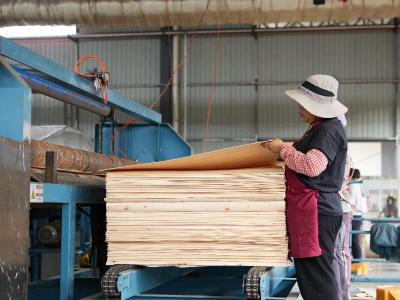
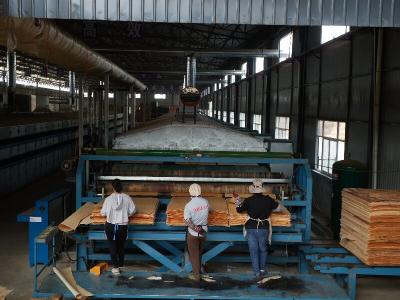
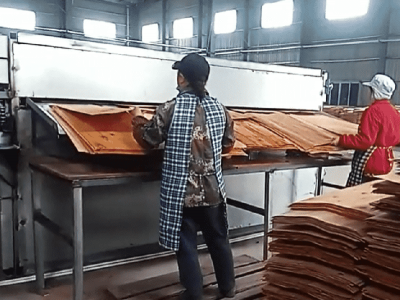
Both the veneers (before and after assembly) and the wood blocks require precise drying, which is the primary application for veneer dryers. Freshly dyed and rinsed veneers have high and unevenly distributed moisture content; proceeding directly to gluing and pressing would likely result in defects such as deformation, warping, delamination, mold, and inconsistent color. Therefore, professional veneer dryers must be used to systematically dry the wet veneers, precisely controlling moisture levels and stabilizing the wood fiber structure.
5. Precision Slicing and Finishing
Once dried and set to the required moisture content, the engineered wood blocks undergo ultra-thin slicing using high-precision equipment to produce finished veneers ranging from 0.15mm to 0.6mm in thickness. After slicing, products with irregular grain patterns or surface damage are manually discarded. Qualified veneers undergo sanding, dedusting, and edge trimming to ensure a smooth, flat surface and a clear, three-dimensional grain appearance.
6. Finished Product Inspection and Packaging
Finally, the veneers undergo comprehensive testing for moisture content, flatness, color consistency, grain integrity, and toughness. Qualified products are sorted, packaged, and stored in sealed conditions to prevent moisture-induced deformation, thereby completing the entire production process.
III. Equipment Types, Working Principles, And Process Value Of Wood Veneer Dryers
In engineered wood veneer production lines, the veneer dryer is a core piece of specialized equipment essential for ensuring product stability and minimizing defect rates. Unlike standard drying equipment, it is specifically designed to handle the characteristics of thin veneers—which are lightweight, prone to deformation, and susceptible to heat damage. Capable of low-temperature, steady-speed operation with precise humidity control and uniform drying, it is indispensable for the large-scale production of modern engineered wood veneers.
1. Classification of Mainstream Equipment
Based on production processes and capacity requirements, veneer dryers fall into three main categories suited to different production scenarios: First, roller-type continuous dryers, which utilize a multi-layer roller conveyor structure to enable continuous feeding and drying; these are ideal for large-scale assembly-line production and standard-thickness engineered veneers. Second, belt-type dryers, which feature uniform airflow distribution and minimal drying fluctuations; designed specifically for ultra-thin veneers, they effectively prevent the deformation or breakage of thin sheets. Third, vertical drying equipment, which has a compact footprint suitable for small-to-medium production lines and accommodates the drying needs of both core veneers and face veneers.
In terms of heating methods, the equipment operates via three modes—hot air circulation, steam heating, and thermal oil heating—and supports various heat sources such as natural gas, biomass, and electricity. Notably, biomass-heated dryers utilize wood waste as fuel; this energy-efficient, eco-friendly approach significantly reduces production costs and aligns with the wood industry's trend toward green development.
2. Core Working Principles
Veneer dryers are equipped with intelligent temperature and humidity control systems and sealed hot air circulation modules. During operation, the heating system generates constant-temperature hot air. Specialized airflow distribution structures ensure this hot air flows evenly within the drying chamber, enveloping the entire surface of the veneer. The equipment utilizes multi-zone temperature control technology, allowing for precise adjustment of drying temperatures (ranging from 120°C to 200°C) and airflow speeds based on veneer thickness, moisture content, and wood species. Moisture is removed gradually from within the wood, preventing issues such as cracking, surface scorching, or color fading often caused by rapid, high-temperature drying.
Additionally, an intelligent control system monitors internal temperature, humidity, and veneer moisture content in real-time, automatically adjusting drying parameters. This strictly limits the overall moisture content deviation to within ±1.5%, ensuring uniform moisture distribution within individual sheets and consistency across the entire batch. This effectively eliminates the drawbacks of traditional air-drying methods, such as uneven moisture levels and susceptibility to weather conditions.
3. Core Value of the Production Process
First, it stabilizes product dimensions and eliminates deformation defects. Engineered wood veneers are thin and prone to deformation; natural drying often leads to issues like curled edges and uneven surfaces. The veneer dryer employs uniform hot airflow to facilitate the slow, even contraction of wood fibers, effectively setting the veneer's structure. This significantly enhances flatness and dimensional stability, fundamentally reducing defect rates associated with warping, deformation, and cracking.
Second, it ensures bonding quality and improves the durability of the finished product. Precise drying stabilizes the veneer's moisture content within industry-standard ranges, making it perfectly suited for subsequent gluing and hot-pressing processes. Veneers with optimal moisture content allow for superior adhesive strength and tight bonding, effectively preventing issues such as delamination, separation, or blistering in the final furniture or panels, thereby greatly extending the product's service life.
Third, it sets the grain and color, enhancing the decorative quality. The color of dyed engineered wood veneer is initially unstable, and traditional drying methods often result in color bleeding or uneven shading. The dryer’s constant-temperature, low-speed drying mode effectively sets the wood pigments and prevents color inconsistency, resulting in clear, three-dimensional grain patterns and uniform, vibrant colors that elevate the decorative appeal of the finished product. Fourth, enhancing production efficiency to achieve standardized mass production. Unlike natural air-drying—which is time-consuming, inefficient, and weather-dependent—mechanized drying enables continuous 24-hour operation. This significantly shortens production cycles while ensuring uniform drying standards and consistent quality across batches, thereby facilitating the industry's transition toward standardized, large-scale, and intelligent manufacturing.
IV. Conclusion: Process Upgrades Empower High-Quality Industry Development
The superior quality of engineered wood veneer stems from a standardized and refined end-to-end production process; drying technology serves as a core process step and a critical link between wood modification and final product formation. Traditional, rudimentary production methods can no longer meet the quality demands of modern high-end decorative materials. However, the widespread adoption of intelligent veneer dryers has effectively resolved long-standing industry pain points, such as uneven moisture content, deformation and cracking, excessive color variation, and low efficiency.
As the home furnishing and building materials industry shifts toward high-end, eco-friendly, and intelligent operations, engineered wood veneer is leveraging its inherent advantages to expand its market applications. By continuously optimizing production processes, upgrading intelligent drying equipment, and strictly controlling every stage of manufacturing, the stability, aesthetics, and practicality of engineered wood veneer can be further enhanced. This allows this innovative, eco-friendly material to increasingly replace rare natural veneers, thereby promoting the efficient use of timber resources and the high-quality development of the home furnishing industry.