Español
 Русский
 Francés
 Português
 ภาษาไทย
 Indonesia
 Việt
Việt
 العربية
 Melayu


Key Differences Between Film-Faced Plywood And Standard Plywood
Key Differences Between Film-Faced Plywood And Standard Plywood
In the traditional plywood industry, standard plywood and film-faced plywood are two core product categories. Although many professionals handle their production and shipment daily, they often fail to grasp the fundamental differences between the two, leading to issues such as order mismatches, pricing confusion, customer churn, and shrinking profit margins. Many in the industry mistakenly believe the only difference is the presence or absence of a surface film; in reality, they differ fundamentally in production processes, physical properties, application scenarios, service life, and profit potential.
This distinction is particularly critical given the current cutthroat competition in the building materials market. While low-end standard plywood suffers from intense price wars, film-faced plywood has become a staple in construction projects due to its superior durability and versatility. Understanding the differences allows businesses to precisely meet customer needs and avoid after-sales disputes, while also optimizing product portfolios and boosting overall revenue.
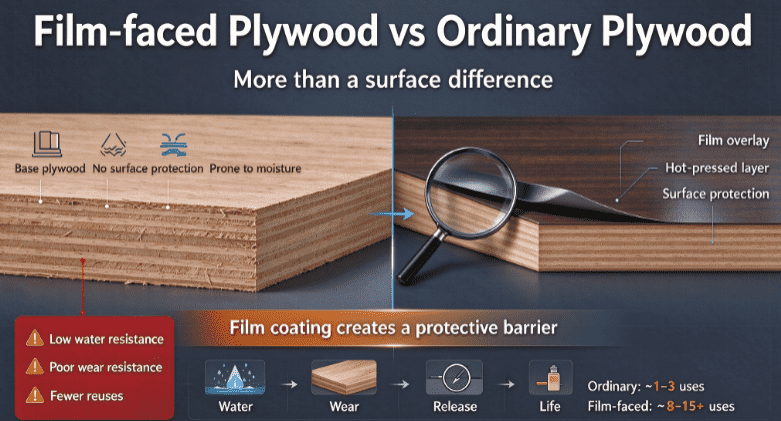
I. Production Process: The Film-Lamination Step Defines the Product Tier
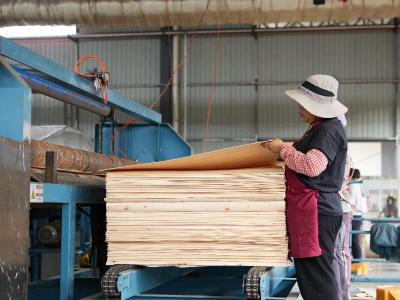
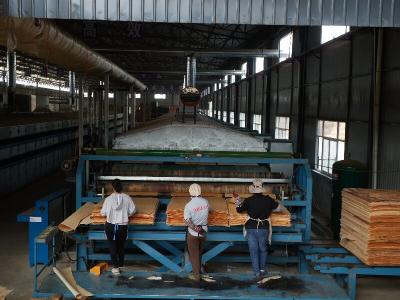
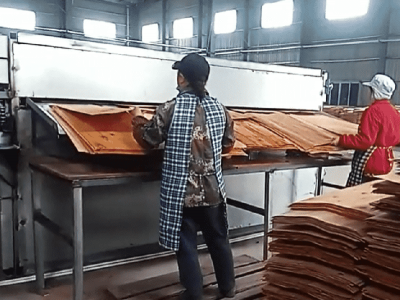
Both standard and film-faced plywood share the same base material: multiple layers of wood veneer (such as eucalyptus or pine) arranged in alternating grain directions and bonded under high heat and pressure. This ensures structural stability, but the core difference lies in the subsequent processing stages.
Standard plywood is a basic finished product; it is ready for shipment after the base material undergoes hot pressing and sanding. Its surface retains the natural wood grain without any protective coating. Characterized by simple production steps, short lead times, and low equipment investment, it serves as a high-volume staple for traditional plywood manufacturers.
Film-faced plywood is an upgraded version of standard plywood. After the base material is sanded and formed, specialized phenolic film paper is applied to both sides. A secondary high-temperature, high-pressure bonding process then fuses the film seamlessly with the wood core, ensuring it will not peel or delaminate. Although this key step appears simple, it significantly enhances the board's density, sealing capabilities, and stability—serving as the root cause of all performance differences between the two products. Furthermore, film-faced plywood typically utilizes waterproof WBP phenolic resin adhesive. Compared to the standard urea-formaldehyde adhesive used in ordinary plywood, this offers significantly superior bonding strength and water resistance, establishing a clear quality advantage right from the manufacturing stage.
II. Core Performance: Waterproofing, Wear Resistance, and Service Life
For end-users, performance directly dictates the user experience and the number of times the board can be reused; it is also the primary reason for the differences in pricing and target markets between the two products. Specific differences center on four key dimensions:
1. Waterproof and Moisture-Proof Performance
Ordinary plywood features exposed wood fibers on its surface, making it highly absorbent. In wet or humid environments, it readily absorbs moisture, leading to swelling, mold growth, and delamination (separation of layers). Even brief exposure to rain or dampness can cause surface deformation and render the board unusable; it is suitable only for dry indoor environments.
The phenolic film layer on film-faced plywood acts as a natural, highly effective waterproof barrier. Industry tests confirm it can withstand 24 hours of boiling without delamination or film separation. It withstands outdoor rain, damp construction sites, and immersion in concrete slurry. With exceptional weather resistance, it is perfectly suited for harsh conditions found outdoors and on construction sites.
2. Wear Resistance, Durability, and Form-Release Performance
Ordinary plywood has a rough, low-hardness surface with high friction. When used as construction formwork, the concrete adheres tightly to the board as it sets. Stripping the formwork often results in surface tearing, crumbling, and uneven walls, necessitating extensive manual repair—a process that is both time-consuming and labor-intensive. Additionally, the surface is easily scratched by sand, gravel, and tools, leading to rapid wear and tear.
Film-faced plywood features a smooth, hard, and highly wear-resistant surface that does not stick to concrete. It releases easily without extra treatment, producing walls that are smooth and even—free from surface pitting or cracks—thereby eliminating the need for secondary plastering or sanding. Moreover, the surface resists scratches and acid/alkali corrosion, withstanding abrasion from site debris and erosion from cement, resulting in a very low rate of wear and damage. 3. Reusability and Service Life
Service life is a critical factor influencing repeat purchases and product reputation. Standard plywood lacks toughness and is prone to warping and cracking; its reusability is very low, often becoming unusable after just 1–3 cycles on a typical construction site, resulting in significant waste in high-frequency construction scenarios.
Film-faced plywood features a stable structure, resists warping and cracking, and offers a reusability rate of 8–15 cycles—with high-quality, high-density variants reaching over 40 cycles. This lifespan is several to over a dozen times that of standard plywood, drastically reducing material costs per construction cycle for end-users.
4. Environmental Friendliness and Stability
Standard plywood often utilizes urea-formaldehyde adhesive, resulting in relatively high formaldehyde emissions; it is prone to releasing harmful substances when exposed to moisture and lacks stability. In contrast, film-faced plywood uses high-quality phenolic adhesive, ensuring superior bonding stability and lower formaldehyde emissions. Additionally, the film coating acts as a barrier against air and moisture, effectively preventing aging, warping, and degradation, thereby ensuring greater long-term stability.
III. Application Scenarios: Precise Positioning to Avoid Indiscriminate Orders and Wasted Capacity
Many business owners accept orders haphazardly, often failing to distinguish between the appropriate use cases for these two types of plywood. This leads to mismatches—such as using low-end boards for high-end requirements or vice versa—resulting in lost clients or eroded profits. The application boundaries for these two products are distinct, precisely addressing different market needs:
Standard Plywood (Low-end, essential indoor use)
Positioned for cost-effectiveness and high-volume sales, this product is suitable only for dry indoor environments that do not require waterproofing or high wear resistance. Key applications include: substrates for interior renovation, standard furniture panels, packaging pallets, interior partitions, and simple cabinetry. These scenarios prioritize low costs over weather resistance or reusability, making it the mainstream choice for home renovation and light industrial packaging markets.
Film-Faced Plywood (High-end, essential outdoor/engineering use)
Positioned for high performance and reusability, this product is suitable for complex working conditions and projects demanding superior panel quality. Key applications include: fair-faced concrete formwork for architectural projects, bridge and tunnel construction, outdoor infrastructure, hydraulic engineering, and high-end prefabricated construction. These scenarios demand exceptional wall-forming results, panel durability, and high reuse rates—requirements that standard plywood cannot meet—making this a high-margin product in the construction materials market.
IV. Costs and Profits: The Profitability Gap That Matters Most to Business Owners
Discussing a product without addressing performance is meaningless; for panel manufacturers, the core concerns are costs, selling prices, profit margins, and market competitiveness.
1. Ex-factory Costs and Selling Prices
Standard plywood involves simple production processes, low raw material costs, and rapid output; its low ex-factory price per square meter relies on a "low margin, high volume" strategy. The market is hyper-competitive, plagued by price wars and cut-throat tactics among peers, resulting in razor-thin margins per unit and a reliance on sheer volume for profitability.
Film-faced plywood incurs higher production costs due to the addition of overlay materials and a secondary hot-pressing stage, resulting in a higher ex-factory unit price. However, its superior performance grants manufacturers greater pricing power; it avoids the chaos of low-price competition, and the profit margin per unit far exceeds that of standard plywood.
2. Overall Profitability and Customer Loyalty
Although standard plywood has a low unit price, it is prone to post-sale issues—such as moisture-induced warping, delamination, cracking, and surface crumbling—leading to frequent customer complaints and returns. These issues invisibly drive up after-sales costs and damage the brand's reputation, resulting in poor customer retention and a reliance on one-off orders from small-scale buyers.
In contrast, film-faced plywood offers high stability and minimal after-sales issues. Its advantages—high turnover rates, efficiency, and labor savings—make it a favorite among general contractors, construction firms, and infrastructure companies, facilitating long-term partnerships with major clients and securing stable, bulk orders. While the unit price may appear higher, the product offers superior overall value at the end-user level, ensuring more stable long-term profitability for manufacturers. V. Neither board type is inherently superior; choosing the right market segment is the key to profitability
Overall, film-faced plywood and standard plywood do not displace one another; rather, they are complementary products suited to different market segments:
Standard plywood meets basic, essential demand. It targets lower-end markets—such as home renovation, packaging, and general furniture—focusing on high sales volume and capacity utilization to maintain baseline revenue.
Film-faced plywood is a high-value, high-demand product. It targets high-end markets—such as construction projects, outdoor infrastructure, and hydraulic engineering or bridge building—focusing on high profit margins and customer stability. It is the core product for boosting overall profitability and gaining a competitive edge over industry peers.
For owners of traditional plywood factories, the low-end market is currently plagued by cutthroat competition, making it difficult to turn a profit relying solely on the volume sales of standard plywood. Success amidst fierce competition requires optimizing the product mix to balance high-volume staples with high-profit premium products. By precisely meeting diverse customer needs—retaining the retail market while securing major engineering clients—manufacturers can solidify their market position and ensure sustained profitability.