Español
 Русский
 Francés
 Português
 ภาษาไทย
 Indonesia
 Việt
 العربية
 Melayu



How To Extend The Service Life Of Veneer Dryers And Reduce Wood Factory Operation And Maintenance Costs
How To Extend The Service Life Of Veneer Dryers And Reduce Wood Factory Operation And Maintenance Costs
The veneer dryer is the core equipment in the plywood and veneer processing production line. The stability of the equipment directly determines the factory capacity, veneer drying quality and production cost. Many manufacturers only focus on startup output, but ignore daily maintenance. Problems such as reduced heat exchange efficiency, abnormal noise from the fan, deviation of the conveyor belt, damage to the insulation layer, dust accumulation in the furnace, and failure of moisture content detection often occur. The equipment ages in advance, and the cost of maintenance, shutdown, and replacement of parts remains high. Standardized use and regular maintenance can effectively extend the service life of the dryer, reduce sudden failures, and allow the equipment to stably produce qualified veneer in the long term.
1. Standardize startup operations and reduce equipment losses from the source
Unreasonable operating habits are the most common cause of accelerated dryer damage.
Before starting the machine, check the entire drying line: loading mechanism, negative pressure plate feeding system, conveyor belt/roller chain, fan, sealing structure, temperature and moisture content sensors for any abnormalities. Make sure that there are no excessive accumulation of wood chips and dust in the furnace and heat exchange pipes. Clean the internal debris to avoid feeding pallets and friction and scratching the conveying structure.
Do not burn directly at full load during the heating stage. Whether it is biomass combustion for heating or waste heat recovery for heating, the temperature must be raised step by step to allow the furnace body, heat exchange components, and cylinder to be heated evenly to prevent sudden changes in cold and heat from causing cracking of steel plates, detachment of welds, and peeling of the insulation layer. Thermal deformation damage of many drying equipment comes from rapid heating and sudden cooling.
During the drying process, the feeding rhythm should be controlled, and the veneers should be paved evenly to avoid excessively thick local materials and uneven loading, and prevent the rollers and mesh belts from deformation and deviation due to long-term uneven stress. At the same time, set a reasonable drying curve according to the wood species, insist on low temperature and slow drying, and do not blindly increase the temperature in pursuit of speed; over-temperature operation will not only easily cause the veneer to crack and be scrapped, but will also continue to aggravate the aging of heat exchange tubes, fans, and seals.
When shutting down, the power cannot be cut off directly by cutting off the heat source. Feeding should be stopped first, and the induced draft fan and circulating fan should be kept running for a period of time to take away the waste heat inside the equipment, and then stop them in sequence after the cavity temperature drops. If the airflow is stopped immediately under high temperature, heat will accumulate inside, which can easily burn out seals, bearings, and sensors, and also accelerate metal corrosion.
2. Carry out daily cleaning and dust removal to prevent accumulation of dust and sawdust
Veneer drying will continue to produce wood powder and wood chips. Such lightweight materials accumulate in heat exchange pipes, furnaces, water film dust collectors, fan impellers, and air ducts, causing great hidden dangers. On the one hand, dust accumulation on sawdust will reduce heat exchange efficiency and increase energy consumption; on the other hand, accumulated sawdust is flammable and poses a risk of fire. It will also wear the impeller, block the air duct, and cause excessive vibration of the fan.
Establish a daily and weekly cleaning system: after each shift of production, clean the scattered veneers and sawdust on the surface of the conveyor line and the bottom of the cavity; regularly open the inspection port to clean the heat exchanger and flue dust. The supporting water film dust removal system must also discharge sewage and clean scale on time to ensure the dust removal effect and prevent smoke from corroding the flue and furnace body.
Pay attention to the method when cleaning, and do not use hard objects to hit the heat exchange fins and insulation layer vigorously to prevent damage to the insulation board, deformation of the heat exchange tube, and damage to the insulation performance of the equipment. Once the insulation layer is damaged and heat leaks, not only the energy consumption will increase, but the outer steel plate will alternate between cold and hot for a long time, and the corrosion rate will be significantly accelerated.
3. Focus on inspection of wearing parts, lubricate them on time and replace them in time
The dryer has a number of continuously running moving parts, which are the focus of maintenance: bearings, chains, rollers, transmission motors, belts, correction mechanisms, and servo plate feeding components.
All bearing points are filled with high-temperature resistant grease in strict accordance with the instruction manual. Dry grinding due to lack of oil will quickly ablate the bearing seat, causing vibration and abnormal noise. In serious cases, it will directly block the machine and shut down. The chain should be cleaned regularly, lubricated with special oil, and checked for tightness to avoid tooth skipping and breakage.
Observe the operating status of the fan on a daily basis: the vibration of the fan becomes larger and the noise is abnormal, which is mostly due to the dust sticking to the impeller being unbalanced or the bearing being damaged. Perform dynamic balancing or replace accessories as soon as possible, and do not continue production while sick.
Sensors cannot be ignored: moisture content probes and temperature probes have been in high temperature and dusty environments for a long time, and wood powder is easy to adhere to the surface, causing inaccurate detection data, operators misjudging the temperature, and long-term over-temperature operation. Regularly wipe and calibrate the sensing components to ensure accurate signals.
Don’t delay when you find minor faults: the conveyor belt is slightly off track, the sealing strip is leaking, and the weld is slightly smokey. Deal with small problems in time. When the fault expands, the difficulty and cost of repair will increase exponentially. Priority should be given to replacement parts that match the original factory specifications to avoid mismatching of non-standard parts and causing secondary damage.
4. Refined maintenance of heating and flue gas systems to protect core heat sources
The biomass burner and waste heat exchange system are the heart of the dryer. Coking and carbon deposits inside the burner will reduce combustion efficiency and continue to corrode the furnace lining. Clean the coke regularly according to the quality of the fuel, and use biomass fuel with stable calorific value and low impurities to reduce stones and metal impurities from entering the burner and avoid grate wear.
The flue and heat exchanger are high-temperature heat exchange areas. The long-term adhesion of wood tar and dust in the flue gas will corrode the pipe wall. Regularly purge and check the corrosion of the pipe wall. If thin rust is found, anti-corrosion treatment should be carried out in time. The supporting air induction and blower pipelines must be checked for sealing. Air leakage will disrupt the internal negative pressure, worsen the drying effect, and increase the fan load.
If it is equipped with a kiln waste heat recovery system, the heat exchange pipeline valves must be checked regularly to ensure the smoothness of the waste heat cascade utilization system and to avoid abnormal local pressure from impacting the equipment.
5. Do a good job in moisture-proof, anti-corrosion and idle protection, and pay attention to off-season storage.
When equipment is shut down and idle, many manufacturers tend to neglect management, and metal casings and pipes quickly rust and corrode in humid environments.
Before shutting down for a long period of time, it is necessary to thoroughly clean the internal sawdust and dust, dry the moisture inside the drying cavity, and provide rust protection for exposed metal parts, chains, and bearings; close the access door and seal it to prevent rainwater and moisture from entering the cavity and flue. For units placed in an open-air environment, cover them from rain and focus on protecting the motor, electrical control cabinet, and sensors. The electrical control box should be kept dry and dust-proof to prevent short circuits from burning electrical components.
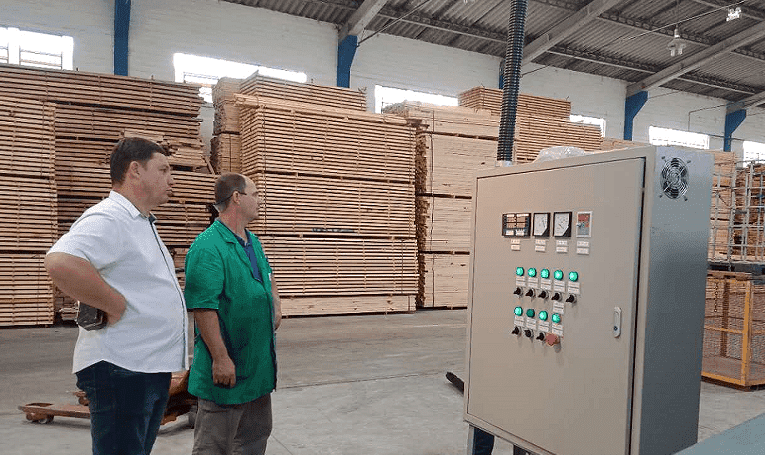
The electronic control system also needs maintenance: regularly check whether the line terminals are high-temperature aging or loose, and whether the cooling fan of the control cabinet is normal to avoid aging short circuits. Desiccant can be placed in the electrical control cabinet in humid areas.
6. Establish equipment ledger and standardize personnel management
It is recommended to establish an operation and maintenance account for each dryer to record the start-up time, heating fuel type, fault records, maintenance time, and parts replacement records. Through records, you can find the pattern of equipment failure and arrange preventive maintenance in advance instead of waiting for it to break down before repairing it.
Operation and maintenance personnel need to be familiar with the equipment parameters and understand the drying processes corresponding to different wood species (eucalyptus, rubber wood, birch, technical veneer, etc.), and avoid arbitrary changes in temperature and wind speed parameters based on experience. New employees should be well trained before taking up their posts to avoid irreversible equipment damage caused by misoperation.
The service life of a veneer dryer is not simply determined by the material of the equipment itself, but depends more on daily management. Stable and reasonable operation, regular dust removal, regular lubrication inspections, and timely handling of minor hidden dangers. After the entire maintenance process is implemented, the equipment will not only have a longer service life, but also have stable drying quality and controllable energy consumption. It can also help the processing plant avoid sudden shutdown losses and maximize the value of the equipment.