Español
 Русский
 Francés
 Português
 ภาษาไทย
 Indonesia
 Việt
 العربية
 Melayu



Key Considerations In Oak Veneer Production
Key Considerations In Oak Veneer Production
Oak is a popular hardwood used for high-end finishes, furniture, flooring, and the face veneers of plywood. Both red and white oak are prized for their unique grain patterns and premium texture; however, due to their high density, prominent wood rays, and tannin content, they are notoriously difficult to process. Compared to species like eucalyptus, poplar, or rubberwood, oak veneers are more prone to defects such as blue stain, splitting along the wood rays, warping, color variation, "pinholes" (voids), and surface fuzzing. Consistently producing high-quality oak veneer requires meticulous, end-to-end process control—from log selection and steaming/softening to peeling/slicing, drying, grading, and storage.
I. Log Selection And Inbound Control: Mitigating Inherent Defects At The Source
The quality of oak logs directly determines the yield of high-grade veneer; many issues—such as splitting or discoloration that appear later in the process—actually originate at the log stage.
It is essential to distinguish between red oak and white oak, as their structural properties differ significantly. White oak vessels contain tyloses, which provide a tight seal and resist rapid water absorption. In contrast, red oak has open vessels that allow for quick moisture penetration; its higher tannin content makes it much more susceptible to oxidation and blue stain. Consequently, these two types must be processed separately—never on the same production line.
When selecting logs, prioritize those that are straight and contain a high proportion of mature heartwood. Avoid juvenile wood, partially decayed timber, logs with ring shakes, insect holes, or reaction wood (stress wood). Juvenile wood exhibits inconsistent shrinkage, which often leads to severe warping or "wavy" defects during drying. Logs with ring shakes are particularly problematic: during peeling, these cracks tend to propagate along the wood rays, resulting in a high rejection rate for the entire roll of veneer.
Once logs arrive at the facility, proper protection is critical. They should be shielded from direct sunlight and rain, and the ends should be waxed promptly to prevent rapid moisture loss, which can cause end-splitting. Oak logs should not be stored for extended periods; the storage duration for green (wet) logs must be strictly limited. During seasons characterized by high heat and humidity, ensure adequate ventilation within the log stacks to prevent internal mold growth and premature blue staining. Upon arrival at the facility, logs must be sorted and stacked according to their origin, grade, and age (fresh vs. seasoned). Mixing fresh and seasoned logs during the steaming or rotary-cutting processes leads to uneven softening, resulting in inconsistent veneer thickness and significant color variation.
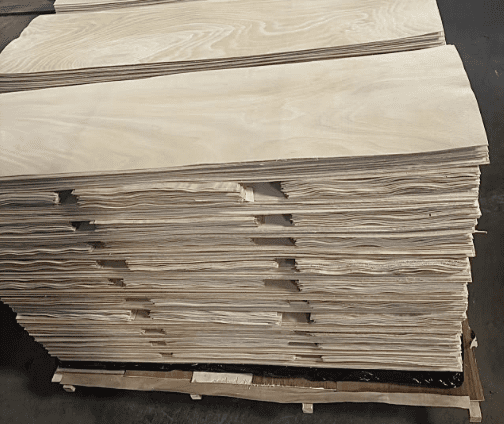
II. Steaming (Softening) Process: A Common Pitfall For Oak Veneer
Oak is characterized by high hardness and coarse wood rays. If the softening process is insufficient, the wood will develop fuzz, burrs, knife marks, and fractures along the wood rays during rotary cutting. Conversely, if the wood is over-softened, excessive tannins are released, causing the veneer surface to darken or become blotchy, leading to severe color inconsistency.
Steaming temperatures and durations must be adjusted based on log diameter, the ratio of heartwood to sapwood, and the season; parameters used for softwood species should not be applied to oak. Red oak, which contains more reactive tannins, requires lower steaming temperatures—ideally using a gradual, low-temperature heating approach—to prevent rapid oxidation and discoloration. For white oak, the steaming duration can be extended to ensure uniform softening throughout the log.
Attention must be paid to water quality and metal contamination in the steaming vats. Oak tannins react rapidly with iron ions to form blue-black stains—a phenomenon commonly referred to in the industry as "blue stain." Steaming vats, transport racks, and clamps should be free of exposed iron. Furthermore, the water in the vats should be changed regularly to keep iron ion concentrations under control—a critical detail often overlooked by many factories.
Once steaming is complete, the logs should undergo a "tempering" (equilibration) phase at a constant temperature. This allows the internal and external temperature and moisture content of the logs to stabilize before they are moved to the rotary-cutting machine. If the logs are not uniformly softened, the resulting veneer will exhibit significant thickness fluctuations, both across the sheet and locally. This leads to uneven stress during subsequent drying, which drastically increases the risk of cracking.
III. Rotary Cutting / Slicing: Controlling Thickness, Ray-Related Cracking, And Surface Quality
Oak veneers are produced either via rotary cutting (typically for plywood face veneers) or slicing (for high-end decorative wood veneers). While each method has specific requirements regarding cutting tools, rotational speeds, and pressure bar settings, they share a common, core challenge: the wood rays are highly susceptible to cracking. Cutting tools must be kept sharp; a dull edge can cause surface fuzzing and fiber tearing, leading to a blurred grain appearance after subsequent sanding. The gap and pressure of the pressure bar must be calibrated to the density of the oak: insufficient pressure results in loose or buckled veneer, while excessive pressure causes the wood rays to crack, resulting in a dense network of fine, ray-related fissures.
Thickness precision is of paramount importance. Oak veneer tends to be thin, so thickness tolerances must be strictly controlled. Significant variations in thickness lead to uneven moisture evaporation during drying—thinner areas dry faster than thicker ones—which creates internal stress and subsequently causes warping or cracking. The rotary-cutting speed should not be too high; because oak fibers are highly resilient, high-speed cutting often produces chatter marks or wavy patterns.
Wet veneer coming off the rotary-cutting line must be transported promptly; it should not be left stacked for long periods in a humid, sweltering workshop. When exposed to air, red oak can develop localized oxidative discoloration within just a few hours. Whenever possible, wet veneer should be moved directly into the dryer to minimize waiting time. Furthermore, ensure proper stacking by separating veneers based on grade and face quality to avoid the complications of mixed batches during later sorting.
IV. Drying Process: The Core Of Oak Veneer Quality Control
Oak is a refractory (hard-to-dry) hardwood. The primary rule—and the key distinction from drying species like eucalyptus or poplar—is that high-temperature, rapid drying is strictly prohibited. Moisture migration is slow in the wood ray regions; if the surface loses moisture too quickly and hardens, internal moisture becomes trapped. This easily leads to ray-related cracking, honeycomb checking, surface checking, warping, and cupping.
A "slow drying at low temperatures" approach with staged temperature control is preferred. Whether using a roller dryer or a platen (press-type) dryer, the equipment should be divided into distinct temperature and humidity zones: the infeed section should be kept at a lower temperature for gradual preheating, allowing the veneer to warm uniformly and release free water; the middle section should see a moderate increase in temperature; and the outfeed section should involve cooling and humidity adjustment (conditioning) to balance the moisture content and minimize the gradient between the interior and exterior of the veneer. The target moisture content must align with the intended downstream application. For plywood face veneers, it is generally controlled between 8% and 10%. For wood veneers used in decorative paneling or flooring, the moisture content should be fine-tuned based on the equilibrium moisture content (EMC) of the region where the product will be used—slightly higher for humid southern regions and lower for arid northern regions. Uneven moisture content is a primary cause of cracking during subsequent use.
Drying equipment must ensure uniform airflow distribution and stable air volume, avoiding areas with excessive airflow or "dead zones" (stagnant air). If airflow velocity is inconsistent across the drying line, veneers within the same stack may end up dry on one side and damp on the other, leading to widespread issues such as color variation and warping. Dried veneers should not be packed immediately; instead, they must be placed in a climate-controlled conditioning chamber (with constant temperature and humidity) to "rest" and re-equilibrate. This process allows drying-induced stresses to dissipate and moisture content to become uniform. Many factories skip this conditioning step, resulting in consistently high rework rates for finished products.
Furthermore, excessively high drying temperatures can cause the color of oak to darken—red oak may take on a reddish or murky tone, while white oak may turn yellow—stripping away the fresh, natural appearance of the grain. Since high-end orders demand strict color consistency, it is essential to establish standardized drying curves and retain samples from each batch for comparison.
V. Sorting, Repairing, And Surface Protection: Eliminating Latent Defects
Defects in oak veneers are often well-hidden; many fine cracks are nearly invisible when the veneer is damp but become apparent only after the moisture is removed during drying. Consequently, the sorting process should involve two rounds of inspection: an initial check of the damp veneer and a follow-up inspection after the drying and conditioning phase.
Key areas for inspection include ray-related cracks, end cracks, insect holes, knots, blue stain, knife marks, thickness variations, "pinholes" (perforations), and surface fuzzing. Fine cracks along the wood rays are the most common latent defects in oak veneers; it is crucial to distinguish between repairable fine cracks and deep, penetrating fissures—the latter should not be used for high-end orders.
When selecting repair adhesives or patches, one must also consider the risk of tannin-induced discoloration. It is vital to choose adhesives that do not react with the tannins in the oak, as such reactions can cause the repaired areas to turn black over time. During the sorting process, veneers are categorized and packed based on grain pattern (straight grain, cathedral grain, or figured grain), color, and grade. Efforts are made to ensure color consistency within each batch to meet the specific pattern-matching requirements of furniture and decorative surface manufacturers.
VI. Storage, Packaging, And Protection Against Moisture And Oxidation
Once dried and moisture-stabilized, oak veneers become highly sensitive to environmental humidity. Warehouse temperature and humidity must be kept stable to prevent issues caused by significant diurnal temperature fluctuations or dampness during the rainy season. In high-humidity environments, red oak veneers are prone to re-oxidation, leading to "blue stain" (discoloration); conversely, if the environment is too dry, the moisture content of the veneers may drop further, resulting in secondary shrinkage and cracking.
Packaging must be sealed and protective; veneers should be wrapped in moisture-proof film, stacked on raised platforms to avoid ground-level dampness, and kept away from walls. Different batches or veneers with varying moisture content levels should not be stored together, as this can lead to moisture transfer between them. Precautions against rain must be taken during dispatch and loading. For long-distance ocean shipments, special attention should be paid to condensation within shipping containers; enhanced moisture-proof packaging is essential to prevent widespread discoloration or mold growth upon arrival.
VII. Bonding And Downstream Compatibility (Key Considerations For Plywood Manufacturers)
When using oak as a face veneer, one must account for the internal stress of the wood; hot-pressing parameters used for softer wood species cannot simply be applied to oak. Due to its high rigidity and significant shrinkage rate, oak veneer is susceptible to surface cracking, glue penetration (bleed-through), or whitening of the panel surface if the temperature rises too rapidly or if the applied pressure is inappropriate.
Furthermore, the tannins present in oak can interfere with the curing process of certain adhesives. It is crucial to conduct small-scale pilot tests when selecting adhesives to avoid delamination or surface contamination.
The primary challenges in oak veneer production essentially boil down to balancing two factors: the oxidation/discoloration caused by tannins and the drying-induced stress characteristic of hardwoods. The entire production process—from the steaming and softening of logs and precision-controlled rotary cutting to multi-stage low-temperature drying, moisture stabilization, and protective storage—is an interconnected system. Simplifying or accelerating any single step can lead to widespread defects, including cracking along the wood rays, blue stain, color inconsistency, and warping. Consistent process parameters, stable equipment performance, controlled ambient temperature and humidity, and rigorous grading protocols—these are the essentials for the reliable production of oak veneers with uniform color, minimal cracking, and precise dimensions, meeting the demands of the high-end furniture, wood paneling, and multi-layer plywood markets.