Español
 Русский
 Francés
 Português
 ภาษาไทย
 Indonesia
 Việt
 العربية
 Melayu



Precautions For Operating A Veneer Dryer
Precautions For Operating A Veneer Dryer
The veneer dryer is a core piece of equipment in a plywood production line, directly determining the quality of the dried veneer, the yield, and overall production efficiency. Different types of veneer—such as eucalyptus, rubberwood, birch, or reconstituted wood veneer—have specific requirements regarding drying temperature, air velocity, and target moisture content. Standardized operation and diligent daily management not only help prevent issues like veneer cracking, curling, uneven moisture distribution, or spoilage due to mold, but also ensure stable equipment performance and mitigate safety risks such as dust fires, burns, or mechanical jams. The following guidelines outline key operational points across six areas: pre-start preparation, feeding and process control, routine inspection, shutdown procedures, daily maintenance, and emergency response.
I. Pre-Start Inspection and Preparation
Operators must undergo specialized training and be thoroughly familiar with the equipment’s structure, temperature control systems, conveying systems, combustion units, and dust collection systems; unauthorized or untrained personnel are strictly prohibited from operating the equipment independently. Before startup, clear any accumulated wood chips, sawdust, or resin deposits from the drying channels, conveyor rollers, mesh belts, and air ducts. This prevents dust buildup from impairing heat exchange efficiency and eliminates the risk of spontaneous combustion.
Carefully inspect electrical wiring, sensors, moisture-detection probes, fans, drive chains, and alignment/tracking mechanisms to ensure they are in good working order. Check seals for damage or air leaks, and inspect the water-film dust collection system and waste-heat recovery piping for any leaks. Verify that emergency stop buttons, alarm systems, and fire-suppression equipment are present and fully functional.
Based on the specific wood species, thickness, and initial moisture content of the veneer to be processed, retrieve the appropriate drying parameters; never apply settings arbitrarily. Additionally, inspect the veneer before it enters the dryer, removing any pieces containing soil, large chunks of bark, or metallic debris to prevent hard objects from scratching the rollers or causing the conveyor line to jam.
II. Loading Procedures and Process Parameter Control
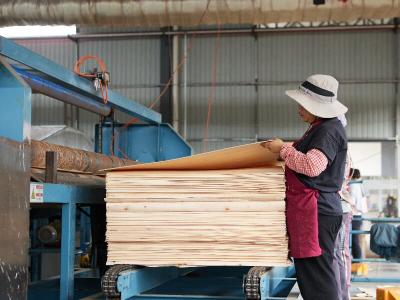
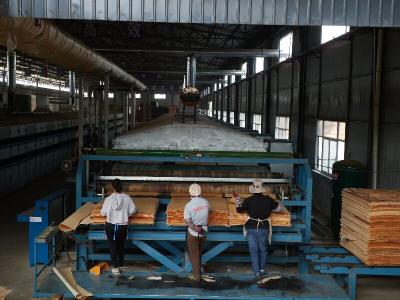
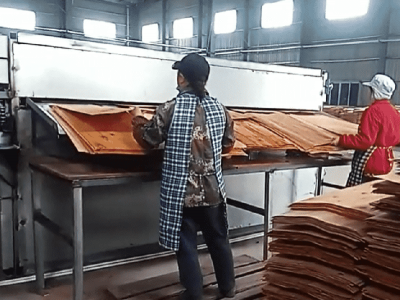
Veneers must be loaded neatly and spaced evenly, without overlapping or clumping. Adequate channels for hot air must be maintained between the veneers to ensure uniform airflow penetration, preventing localized damp spots or excessive moisture disparities. Overloading the equipment or operating beyond its rated capacity can lead to uneven drying, veneer misalignment, or jamming; it also increases the mechanical load, thereby shortening the equipment's service life.
Adhering to a "low-temperature, slow-drying" approach is key to minimizing veneer cracking and warping. Parameters should be tailored to specific wood species: for thin veneers or birch (which is prone to cracking), temperatures should be kept moderate. For thicker veneers or eucalyptus with high moisture content, the drying time should be extended, and the temperature increased gradually—rapid, high-temperature drying is strictly prohibited.
During production, utilize in-line moisture detection systems for continuous monitoring, supplemented by periodic manual spot-checks at the discharge end. Adjust hot-air temperature, conveyor speed, and exhaust airflow dynamically based on the final moisture content of the product. Insufficient moisture exhaust can lead to re-dampening and mold growth, while excessive exhaust can cause the veneer surface to "crust over" too quickly, trapping internal moisture and leading to internal cracking.
For units equipped with biomass burners, ensure stable heat source control to maintain a consistent hot-air temperature, avoiding significant fluctuations. If the system includes a waste-heat recovery unit, manage the residual heat effectively to balance energy efficiency with drying stability.
III. Operational Inspection Protocols
Personnel must remain at their assigned stations while the equipment is running, continuously monitoring its status. Pay close attention to the stability of the conveyor system, checking for veneer misalignment, jamming, or wrinkling. Monitor the sound of the fans, bearing temperatures, and the stability of readings on temperature control instruments; address any alarms or irregularities immediately.
It is strictly forbidden to reach toward rollers, chains, or drive components while the equipment is in operation. Before clearing debris or resolving a jam, the operator must press the emergency stop button, disconnect the main power supply, and display a warning tag. Ensure the equipment has come to a complete, stationary stop before performing any maintenance to prevent mechanical injury. Ensure the workshop remains well-ventilated and the dust removal system is kept running at all times to promptly exhaust moisture vapor and wood dust generated during the drying process. Regularly inspect air ducts and filter screens for blockages; obstructions can impair hot air circulation, increase energy consumption, and compromise drying efficiency.
Additionally, keep the area surrounding the equipment free of flammable materials. Do not stack veneers or wood shavings near the main unit or hot-air ducts, as this poses a fire risk due to high temperatures.
IV. Shutdown Procedures
For a standard shutdown, first stop the feeding process and allow all remaining veneers in the drying chamber to be discharged. Next, shut down the heating and combustion systems in sequence. Once the temperatures in the air ducts and furnace have sufficiently decreased, turn off the fans and the conveyor system. Do not simply cut off the main power supply to shut down the machine.
In the event of an unexpected power outage, immediately close the heating and fuel supply valves to prevent the equipment from restarting automatically when power is restored. When power returns, do not restart the machine immediately; first, inspect all components to ensure there are no jams or other irregularities before resuming production.
At the end of each daily production shift, wait for the equipment temperature to drop to a safe level before performing any cleaning. Never attempt to blow away dust while the equipment is still hot, as wood shavings could ignite upon contact with residual heat.
V. Regular Maintenance to Extend Equipment Lifespan
Routine maintenance is the foundation of stable production. Clean wood shavings and dust from conveyor rollers, mesh belts, air ducts, and the furnace interior daily. Check chain tension and sensor calibration weekly. Apply high-temperature-resistant lubricant to fan bearings at scheduled intervals to prevent overheating, damage, unusual noises, or operational failures.
Periodically inspect insulation layers and seals; damaged insulation leads to heat loss and increased energy consumption. Regularly drain and clean the water-film dust removal system to ensure compliance with environmental regulations and prevent exhaust emissions from exceeding permitted limits.
If the equipment is to be left idle for an extended period, thoroughly remove all residual wood shavings, take measures to prevent moisture and rust, disconnect the main power supply, and cover the unit with a dust-proof cover. Before putting the equipment back into service, conduct a comprehensive inspection and a no-load test run to ensure everything is in proper working order before resuming production.
VI. Common Faults and Emergency Response
If large-scale cracking or curling of veneers occurs during production, it is usually due to excessively high temperatures, a heating rate that is too rapid, or improper moisture exhaust. In such cases, immediately lower the temperature, reduce the conveyor speed, and adjust the moisture exhaust valves.
If there are significant fluctuations in the moisture content of the output, first check whether the moisture probes are obstructed by wood chips or if the sensors have become inaccurate. Next, verify that the veneers are fed in with a uniform thickness and are not stacked in a way that blocks the flow of hot air.
In the event of a jam or blockage, perform an emergency stop and cut off the power immediately. Follow "lockout/tagout" (LOTO) procedures before attempting to clear the obstruction; never attempt to force the equipment open or pry it loose.
If smoke or fire is detected, immediately stop the machine, halt the feed, and cut off the heat source. Use the provided firefighting equipment to address the situation and simultaneously evacuate all personnel.
The key to operating a veneer dryer lies in maintaining stable temperature and humidity, ensuring uniform feeding without overloading, conducting thorough inspections to identify potential hazards, and performing regular maintenance to minimize malfunctions. Many instances of veneer spoilage and equipment failure stem from careless operation, arbitrary adjustment of parameters, or a failure to clear accumulated dust. By fully understanding the drying characteristics of different wood species and strictly adhering to operational protocols, operators can ensure consistent veneer quality, improve yield, reduce production costs, and uphold safety standards—ultimately keeping the drying production line running efficiently and reliably.