Español
 Русский
 Francés
 Português
 ภาษาไทย
 Indonesia
 Việt
 العربية
 Melayu


Turning Waste Into Treasure: Diverse Pathways For Repurposing Wood Residue From Veneer Peeling
Turning Waste Into Treasure: Diverse Pathways For Repurposing Wood Residue From Veneer Peeling
In plywood and veneer production facilities, the process of rotary-peeling logs to produce standard veneers inevitably leaves behind cylindrical wood cores, veneer scraps, offcuts, and bark fragments. In the past, many manufacturers would dispose of these materials at a nominal price or simply burn them—practices that not only wasted timber resources but also created environmental burdens. Today, as the wood industry supply chain expands and resource-recovery technologies mature, a comprehensive utilization strategy for peeling residues has emerged. This ranges from high-value deep processing and the production of auxiliary panel components to biomass energy and agricultural substrates. This approach ensures that every part of a log is fully utilized, simultaneously reducing costs, increasing efficiency, and fostering greener production.
Wood residues from the peeling process generally fall into two categories: intact wood cores (spindles)—the cylindrical centers remaining after the peeling process—and fragmented waste, such as veneer scraps, offcuts, bark, and wood chips. Given their differences in material quality and physical form, each category is directed toward specific, tailored applications.
For wood cores that remain in good condition—free from cracks or decay—the most profitable approach is secondary peeling. After conventional spindle-based rotary peeling, the remaining cores typically have a diameter of 8–14 centimeters. By using spindleless peeling equipment, these cores can be processed further to yield thin veneers, which are then fed back into the plywood production line, effectively increasing the total veneer yield from each log. Only those cores with significant defects—rendering them unsuitable for further peeling—are diverted into other deep-processing channels.
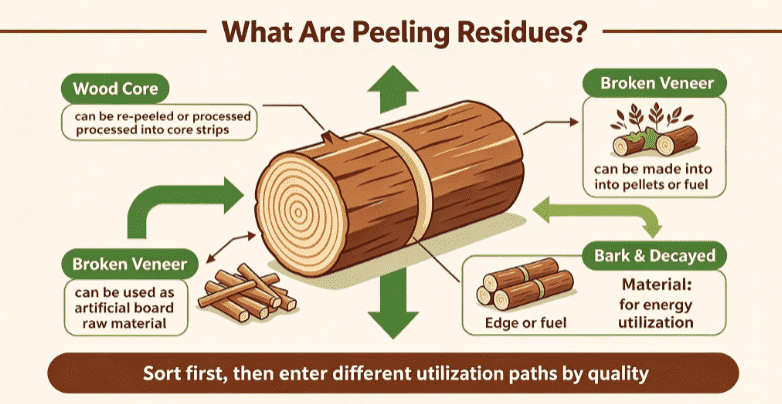
The primary applications for deep-processing these wood cores include the production of core strips for blockboard, glued-laminated timber (glulam), and core materials for doors. Logs can be sawn into square-edged timber, cut to size, and cleared of defects to produce uniform wooden strips. These are then joined to form the core of blockboard—a material widely used in furniture manufacturing and for door panels. Alternatively, these strips can be finger-jointed to create laminated timber cores, which serve as the base material for door and window frames, bed frames, and cabinetry; eucalyptus and poplar are well-established, commonly used species for such cores. Some enterprises further process these wooden cores into honeycomb-structured materials, which, once assembled, can replace large-diameter logs in the production of lightweight structural components for packaging or as a substrate for decorative panels—significantly reducing the procurement costs of large-dimension timber. Lower-grade wooden cores can also be cut into shorter lengths to serve as pallet blocks, garden fencing stakes, or simple structural supports—products that are easy to manufacture and offer a quick turnover, catering to the packaging and landscaping sectors.
Veneer scraps and offcuts represent the largest volume of by-products from the rotary-cutting process, and wood-based panel production lines provide a reliable outlet for them. Clean, adhesive-free scraps are chipped, pulverized, and screened before being fed into particleboard or fiberboard production lines—serving as fine surface particles or coarse core chips, respectively. Suitable short veneer pieces can also be used directly as filler for the core layers of plywood, thereby reducing the consumption of fresh veneer. This model is particularly well-suited for industrial clusters, where veneer mills can partner with nearby particleboard plants; this allows waste to be monetized without leaving the industrial park, keeping logistics costs to a minimum.
Beyond panel production, residual wood also serves as an excellent feedstock for biomass energy. Bark, sawdust, offcuts containing adhesive, and decayed wood cores—unsuitable for panel manufacturing—can be pulverized into biomass pellets. These are then used on-site to fuel biomass burners and boilers, providing heat for veneer dryers and hot presses, which directly lowers coal procurement costs. Any surplus pellets can be sold externally. This internal circular system—converting waste into thermal energy for production—has become a standard practice in the vast majority of veneer and plywood factories.
In recent years, the repurposing of these materials for agricultural applications has also become increasingly common. Wood chips and wood shavings that have undergone harmless treatment can serve as a substrate for cultivating edible fungi, such as *Stropharia rugosoannulata* (garden giant mushroom) or shiitake mushrooms. Once decomposed, these materials can also be repurposed as landscape mulch or as a raw material for organic fertilizer to improve soil quality. This creates an ecological cycle—"tree cultivation → rotary cutting → mushroom cultivation using wood waste → returning mushroom residue to the land"—offering a viable diversification strategy for processing plants located near agricultural or forested areas.
Naturally, to effectively repurpose wood residues, it is essential to implement rigorous pre-sorting and classification; otherwise, mixing different types of raw materials will diminish their overall value. On the production floor, materials should be rapidly sorted by quality: intact log cores should be set aside for secondary rotary cutting or the production of core strips; clean, glue-free veneer scraps can be directed toward the manufacture of wood-based panels; and bark, decayed wood, or glue-contaminated waste should be collected separately for energy recovery. Furthermore, it is important to manage dust and metal contamination, ensure proper storage to prevent mold, and promptly dry log cores to avoid cracking or fungal growth, which could compromise their value for subsequent processing.
Given long-term industry trends—characterized by tightening timber resources and rising procurement costs for raw logs—maximizing the value of wood residues from the rotary-cutting process is no longer merely an optional "value-add." It has become a prerequisite for veneer manufacturers to enhance their overall competitiveness. By strategically integrating pathways such as secondary rotary cutting, core-strip production, the manufacture of wood-based panels, and biomass energy utilization—tailored to a facility’s specific production capacity and local infrastructure—manufacturers can reduce solid waste and meet environmental compliance standards. In doing so, they transform what was once considered "waste" into a reliable source of revenue, paving the way for a green, low-loss, and highly circular model of development in the timber industry.