Español
 Русский
 Francés
 Português
 ภาษาไทย
 Indonesia
 Việt
 العربية
 Melayu



Methods To Prevent Wood Cracking During The Drying Process
Methods To Prevent Wood Cracking During The Drying Process
Wood is a natural biomass material that exhibits significant differences in shrinkage across various directions. During drying, if moisture evaporates from the surface much faster than it can migrate from the interior, a steep moisture content gradient develops. This creates internal stress, leading to surface checks, internal cracks, and end splits. Such defects downgrade the quality of boards and veneers, resulting in substantial losses for manufacturers of plywood, furniture, and wood-based decorative panels. At its core, cracking is caused by a lack of synchronization between internal and external drying rates, combined with uncontrolled stress release. Drawing on practical experience with both continuous and kiln-based drying systems, several reliable methods for preventing cracks are outlined below.
1. Employing Low-Temperature, Slow-Drying Processes With Staged Temperature And Humidity Control
This is the most fundamental and critical approach to preventing cracks—particularly for "hard" hardwoods prone to splitting, such as eucalyptus and rubberwood. It is strictly prohibited to subject wood to high temperatures and strong airflow immediately upon entering the dryer.
In the initial drying phase, a low-temperature, high-humidity preheating stage should be used to soften the wood fibers and open pathways for internal moisture migration. This ensures the wood’s temperature rises uniformly, preventing the surface from losing moisture too rapidly and hardening (case-hardening). As the wood moves into the primary drying stage, the temperature should be increased—and humidity decreased—in controlled, incremental steps. This regulates the rate of moisture evaporation, ensuring that internal moisture can migrate to the surface at a pace that keeps up with evaporation.
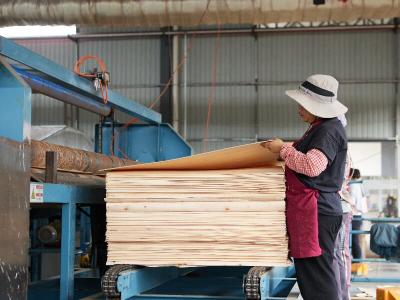
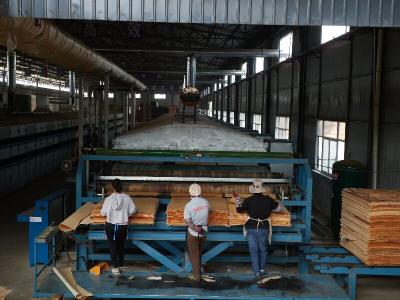
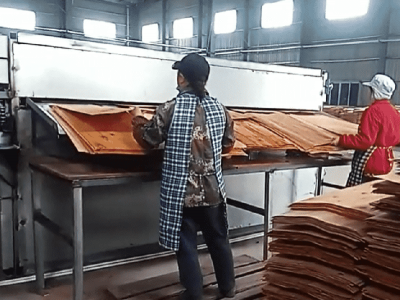
For roller dryers or continuous mesh-belt dryers, the system can be divided into distinct temperature zones: a preheating and humidity-conditioning zone at the start, a steady-rate dehydration zone in the middle, and a final balancing/conditioning zone. For wood with high initial moisture content or greater thickness, the rate of temperature increase must be kept low; the goal should not be rapid drying. As the moisture content approaches the target level, the wood should undergo a balancing (conditioning) phase to minimize moisture variance across the batch, eliminate drying stresses, and prevent secondary cracking after the wood leaves the dryer.
II. Sealing Of End-Grains To Prevent End-Splitting
Moisture moves much faster along the grain of wood than across it; consequently, the ends lose moisture most rapidly, making end-splitting the most common defect.
Before drying, apply paraffin wax or specialized end-sealing coatings to the ends of boards or veneers. This seals the pores, slows down moisture evaporation at the ends, and balances the drying rate between the board surfaces and the ends. During loading, ensure that hot air does not blow directly onto the ends of the wood. When stacking, place the drying stickers (spacers) close to the ends and align them tightly to minimize the surface area exposed to airflow. If minor end-splits are already present, trim off the affected sections before drying to prevent the cracks from extending or widening during the process.
III. Proper Stacking and Arrangement to Ensure Uniform Airflow
Whether in a drying kiln or a continuous veneer dryer, uneven airflow is a major cause of localized cracking.
When stacking lumber for kiln drying, use straight, uniform drying stickers. Align them vertically and space them consistently to ensure clear airflow channels between layers, while avoiding any bending or crushing of the wood. Leave ventilation gaps between stacks to prevent the formation of localized eddies or "dead zones" (stagnant air pockets).
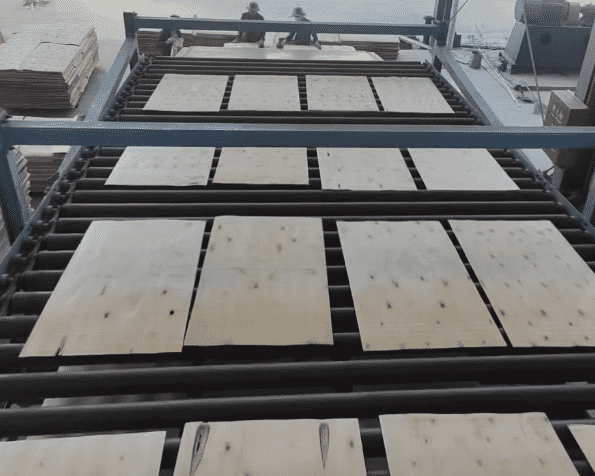
For roller or mesh-belt veneer dryers, ensure that veneers are aligned, non-overlapping, and straight, while maintaining a steady feed rate. Regularly inspect fans and air ducts to correct any airflow imbalances and prevent concentrated, high-velocity air from striking specific areas of the wood. In areas with excessive airflow or high wind speeds, the wood surface may dry too rapidly, leading to surface cracks; conversely, in areas with insufficient ventilation, the wood may remain damp and humid internally, which often results in internal cracking later on. Uniform and stable airflow is essential for ensuring that the entire batch of wood dries at an even rate.
IV. Timely Steaming (Intermediate Humidification) To Relieve Drying Stresses
As the wood reaches critical moisture content thresholds—most notably near the fiber saturation point—internal stresses peak, making the material highly susceptible to surface and internal cracking. At this stage, a steaming conditioning process—also known as intermediate reconditioning—should be performed.
By injecting low-pressure saturated steam, the humidity inside the kiln is briefly increased. This allows the overly dry surface layers of the wood to reabsorb some moisture, restoring elasticity to the fibers, relieving surface tensile stress, and narrowing the moisture content gap between the surface and the core.
For hardwoods, thick stock, and high-risk wood species, it is advisable to include one or two additional intermediate conditioning cycles. Toward the end of the drying process, a final balancing treatment (equalization) should also be carried out. Conditioning is not about re-wetting the wood; rather, it is a method for stress relief. Resuming a steady drying process after this treatment significantly lowers the risk of latent internal cracking—many internal fissures, invisible to the naked eye, can be prevented through a properly executed steaming protocol.
V. Implement Raw Material Grading And Batch Drying Based On Initial Moisture Content And Thickness.
Mixing timber with widely varying moisture levels, thicknesses, or species in the same kiln makes it impossible to establish a uniform drying schedule. Inevitably, some pieces will dry too quickly and crack, while others will remain insufficiently dried.
Before loading, measure the initial moisture content and categorize the timber into groups based on moisture ranges, board thickness, and wood species. Apply a gentle drying schedule for thick boards and high-density hardwoods, while using appropriate continuous drying parameters for thin veneers. If freshly rotary-cut veneers have an extremely high initial moisture content, allow for natural pre-drying—if conditions permit—to bring the moisture down to a manageable range before kiln drying. This reduces the dehydration stress during the drying phase and lowers the likelihood of cracking. Furthermore, discard any material with insect holes, pith, reaction wood (tension/compression wood), or distorted grain; such timber inherently possesses high internal stress and offers very little margin for error during the drying process.
VI. Manage Cooling And Storage Stability After Unloading To Prevent Delayed Cracking.
Often, cracking does not occur inside the kiln, but rather after the timber has been removed. If wood that has been dried at high temperatures is suddenly exposed to a cooler, drier environment, its surface temperature will drop rapidly, and the moisture balance will be disrupted—creating new, damaging stresses. Once timber exits the drying equipment, it should not be immediately stacked in an open area. Instead, it should first be placed in a "cooling-down" room—an environment with stable temperature and humidity—to allow for gradual cooling, moisture content balancing, and the release of internal stresses. Only after this process is complete should the timber be moved to the workshop for further processing or placed into storage. For continuous production lines, an insulated cooling zone can be integrated at the discharge end to minimize the impact of sudden changes in temperature and humidity from the external environment. Once finished boards or veneers are moved into storage, the warehouse must be maintained at a consistent humidity level; avoiding frequent fluctuations between dry and damp conditions is essential to prevent the material from cracking or warping during subsequent use.
Preventing cracks during timber drying is, at its core, a matter of precisely managing moisture content gradients and internal stresses. No single method can resolve all cracking issues; effective production requires a comprehensive approach—combining graded raw material preparation, end-sealing, multi-stage temperature and humidity profiling, uniform airflow, intermediate conditioning, and controlled cooling upon discharge. This should be supplemented by intelligent, real-time online moisture content monitoring, with drying parameters flexibly adjusted according to the specific wood species.
For plywood manufacturers and veneer processing enterprises, the key to reducing costs and increasing efficiency in the drying process lies in prioritizing stable drying quality and minimizing the rate of rejection due to cracking—all while maintaining production capacity.