Español
 Русский
 Francés
 Português
 ภาษาไทย
 Indonesia
 Việt
 العربية
 Melayu

Fuel Selection Analysis For Biomass Burners
Fuel Selection Analysis For Biomass Burners
A key premise: The fuel requirements for veneer dryers (roller dryers, flap/conveyor dryers, or mesh-belt dryers) go beyond mere calorific value. Factors such as moisture content, ash content, slagging/clinkering tendencies, feed consistency, cost, local raw material availability, and the precision of temperature control during the drying process must all be considered. Veneer drying is particularly sensitive to temperature fluctuations, flue gas ash accumulation (which can cause blockages), and the presence of tars that may corrode heat exchange piping—distinguishing it significantly from standard boiler heating applications.
Commonly used fuels include: wood chips (including offcuts, scraps, and rotary-cut wood waste), biomass pellets, wood blocks, bark, wood shavings, sawdust, straw, bamboo chips, and fruit shells.
In the veneer industry, the primary fuels used are **wood chips, wood shavings, sawdust, and biomass pellets**; straw and bark are generally not recommended.
I. Reference Calorific Values (Net Calorific Value/Lower Heating Value—standard for industrial use; unit: kcal/kg)
Note: The calorific value of biomass is heavily influenced by its moisture content. The figures below represent reference values for raw materials dried to specific moisture levels. It is critical to understand that as moisture content increases, the calorific value drops sharply. 1. Pure woody biomass (logs, hardwood): ~4200–4500 kcal/kg (on an oven-dry basis)
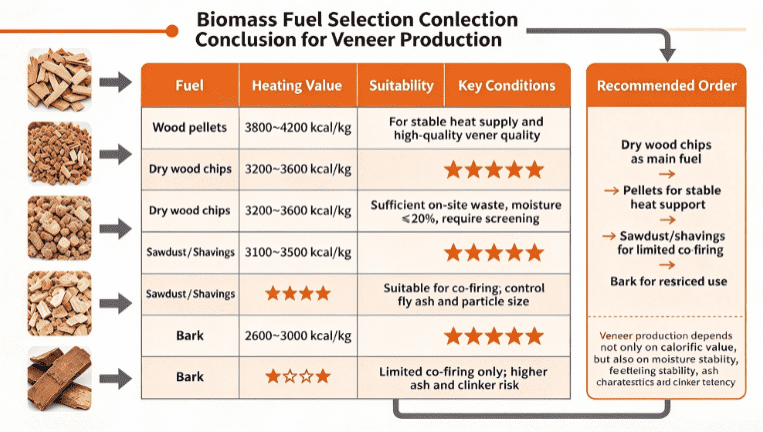
2. Wood chips (clean mixed wood, 15%–20% moisture content): 3200–3600 kcal/kg
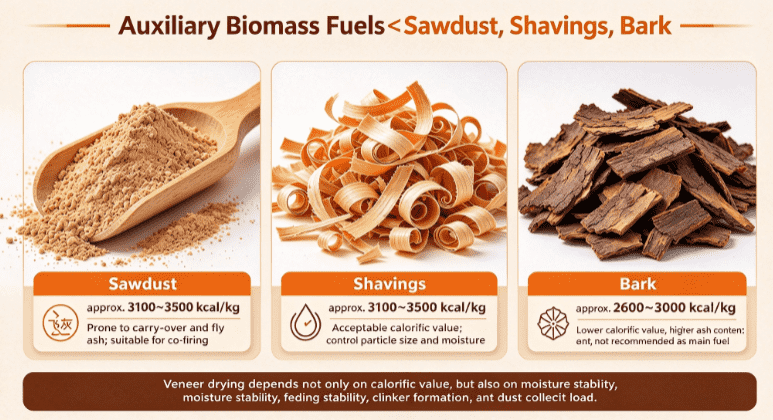
3. Wood shavings and coarse sawdust (clean, 15%–20% moisture content): 3100–3500 kcal/kg
4. Woody biomass pellets (≤8% moisture content): 3800–4200 kcal/kg
5. Tree bark (>20% moisture content): 2600–3000 kcal/kg
6. Straw/stalks (e.g., corn stalks): 2800–3200 kcal/kg; high ash content
7. Wet wood residues from rotary cutting (fresh veneer trimmings/offcuts, 40%–60% moisture content): 1800–2400 kcal/kg
✅ Calorific value ranking (assuming equal cleanliness): Woody pellets > Dry wood chips > Shavings/sawdust > Bark > Wet wood residues > Straw/stalks
Because biomass pellets undergo compression, dewatering, and densification, they have the lowest moisture content and, consequently, the highest calorific value per unit of weight.
⚠️ However, a high calorific value does not necessarily mean a material is ideal for veneer drying. A detailed, multi-dimensional comparison follows.
II. Detailed Comparison: Wood Chips vs. Woody Biomass Pellets (in the context of a veneer production line)
1. Wood chips (generated in-house: rotary-cut offcuts, panel-trimming chips, wood ends)
Advantages
1. Greatest cost advantage: Veneer mills continuously generate wood chips as byproducts from rotary cutting and panel trimming. Much of this material is essentially in-house waste, resulting in extremely low—or even zero—procurement costs. This represents a core competitive advantage for plywood and veneer manufacturers. 2. Low transport and storage costs: No additional deep processing is required; the material can be used directly as collected on-site. For high-output production lines with significant fuel consumption, the cost advantage of wood chips (per ton) becomes even more pronounced.
3. Combustion flue gas characteristics: Clean, mixed-wood chips have a low alkali metal content, making them less prone to severe coking or slagging compared to straw. Furthermore, clean wood chips produce a moderate amount of tar.
Drawbacks (Veneer drying is a critical factor)
1. Moisture fluctuation is the primary challenge: Freshly rotary-cut wood chips often have a moisture content of 40%–60%, which effectively halves their calorific value. If wet chips are fed into the burner, the furnace temperature fails to reach the required level; this leads to slow heating and unstable temperatures in the dryer, resulting in uneven moisture content across the veneer—often causing one side to be dry while the other remains damp, or leading to warping.
2. Difficulties in feeding: Wood chips vary in size; long or thin pieces can easily cause "bridging" or clogging. This places high demands on the burner’s feed auger and the anti-bridging mechanisms within the storage silo. If a basic, low-end burner is used, the fuel supply is prone to interruption, which can cause the flame to extinguish and lead to fluctuations in drying temperatures.
3. Large storage footprint: Due to their low bulk density, wood chips require a significant amount of storage space. They also tend to absorb moisture during rainy weather, becoming wetter the longer they are stored.
4. Ash content: Clean, hardwood chips typically have an ash content of approximately 0.8%–2%, which is manageable. However, if bark or soil is mixed in, the ash content spikes—rapidly clogging water-film dust collectors and heat exchanger pipes, necessitating frequent ash removal.
✅ Suitable Scenarios
- Operations with an in-house rotary-cutting line that consistently generates large quantities of clean wood scraps, paired with a biomass burner system equipped with a high-capacity silo, anti-bridging devices, and a uniform feeding mechanism.
- Large-scale production lines (e.g., double-deck 56-meter dryers or six-layer roller dryers) that require high fuel consumption.
- Facilities equipped with pre-drying silos, allowing wood chips to be air-dried to a moisture content of below 20% before entering the furnace.
- Operations capable of dedicating personnel to screen the material, ensuring the removal of soil, bark, and other impurities.
> Important Note: Burning wet wood chips directly is a major pitfall in veneer drying. Many manufacturers burn their own wet wood waste, which causes the thermal efficiency of the dryer to drop by over 30% and increases the rate of defective veneer.
2. Wood-based Biomass Pellets (Commercial-grade pellets, typically made from mixed wood or eucalyptus)
Advantages
1. Stable calorific value and very low moisture content (≤8%). This ensures consistent heat output and controllable furnace temperatures with **high precision**, making them ideal for the constant-temperature requirements of veneer drying. This results in uniform drying, which reduces warping, cracking, and color variation.
2. Uniform shape and high density ensure excellent flowability. They feed smoothly via screw conveyors with virtually no risk of bridging or clogging, allowing for high levels of automation and minimal supervision during night shifts.
3. Easy to store—whether in bags or sealed silos—without the risk of moisture absorption from rain, ensuring long-term stability in calorific value.
4. Efficient combustion results in minimal fly ash and a low risk of clinker formation, extending the maintenance intervals for heat exchange pipes and dust collection systems.
Disadvantages
1. Higher procurement costs—typically 2–3 times that of wood chips. Since veneer drying is a continuous, high-heat-consumption process, the long-term fuel cost can be a significant burden.
2. Supply chain risks: Pellet market prices are volatile, with potential shortages and price hikes during peak seasons. Long-distance procurement also incurs additional transportation costs.
3. Some low-cost pellets may contain additives like tree bark, straw, or adhesive powder, which can lead to increased ash content and clinker formation; therefore, strict quality control is essential when purchasing pellets.
Ideal Use Cases
- Facilities that lack sufficient in-house wood waste and do not have a reliable supply of wood chips.
- Small to medium-sized drying operations that prioritize ease of use, stability, and low maintenance.
- Production of high-end veneer or engineered wood veneer, where extreme drying consistency is required and temperature fluctuations are unacceptable.
- Operations with high levels of automation, where there is no desire to assign personnel to screen or sun-dry wood chips.
III. Brief Evaluation of Other Fuels (Generally Not Recommended)
1. Sawdust and Wood Shavings: These have a slightly lower calorific value than clean wood chips. Due to their fine particle size, they are easily carried away by airflow, leading to incomplete combustion, high fly-ash content, and potential clogging of heat exchanger tubes. They are suitable for co-firing with wood chips but are not recommended as a primary, standalone fuel.
2. Tree Bark: Characterized by low calorific value, high ash content, and a high concentration of alkali metals, bark is highly prone to slagging (caking) and clogging heat exchangers. It should only be used in small proportions as a supplement, never as a primary fuel.
3. Agricultural Straw/Stalks: These contain extremely high levels of ash, potassium, and sodium, which cause severe melting and slagging—often effectively "welding" burner grates and heat exchange surfaces together. Furthermore, the resulting flue gas is highly corrosive; therefore, such materials are essentially prohibited for use in veneer drying systems.
IV. Selection Recommendations for Veneer Production (Two Options)
Option A: Primary Recommendation — Clean, Dried, and Shredded Wood Chips (The optimal solution for the vast majority of plywood and veneer mills)
Prerequisites:
① Raw material sorting to remove soil and bark; ② Pre-drying in a storage yard to ensure moisture content at the point of combustion is ≤20%; ③ Burner systems equipped with anti-bridging silos and variable-frequency feeding mechanisms tailored for wood chips; ④ Integration of waste-heat recovery/heat exchange systems and water-film dust collectors.
Advantages: Lowest thermal cost; enables the repurposing of in-house waste, yielding the highest overall economic benefit.
Risk Mitigation: Strict control of moisture content; direct combustion of high-moisture, "fresh" wood waste is strictly prohibited.
Option B: Biomass Pellets (Suitable for high-end veneer production or facilities with insufficient in-house waste)
Advantages: Stable combustion, precise temperature control, and low maintenance requirements; results in superior veneer drying quality.
Disadvantages: Higher fuel costs; best suited for production lines with high-value-added products and lower output volumes.
Hybrid Approach (Commonly used in many factories): Wood chips as the primary fuel, supplemented with a small proportion of biomass pellets.
When wood chip moisture is too high or the calorific value is insufficient, adding 10%–20% pellets helps stabilize the furnace temperature, balancing cost-efficiency with drying stability, production output, and veneer quality. V. Supplementary Recommendations (for use with Shine Machinery biomass burners)
Veneer drying relies on indirect heat (the burner generates high-temperature flue gas, which passes through a heat exchanger to heat the drying air; the flue gas does not come into direct contact with the veneer). This process is highly sensitive to combustion stability and the presence of products of incomplete combustion:
1. For wood chip-fired systems: The burner should feature a grate design suitable for large-sized fuel particles, along with a secondary air supply system to minimize incomplete combustion and tar formation.
2. For pellet-fired systems: A combination of suspension and grate combustion is sufficient, and the fuel feeding system can be relatively simple.
3. Regardless of the fuel type, impurities (such as dirt and sand) are the primary cause of dust-related issues and wear on the heat exchanger; therefore, pre-screening the fuel is essential.
4. Cost estimation guideline: When comparing fuels based on equivalent effective heat output, if the unit price of pellets exceeds that of dry wood chips by more than 2.2 times, the pellets become significantly less economical than dry wood chips.