Español
 Русский
 Francés
 Português
 ภาษาไทย
 Indonesia
 Việt
 العربية
 Melayu



How To Increase Drying Speed In Veneer Dryers
How To Increase Drying Speed In Veneer Dryers
In plywood production, veneer drying is a critical process that constrains the capacity of the entire production line. Slow drying speeds not only cause bottlenecks—leading to material backups at the rotary-peeling stage and congestion along the production line—but also increase energy consumption per unit of veneer. However, simply increasing the speed can easily result in issues such as warping, cracking, uneven moisture distribution (where the surface is dry but the interior remains damp), and compromised bonding quality. To safely and consistently increase drying speed, one cannot rely solely on blindly raising temperatures or accelerating the veneer feed rate. Instead, a systematic approach is required—encompassing raw material pre-treatment, optimization of hot-air systems, zoned drying processes, improved equipment sealing and insulation, intelligent monitoring and control, and diligent daily maintenance—to strike the right balance between drying efficiency and the quality of the finished veneer.
At its core, veneer drying involves two processes: the migration of moisture from the interior of the veneer to its surface, and the removal of surface moisture by a flow of hot air. The bottleneck in drying speed is often not a lack of heat, but rather the formation of a saturated, humid air boundary layer on the veneer surface, which hinders continuous evaporation. Alternatively, the rate of internal moisture diffusion may fail to keep pace with the rate of surface evaporation, leading to stress-related defects—specifically, a "dry-outside, wet-inside" condition. Any strategy to increase drying speed must focus on overcoming these bottlenecks while aligning with the natural kinetics of moisture migration.
I. Prioritize Upstream Sorting And Pre-drying To Reduce The Load At The Source
Many manufacturers overlook the infeed stage, allowing veneers with varying moisture content, thicknesses, and wood species to be dried together. In such cases, the dryer must be set according to the requirements of the most difficult-to-dry material, which significantly drags down the overall processing speed.
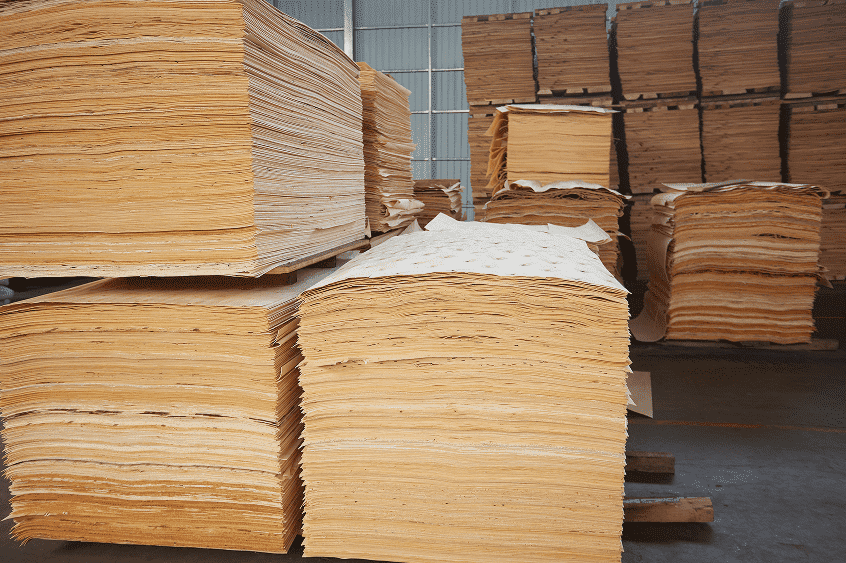
Veneers should be sorted after rotary peeling based on their initial moisture content, thickness, and wood species, and then fed into the dryer in uniform batches. Veneers with high moisture content should be grouped separately; they should not be processed alongside thin, low-moisture veneers. Where conditions permit, incorporate a natural pre-drying phase or a simple pre-drying zone. This allows the veneer to shed some of its "free water" before entering the main dryer, thereby reducing the moisture load. This not only shortens the required drying time within the main unit but also mitigates the risk of cracking caused by rapid, aggressive evaporation during the initial stages. Additionally, minimize the stacking of rotary-cut veneers and prevent localized water accumulation to avoid abnormal spikes in moisture content. When feeding veneers into the dryer, ensure they are aligned correctly—minimizing overlaps or edges resting on top of one another—so that every sheet is fully exposed to the hot air, thereby preventing the occurrence of "trapped moisture" (damp spots).
II. Optimizing The Hot Air System: Coordinated Control Of Temperature, Air Velocity, And Zonal Humidity
The temperature, air velocity, and relative humidity of the hot air medium are the three core parameters that determine the drying rate. These must be adjusted in coordination with one another; simply raising the temperature in isolation should be avoided.
1. Implement Zonal, Multi-Stage Drying Instead of Constant-Temperature Drying
For roller-type or mesh-belt veneer dryers, it is recommended to divide the process into distinct zones: a preheating/evaporation zone, a constant-rate drying zone, a falling-rate drying zone, and a moisture-conditioning/equilibration zone. The initial stage, characterized by high temperature and high humidity, facilitates the rapid evaporation of "free water" from the veneers. The middle stage utilizes increased airflow to quickly carry away water vapor. The final stage involves lowering the temperature and adjusting humidity to allow internal moisture to migrate to the surface, preventing "case hardening"—a phenomenon where the surface dries and hardens prematurely, sealing off the pores. A "one-size-fits-all" constant-temperature approach either forces a slower production speed or results in a high volume of defective, rejected veneers.
2. Appropriately Increase Jet Air Velocity to Disrupt the Humid Air Boundary Layer
Increasing the velocity of the air jets directed at the veneer surface is often more effective for accelerating the drying process than merely raising the temperature. High-speed airflow strikes the veneer surface directly, dispersing the saturated water vapor film and maintaining a high evaporative pressure differential. However, higher velocity is not always better; excessive speed can lead to a sharp spike in fan energy consumption, as well as the displacement or misalignment of thinner veneers. The optimal air velocity should be determined based on the thickness of the veneers. Furthermore, regularly inspect the air nozzles and clear away any wood dust blockages to ensure uniform airflow across the entire width of the dryer, preventing uneven drying—where edges remain too damp while the center becomes overly dry.
3. Control Relative Humidity Within the Drying Chamber to Sustain the Evaporative Driving Force
At any given temperature, a lower relative humidity within the drying chamber results in a greater evaporative pressure differential, which in turn accelerates the drying process. It is essential to properly regulate the exhaust airflow to ensure that high-humidity exhaust gas is removed in a timely manner. Simultaneously, implement heat recovery—do not simply vent all the hot air. If moisture removal is insufficient, humidity will accumulate within the drying chamber; even at high temperatures, the drying process will stall.
III. Upgrading Heat Sources, Insulation, And Sealing To Minimize Unnecessary Heat Loss
Heat loss is an often-overlooked reason why many older dryers suffer from slow drying rates and limited production capacity.
First, inspect the insulation layer of the dryer. Replace any aged or damaged insulation panels, and ensure that all seams, access doors, and loading/unloading openings are properly sealed with gaskets to prevent heat loss or the ingress of cold air. Cold air infiltration can cause localized drops in temperature, creating "dead zones" where drying is ineffective. Improving the sealing of a unit often leads to a significant increase in production capacity, even when operating under the same parameters.
Second, optimize the heat supply. Systems such as biomass burners, heat recovery units, or the cascaded utilization of waste heat from kilns can provide a stable, consistent heat source, preventing temperature fluctuations. When the heat source is unstable, operators are often forced to adopt a conservative approach, slowing down the feed rate to avoid issues. Where feasible, production lines can be retrofitted with heat exchange systems that use exhaust heat to preheat incoming fresh air, thereby improving thermal efficiency and increasing drying capacity without requiring additional fuel.
IV. Aligning Conveying Speed With Equipment Structure For Stable, Continuous Material Flow
The conveying speed of the dryer must be coordinated with the drying zones, veneer thickness, and moisture content. For thicker veneers or high-density wood species (such as certain hardwoods), moisture diffusion is slower, meaning the conveyor speed cannot be increased indiscriminately. Conversely, for thinner veneers—such as those made from eucalyptus or rubberwood—the speed can be increased, provided it remains within safe operational parameters.
In multi-layer roller dryers, it is crucial to ensure that the rollers on each level are synchronized and exert uniform pressure to prevent the veneer from slipping, drifting, or piling up. Automated, negative-pressure loading systems and mechanisms that ensure flat feeding help prevent the veneer from wrinkling or overlapping, ensuring that each sheet lies flat and is exposed to heat evenly. In many cases, attempts to increase production speed fail not because of a lack of heat, but because of unstable material flow—frequent jamming or overlapping of veneers forces operators to reduce the operating speed. When selecting new equipment or retrofitting existing units, systems featuring three-dimensional circulating airflow, independently zoned fans, and multi-layer, zone-specific temperature control offer significant advantages over older, single-circulation duct designs. They facilitate higher processing speeds while ensuring greater uniformity in moisture content.
V. Implementing Intelligent Moisture Detection For Adaptive Speed Control
Traditional methods—relying on manual sampling and operator experience to adjust machine settings—rarely allow for consistent operation at the maximum safe speed. By installing in-line moisture sensors to capture real-time data at both the infeed and outfeed stages, the control system can automatically adjust line speed, zone temperatures, and exhaust fan settings. This enables dynamic adaptation: the machine slows down for wetter veneer and speeds up for drier veneer.
Integrating an AI-based visual moisture-sorting system with an intelligent drying setup minimizes human error, maximizes the dryer’s production capacity, and prevents the common practice of running equipment at unnecessarily low speeds "to be on the safe side." It also mitigates issues such as energy waste from over-drying or production defects caused by under-drying (which can negatively impact subsequent hot-pressing).
VI. Establishing Routine Maintenance To Eliminate Hidden Causes Of Speed Degradation
During long-term operation, the accumulation of wood dust is a silent killer of drying efficiency. Dust buildup in nozzles, air ducts, heat exchangers, and fan impellers obstructs airflow, reduces heat-exchange efficiency, and diminishes hot-air volume—leading to a gradual decline in drying speed. Many factories mistakenly attribute this to an inherent lack of equipment capacity.
A structured maintenance plan is essential: regularly clean wood dust from air ducts, nozzles, and heat exchangers; inspect rollers for wear, check belt tension, and monitor fan belts for slippage; and clear exhaust ducts to prevent moisture condensation and blockages. A well-maintained dryer can be more than 20% more efficient than an identical unit suffering from heavy dust accumulation.
VII. The "Red Line" For Speed Increases: Safeguarding Quality Standards
There are clear, definitive limits to how much drying speed can be increased. Excessively rapid heating or high machine speeds can prevent moisture within the veneer from diffusing outward, causing the surface to harden prematurely. This leads to issues such as surface hardening, cracking, warping, and blistering. Since different wood species have varying tolerances—for instance, eucalyptus veneers (whether thin face veneers or thick core veneers) and hardwood veneers require distinct processing parameters—a "one-size-fits-all" approach is not appropriate. When attempting to increase production speed, adopt an incremental, trial-and-error strategy: keep the veneer batch constant, implement small, gradual increases in machine speed, and continuously monitor the moisture content of the output along with the rate of surface defects. This process helps identify the optimal operating range that balances production volume with yield; avoid making drastic parameter changes all at once.
Increasing the drying speed of a veneer dryer is not merely a matter of "cranking up the heat and speeding up the feed." It requires a comprehensive, systemic optimization involving raw materials, hot-air circulation, equipment, and process control. By implementing pre-sorting and pre-drying to reduce the load, utilizing zoned hot-air application to break down moisture boundary layers, and employing intelligent monitoring and control systems to stabilize the process—all supported by proper thermal insulation, sealing, and regular maintenance—manufacturers can sustainably boost drying capacity. This approach allows for higher throughput without a significant rise in defect rates, reduces energy consumption per unit of veneer, aligns with the production cadence of the rotary-cutting and hot-pressing stages, and ultimately enhances the overall efficiency and profitability of the entire plywood production line.