Español
 Русский
 Francés
 Português
 ภาษาไทย
 Indonesia
 Việt
 العربية
 Melayu



Common Issues To Consider In The Production Of Construction Formwork
Common Issues To Consider In The Production Of Construction Formwork
Construction formwork serves as the core substrate for shaping concrete. The quality of the formwork directly determines the surface smoothness and dimensional accuracy of concrete components, while also impacting construction safety, the number of times the formwork can be reused, and the overall project cost. Many formwork products on the market suffer from issues such as blistering, delamination, edge swelling upon contact with water, and deformation—problems that largely stem from lapses in production control. From the selection of raw materials, veneer drying, gluing and assembly, hot pressing and lamination, to edge trimming, sealing, and final factory inspection, every stage carries potential risks that are easily overlooked. Below, we outline common production issues and key control points.
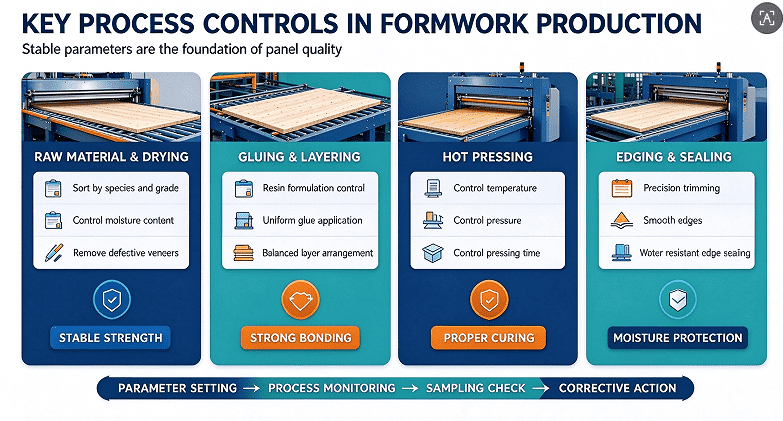
Raw material veneers form the foundation of formwork quality and are the stage most prone to inconsistency. To cut costs, some manufacturers mix veneers of different wood species and grades, resulting in significant thickness variations, cracks on the reverse side, and clusters of knots—all of which make the finished panels highly susceptible to warping and deformation. Controlling the moisture content of the veneers is critical: if the moisture content is too high, internal moisture vaporizes during hot pressing, creating internal pressure that leads to blistering and delamination. Conversely, if the moisture content is too low, the veneers become brittle; this hinders proper adhesive penetration during bonding, reduces bond strength, and causes the panels to delaminate after the formwork is removed. During production, it is essential to sort veneers by wood species and grade, use drying equipment with stable temperature control to keep moisture content within the specified technical range, and discard veneers with severe cracks, decay, or insect damage to prevent substandard materials from entering subsequent production stages.
The processes of adhesive formulation and application determine the formwork’s core resistance to boiling and water immersion. Because construction formwork is frequently exposed to concrete slurry and moisture, the use of an incorrect adhesive type or an improper mixing ratio will directly result in a lower reuse frequency. Common issues include: improper preparation of phenolic resin adhesives (such as arbitrary adjustments to the proportions of curing agents or fillers); uneven adhesive application, leading to areas with insufficient or excessive glue; and a failure to adjust adhesive temperature or gel time in response to fluctuations in workshop temperature and humidity. Insufficient adhesive application leads to weak bonding, while excessive adhesive accumulation results in incomplete curing; both issues cause rapid delamination when exposed to water. Furthermore, environmental compliance is critical—adhesives with excessive free formaldehyde levels fail to meet environmental impact assessment standards and market access requirements. During production, it is essential to standardize adhesive formulations, maintain consistent application rates, ensure thorough mixing and filtration of the adhesive, and conduct regular spot checks on bond strength and boil resistance.
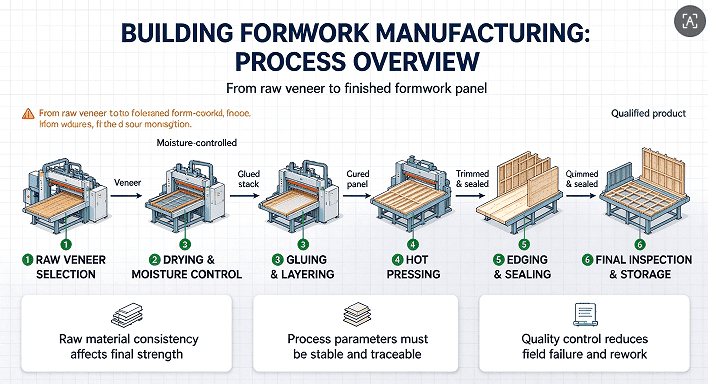
The assembly and layup process is a key stage for controlling panel deformation and thickness tolerances. Many manufacturers handle assembly haphazardly—using veneers with misaligned grain directions or unbalanced symmetrical layering—which creates uneven internal stress. This causes the finished panels to warp or twist when exposed to fluctuations in temperature and humidity. Other common issues include overlapping veneers, excessive gaps, or the mixing of veneers of varying lengths, all of which result in uneven surfaces and localized thickness deviations; such defects lead to large gaps during on-site assembly and potential leakage of concrete slurry. Assembly must adhere to the principle of symmetry: adjacent veneers should have perpendicular grain directions, and veneers of different thicknesses should be combined logically. Proper alignment and gap control are mandatory, as is the pre-pressing of the panel stack to remove trapped air, which prevents slippage or displacement during hot pressing.
Fluctuations in hot-pressing parameters are a primary cause of blistering, delamination, and surface defects. The temperature, pressure, and dwell time (holding time) must be precisely balanced. If the temperature is too low or the dwell time is insufficient, the adhesive will not cure completely, resulting in poor water resistance. Conversely, if the temperature is too high or the heating rate is too rapid, the surface adhesive may cure prematurely, trapping internal moisture and volatile substances; this creates internal pressure that leads to blistering, as well as cracking or embrittlement of the overlay paper. Insufficient pressure prevents the adhesive from adequately penetrating the veneers, leading to weak bonding, while excessive pressure can crush the veneers, causing surface thinning, exposure of the underlying layers, and a reduction in overall strength. For film-faced panels, careful attention must also be paid to the application of the overlay paper; unstable pressure can cause the film to wrinkle or detach in certain areas. In the production workshop, hot-press machines must be calibrated at regular intervals. Process parameters—such as temperature and pressure curves—should be configured based on the specific thickness of the panels and the type of adhesive used. Parameters must remain consistent for all panels within the same batch; arbitrary adjustments based on personal experience are strictly prohibited.
Edge trimming and edge sealing are critical steps that are often overlooked, yet they significantly impact the service life of the panels. If the cutting tools used for trimming large panels after hot-pressing are dull or improperly positioned, the edges may develop burrs or chipping. This exposes the wood fibers, which can then absorb moisture on construction sites, leading to rapid swelling, delamination, and decay that spreads inward from the edges. A common industry malpractice involves cutting corners during the edge-sealing process—such as failing to seal the edges, applying an insufficient thickness of sealant, or using sealants with poor water resistance. This allows rainwater or cement slurry to penetrate the panel core, rendering the formwork unusable after only one or two applications. A proper production process ensures clean, precise cuts and smooth, sanded edges. It requires the use of water-resistant phenolic edge sealant, applied in at least two uniform coats to ensure the edges are completely sealed, thereby blocking any pathways for moisture ingress.
Quality control of the film-faced surface directly affects the ease of formwork removal (demolding) and the final appearance of the concrete. Film-faced construction formwork must feature a smooth, wear-resistant surface that allows for easy release from concrete. Common defects include poor adhesion of the overlay paper—causing it to stick to the concrete during formwork removal—as well as surface pinholes, scratches, wrinkles, or uneven film thickness (which can result in localized translucency). These issues often stem from poor-quality overlay paper, uneven pressure during hot-pressing, an uneven substrate surface, or dust in the workshop settling on the panels. During production, it is essential to keep the panel surfaces clean, select appropriate phenolic overlay paper, and strictly control the temperature and pressure during the hot-pressing process. Every finished panel must undergo a visual inspection to identify and discard any units with scratches, blisters, or defects that would impair the demolding process.
Finally, the curing, storage, and pre-shipment inspection of the finished panels must not be neglected. Panels fresh out of the hot-press still contain internal stresses; if they are packaged and shipped immediately, they are highly prone to deformation later on. Finished panels must be stacked securely in a well-ventilated, shaded curing area, allowing their moisture content to stabilize gradually. Storing formwork in damp environments or exposing it to direct sunlight can lead to surface aging, cracking of the protective film, and deformation caused by moisture absorption. Furthermore, many factories lack standardized sampling procedures, relying solely on visual inspections rather than testing for thickness tolerance, static bending strength, bonding strength, or boil resistance. This results in substandard products reaching construction sites, leading to customer complaints. It is essential to implement a batch-based sampling system—where samples from every batch are tested—to monitor tolerances for length, width, and thickness, as well as diagonal accuracy. Each batch should be clearly labeled with its specifications to ensure full traceability.
In addition, occupational safety and environmental compliance are mandatory requirements in the production process. Operations such as veneer drying, hot pressing, and adhesive preparation generate dust and organic exhaust gases; therefore, dust collection and exhaust treatment systems must operate reliably to meet environmental impact assessment standards. Inadequate guarding on equipment like hot presses and panel saws poses a high risk of workplace accidents. Moreover, adhesives and curing agents are chemical substances that present safety hazards if stored or transported improperly.
In summary, the production of construction formwork is a highly integrated system. Quality issues rarely stem from a single process; rather, they are the cumulative result of factors involving raw materials, equipment, production techniques, and management. To ensure consistent product quality and increase the number of times the formwork can be reused, manufacturers must shift their focus from reactive inspection (sorting out defective boards after production) to proactive control. By establishing standardized processes across every stage—from raw material selection, drying, adhesive formulation, and hot pressing to edge sealing and final storage inspection—and by maintaining stable parameters while minimizing arbitrary manual intervention, manufacturers can consistently produce high-quality construction formwork that features smooth surfaces, strong bonding, and excellent water resistance and durability.