Español
 Русский
 Francés
 Português
 ภาษาไทย
 Indonesia
 Việt
 العربية
 Melayu



Analysis Of Common Problems With Veneer Dryers
Analysis Of Common Problems With Veneer Dryers
Veneer drying is a key linking process in plywood production. The quality of drying directly determines the subsequent panel assembly, hot pressing, gluing stability and finished product qualification rate. For mainstream veneer dryers such as roller type and flap mesh belt type, the failure is often not a single parameter imbalance, but a chain problem caused by the superposition of raw material status, air duct moisture drainage, transmission, heat source system, and daily operation and maintenance. Many factories are accustomed to directly adjusting the temperature or speed, but instead amplify defects, resulting in board scrapping, increased energy consumption, and accelerated equipment loss. This article sorts out typical problems from the three dimensions of finished product defects, equipment operation, and thermal systems, analyzes the underlying causes, and provides practical troubleshooting ideas.
I. Defects in finished single board products
1. The moisture content of the veneer has a large gradient, and the same board has uneven drying and wetness.
Phenomenon: The same veneer is dry on one side and wet on the other, or the surface layer is dry and the moisture content of the core layer is high. The online moisture content detection value jumps greatly, and it regains moisture and deforms after being stored in the warehouse.
The root causes are mainly divided into two categories: First, the air duct layout and air pressure are unbalanced, the air nozzle on one side is blocked by dust, the gap between the upper and lower air nozzles is inconsistent, and the hot air cannot evenly wrap the board surface; second, the feeding state is not uniform, the thickness of the veneer after rotary cutting fluctuates, there is bark, and local glue agglomerates. The initial moisture content of the same batch is very different, but the same set of temperature and speed parameters are applied. In addition, there is no gradient in the temperature zone of each drying section, and there is a lack of preheating and humidity control sections. The surface layer of the veneer quickly loses water when it enters the high-temperature zone, and the moisture migration is blocked, forming an internal dry-humidity difference.
Troubleshooting ideas: First clean the dust on the spray box and air nozzle, and correct the wind pressure on both sides; then produce in batches according to tree species, veneer thickness, and initial moisture content. Use segmented temperature control, low-temperature preheating in the front section, uniform evaporation in the middle section, and humidity control in the rear section to slow stress release and reduce surface sealing.
2. The veneer is warped, wavy, and the edges are everted.
Phenomenon: After drying, the board surface is arched and wavy edges appear. It is difficult to fit during subsequent horizontal assembly and gluing, and the glue is easy to open.
Many people mistakenly believe that the temperature is simply too high, but the actual core is an imbalance of drying shrinkage stress. There are differences in the chordal and radial shrinkage rates of wood. When one side of the veneer is strongly heated and the other side is weakly ventilated, or the roller pressure setting is unreasonable, thin veneers are prone to unidirectional shrinkage. Fast-growing wood such as eucalyptus and rubber wood has high internal stress after rotary cutting. If the temperature rises too fast and the moisture is not released in time, the edge water will lose much faster than the middle part, causing wave deformation. The flipping model will also suffer from misalignment of the timing of the flipping, causing the single board to remain unstable in the cavity, and parts of it will be suspended in the air for a long time and be heated.
Handling points: Prioritize reducing the heating rate, do not blindly increase the temperature; check the parallelism of the rollers and the pressure of the rollers, and appropriately reduce the roller pressure for thin veneers; stabilize the moisture removal negative pressure to avoid local high humidity and suffocation; add a slow cooling storage area after discharging to give the veneers time to release stress, and do not stack them directly in the open air.
3. Cracks at the end of the veneer, fine lines on the board surface, and blown wires
Phenomenon: End cracks and fine cracks on the board surface are concentrated at the discharge port. The thinner the thickness (0.3–0.8mm), the easier it is to appear.
The essence of cracking is that the evaporation rate of water exceeds the tolerance limit of the wood fiber. High-temperature impact and excessive line speed are high-frequency triggers; there is another situation that is easy to ignore: the veneer has been dried below the fiber saturation point, and if it continues to be over-dried, the fiber will lose its toughness, and the slight stress will directly tear the wood grain. In hot-pressure dryers, the steam cannot be discharged in time, and water vapor accumulates inside the board surface, causing the board surface to burst in an instant when the pressure is released.
Distinguishing judgment: cracks at the ends are mostly due to too fast drying speed; fine lines are scattered on the board surface, mostly due to the final moisture content being too low and too dry; partial wire breakage, focus on checking the corresponding area where hot air blows directly, and the tuyere is facing the veneer. Adjustment plan: lower the temperature of the first section and slow down the line speed; lock the lower limit of the target moisture content and rely on closed-loop control of the online moisture content meter to avoid over-baking; install a diversion structure opposite the air outlet of the veneer to reduce direct strong wind blowing.
4. The surface of the veneer is gray, black, and burnt.
Phenomenon: The surface of the board is dull in color, with local scorch spots, and in severe cases, the surface is carbonized, affecting the bonding and appearance grade.
Focal spots generally come from two directions: the hot air temperature on the heat source side exceeds the standard, local hot air circulation dead corners, and the veneers stay in high-temperature areas for a long time; the biomass burner burns insufficiently, and the flue gas carries carbon particles into the drying cavity and adheres to the surface of the veneers. In addition, the surface of the roller has glue and carbon deposits, and direct contact with the veneer at high temperatures will also form massive scorch marks.
Troubleshooting: First check the combustion conditions, check the sealing of the heat exchange system to prevent smoke from flowing into the cavity; clean the colloid and dust on the surface of the roller; control the temperature of the highest temperature zone to prevent the single board from staying in the high temperature zone for a long time.
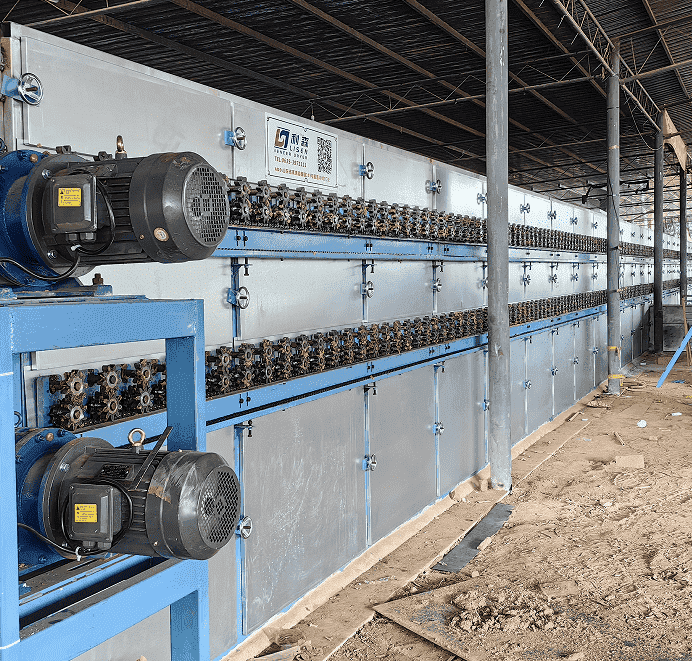
II. Conveying and transmission faults
1. Veneer deviation, jamming, internal blocking and “traffic jam”
Phenomenon: The veneer shifts to one side in the machine, gets stuck in the roller gap, knocks over the plate, accumulates and blocks materials, and the production line is forced to shut down.
The roller dryer focuses on the parallelism of the roller axis and whether the gap between the rollers matches the thickness of the veneer; the chain is inconsistent in tightness, the transmission in different sections is not synchronized, the front section delivers plates quickly and the back section conveys slowly, resulting in plate stacking. Common problems in flipping machines include disordered timing of flipping movements and unstable suction of the negative pressure upper plate. Impurities in raw materials can also cause jamming: bark pieces, wood knots, nails, and dry hard glue blocks get stuck on the surface of the roller, forming raised stuck points that hook the front edge of the veneer.
Maintenance direction: Regularly calibrate the level and parallelism of the rollers, unify the frequency conversion speed in each area; clean the attachments on the roller surface; regularly check the negative pressure pipeline of the vacuum feeding system to ensure the alignment of the feed and reduce the feeding of crooked plates.
2. Abnormal noise in transmission, overheating of reducer, and motor overload alarm
Phenomenon: Continuous vibration and abnormal noise during operation, rapid heating of the box, and frequent overload tripping.
Common causes: Insufficient lubricating oil level, aging oil quality; long-term oil shortage and wear of bearings; uneven chain tension, eccentric load; phase loss in three-phase power supply. Many factories only add lubricating oil after a breakdown and do not establish a maintenance cycle according to the operating time. The decay rate of lubricating oil will be significantly accelerated under high temperature conditions.
Standardize operation and maintenance: Establish a lubrication ledger to distinguish the lubrication cycles of reducers, bearings, and chains; listen for abnormal noises and measure no-load current before starting the machine; stop the machine to cool down if overheating occurs, and do not continue production with faults to prevent gears and bearings from locking and damaging.
III. Thermal engineering, moisture drainage and heat source system issues
1. Slow heating, low overall thermal efficiency, and high energy consumption
Phenomenon: The set temperature is difficult to reach the standard, the fuel or steam supply needs to be continuously increased, and the energy consumption per unit board exceeds the standard.
Prioritize the sealing: the insulation layer of the drying cavity is damaged, cold air leaks from the access door, air duct flange, and flap joint, and a large amount of heat leaks out; secondly, the moisture drainage ratio is unbalanced, the moisture drainage fan is too large, and the hot air is directly extracted; the moisture drainage is too small, the interior of the cavity is saturated with high humidity, and the moisture cannot continue to evaporate, and the drying stagnates. The biomass heating model also depends on the burner air distribution and fuel particle purity. Incomplete combustion will cause insufficient heat and ash accumulation to block the heat exchanger.
Optimization ideas: Repair insulation and seal air leakage points; adjust the frequency conversion of the moisture exhaust fan to maintain a stable negative pressure; regularly clean the heat exchanger and dust accumulation in the heat exchange pipes to ensure heat exchange efficiency; have a production line supporting the kiln waste heat, use the waste heat in a reasonable cascade, and reduce the main heat source load.
2. Water dripping from the moisture drain cylinder and condensation inside the cavity returns to moisture.
Phenomenon: Water drips from the outer wall of the moisture drainage pipe, water drops condense on the top of the cavity, and water droplets drip on the veneer, causing local moisture resurgence, blackening, and mold.
The fundamental reason is that the hot and humid air cools down and condenses in the pipe. When the drying temperature is low and the moisture exhaust air volume is insufficient, the water vapor has no time to be discharged and liquefies in the low temperature section of the air duct; this phenomenon is more prominent in autumn and winter when the ambient temperature is low. The condensed water will flow back into the drying chamber, forming a vicious cycle.
Solution: Increase the moisture drainage wind speed and shorten the residence time of water vapor; insulate the moisture drainage pipes to avoid cooling and condensation on the outer wall; increase the drainage structure of the pipes to drain the condensed water in time to prevent water droplets from flowing back to the veneer area.
3. Large temperature fluctuations and unstable temperature control
Phenomenon: The readings of the temperature control instrument fluctuate high and low, and the temperature difference in the same temperature zone is large.
The main reasons are unstable heat source supply: uneven feed of biomass fuel, coking and blockage of the furnace; unstable steam pipeline pressure, trap failure; dust accumulation on the temperature sensor probe and unreasonable position, and what is collected is not the effective hot air temperature on the panel. If the sensor is covered with dust for a long time, the feedback signal will be distorted and the temperature control system will continue to be misadjusted.
Treatment: Clean the probe regularly and arrange the temperature measurement point in the mainstream area of hot air passing through the veneer; overhaul the combustion feeding mechanism and steam dewatering components; give priority to segmented independent temperature control so that each area does not interfere with each other.
4. Summary of systemic problems and long-term management suggestions
Veneer dryer failures may appear to be caused by veneer quality issues or abnormal noise from the equipment, but behind the scenes they are mostly caused by a disconnect between process parameters, raw material management, and equipment maintenance. Many manufacturers only temporarily adjust parameters when producing defective products, and do not establish a process ledger by tree species and thickness. Eucalyptus, rubber wood, birch, and technical veneer share a set of parameters, and are inherently prone to cracking and deformation.
Long-term control can be divided into three points: first, pre-control of raw materials, stacking rotary-cut veneers, marking the initial moisture content, and rejecting defective products with excessive thickness differences and large pieces of bark; second, establishing a hierarchical inspection mechanism, with daily inspections focusing on wind pressure, moisture drainage, and roll surface shape. Clean the status and sensors, rather than just looking at the temperature gauge; third, pay attention to shutdown maintenance. Heat exchange ducts, rollers, transmission chains, and seals are parts that are prone to wear and tear. They age quickly in high-temperature and high-humidity environments. Preventive maintenance is far less expensive than fault repairs.
The core of the drying process is not to pursue faster and higher temperatures, but to maintain stable drying stress, a uniform hot air field and a reasonable rhythm of moisture removal, to find a balance between production capacity, yield, and energy consumption, reduce veneer scrapping, and stabilize the quality of the entire back-end plywood production line.