Español
 Русский
 Francés
 Português
 ภาษาไทย
 Indonesia
 Việt
 العربية
 Melayu



Key Considerations In the Production Of Engineered Flooring Substrates
Key Considerations In the Production Of Engineered Flooring Substrates
The substrate serves as the core structural framework of engineered wood flooring. Its stability, bonding quality, and moisture content directly determine whether the finished flooring will suffer from arching, cracking, delamination, or deformation. As the core layers and face veneers are the most critical components of the substrate, the processes of rotary cutting, drying, sorting, and assembly are of paramount importance for quality control. Production must be standardized across the entire value chain—from raw material selection and veneer processing to drying, conditioning, gluing, assembly, hot pressing, post-processing, and storage—to mitigate potential production risks.
I. Raw Material Management: Differentiated Selection For Core Layers And Face Veneers
The face veneer acts as the decorative surface layer; therefore, hardwoods with attractive grain patterns and fine textures—such as oak, birch, or black walnut—are preferred. The core layers provide structural support, typically utilizing fast-growing, softer woods like poplar or eucalyptus, which offer moderate density, cost-effectiveness, and good drying stability. For any given batch, it is essential to select wood species with similar properties to prevent excessive internal stress caused by uneven shrinkage.
Upon arrival at the facility, logs must be screened to remove those showing signs of decay, insect damage, large dead knots, or "black heart" (discolored, degraded heartwood). Logs should be stored in a well-ventilated, shaded area—protected from direct sunlight and rain—to prevent localized mold growth or premature cracking. After being cut to length, the logs undergo a steaming or boiling process to soften the wood. This reduces its hardness, thereby minimizing the occurrence of burrs, tearing, or fragmentation during rotary or slicing operations. For face veneers, the steaming temperature and duration must be carefully controlled to ensure a gentler process, preserving the integrity of the wood's natural grain patterns.
II. Key Process Points For Face Veneer And Core Layer Preparation
Face veneers are typically produced via slicing or semi-rotary cutting to ensure a continuous and aesthetically pleasing grain pattern. Core layers are primarily produced through rotary cutting, with a focus on achieving uniform thickness and a flat, even surface. The knife gap and pressure bar settings on rotary-cutting equipment require regular calibration. Veneer thickness tolerances must be strictly controlled; excessive thickness variation can lead to core overlaps, gaps, or an uneven surface on the base panel during the subsequent assembly (lay-up) process.
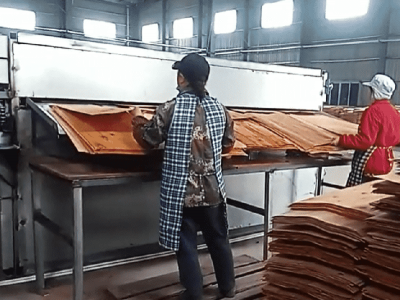
After rotary cutting, wet veneers must undergo an initial sorting process. For face veneers, the focus is on removing pieces with excessive live knots, cracks, bark inclusions, or severe knife marks. For core veneers, the priority is to discard pieces with large holes, long cracks, or significant burrs. Minor defects may be repaired, while severe defects must be diverted and prevented from entering the next stage of production.
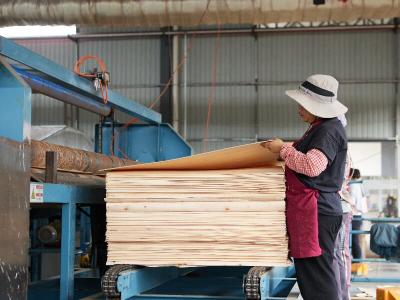
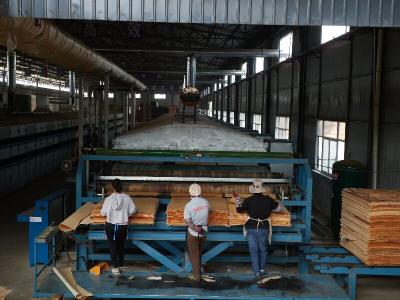
Drying is the most critical step in veneer processing—and often the stage where many factories encounter issues. Wet veneers are fed into a dryer, where they should be dried at a low temperature and a constant, uniform speed; rapid drying at high temperatures is strictly prohibited. The moisture content for face veneers is typically controlled between 8% and 10%, while for core veneers, it is kept between 8% and 12%. **It is essential to keep the moisture content of face and core veneers as close as possible. If the disparity is too great, the face and core layers will shrink at different rates when exposed to subsequent changes in temperature and humidity, which frequently leads to surface warping or cracking of the face veneer.** Once dried, veneers should not immediately proceed to the next production line; instead, they must be placed in a conditioning room to balance their moisture content. This allows internal moisture to be released evenly and eliminates drying-induced stress. The conditioning environment must maintain stable temperature and humidity levels. Veneers should be sorted, clearly labeled, and stacked separately—keeping face and core veneers apart—to prevent them from being mixed up.
The sanding and trimming of veneers are equally important. Core veneers should be sanded to remove rough edges and burrs, while face veneers require only light sanding to avoid damaging the grain. Face veneers should also be graded based on grain pattern and color variation to meet specific assembly requirements. Techniques such as "book matching" and "slip matching" should be grouped separately to ensure a consistent appearance in the final product.
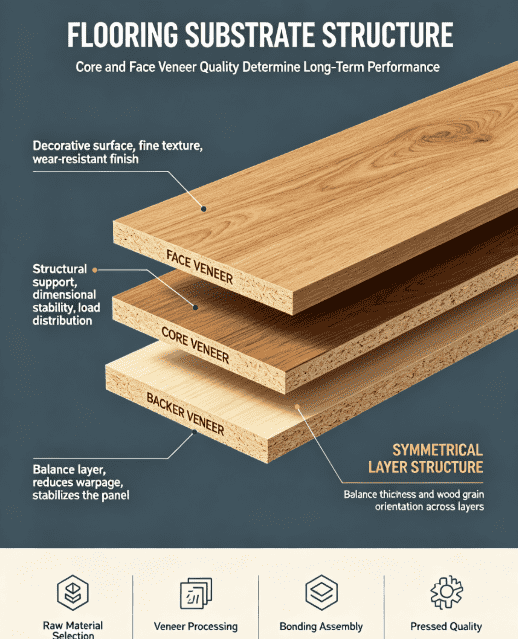
III. Gluing and Assembly: A Symmetrical Structure Is Key To Substrate Stability
Flooring substrates consist of a symmetrical layered structure. The assembly process follows the principle of **alternating grain orientation and symmetrical layering**, which is the fundamental logic for preventing deformation. The grain directions of the face veneers and the adjacent core veneers should be perpendicular to each other. The number of veneer layers, their thicknesses, and the wood species used should be as symmetrical as possible on both the front and back sides; many instances of substrate deformation stem from asymmetrical layup or inconsistent veneer configurations between the two sides.
During the gluing process, the amount of adhesive applied must be adjusted based on the veneer thickness: use less glue for thin face veneers and a higher amount for thicker core veneers. Ensure the adhesive is applied evenly, without gaps or excessive buildup. Prioritize the use of low-formaldehyde, eco-friendly adhesives, and regularly monitor the solid content and pot life of the glue; never use expired adhesive. After application, allow for an appropriate "open assembly time" (aging period) to let the adhesive partially set; this prevents blistering or the formation of air bubbles within the glue line during hot pressing. Adjust this duration based on workshop temperature and humidity—shorten the time in high-temperature environments to prevent the adhesive from curing prematurely and losing its effectiveness.
During the layup process, conduct rigorous inspections: ensure gaps between veneers do not exceed specified limits, and promptly fill any voids or holes in the core veneers. Position face veneers correctly (e.g., face-side down, as per the specific process requirements) to avoid reversing the front and back sides. Align the veneers carefully to prevent edge misalignment or overlapping of core veneers. Once the layup is complete, promptly move the assembly to the pre-pressing stage. Pre-pressing removes air from between the layers, ensures initial adhesion, facilitates transport, and prevents the layup from falling apart.
IV. Process Control During Hot Pressing To Prevent Delamination And Blistering
Hot pressing is the critical stage for bonding and forming. Temperature, pressure, and duration are interdependent variables and should not be altered arbitrarily. If the temperature is too low or the duration too short, the adhesive will not cure completely, resulting in insufficient bond strength and a high risk of subsequent delamination. Conversely, if the temperature is too high, the face veneers may scorch or discolor, and the glue line may become brittle. Insufficient pressure leads to poor contact between veneers and the formation of voids, while excessive pressure can crush the veneers or cause the adhesive to bleed through to the surface.
During hot pressing, pay close attention to the venting sequence and utilize staged pressure release to rapidly expel moisture vapor from within the panel assembly; the accumulation of such vapor is the primary cause of blistering in the substrate. Samples from each production batch are retained and subjected to periodic soak-peel and bond-strength testing to ensure the durability of the adhesive layer meets required standards.
After hot-pressing, the base panels must not be sanded or cut immediately. They must be moved off the production line for a secondary conditioning (curing) phase to allow internal stresses generated during hot-pressing to dissipate. If the panels are precision-cut while internal stresses remain, they will continue to deform during subsequent storage, processing, or end-use, leading to a significant increase in rework rates.
V. Sanding, Edge Trimming, And Quality Inspection: The Final Gatekeeper
Once conditioned, the base panels undergo thickness-calibrating sanding. Using a sequence of abrasive belts—from coarse to fine—ensures uniform thickness and a flat surface. The amount of material removed from the surface veneer must be strictly controlled to prevent sanding through the veneer or damaging its grain. Furthermore, all sanding dust must be thoroughly removed; residual dust can hinder the adhesion of subsequent topcoats, leading to defects such as white spots or poor coating adhesion.
Edges are trimmed to specification, removing burrs and excess adhesive. Each finished panel is inspected: the surface is checked for veneer cracks, color variations, indentations, adhesive bleed-through, or blistering; the core layer is examined for gaps, overlapping veneers, or voids. Additionally, samples are tested for moisture content, modulus of rupture (bending strength), modulus of elasticity, and formaldehyde emission levels. Non-conforming products are isolated for either repair or disposal; they must never be mixed with conforming stock.
VI. Workshop Environment, Storage, And Batch Management
Temperature and humidity in the production workshop must be kept stable. In the humid southern regions, dehumidification is necessary, while in the dry northern regions, humidity should be moderately increased. This prevents veneers and semi-finished products from rapidly absorbing or losing moisture between processing stages. Surface veneers are particularly delicate; prolonged exposure to dry air can easily cause them to shrink and crack. Unused veneers should be covered with protective film.
In the warehouse, finished panels must be stored off the floor and away from walls, placed on support beams (dunnage), and stacked neatly. The stack height must be controlled to prevent deformation caused by excessive pressure. The warehouse must be kept dry and protected from rain, with adequate ventilation to prevent the bottom panels from becoming damp or moldy. Batch management is implemented throughout the entire production process. Every batch—from raw logs, face veneers, and core veneers to adhesives and hot-pressing cycles—is meticulously recorded, enabling rapid traceability to the specific production stage should any quality issues arise.
The quality of a flooring substrate does not depend on perfecting a single process step, but rather on the balanced control of the entire production chain, encompassing both face veneers and core veneers. While the face veneer determines the product's appearance, the core veneer dictates its structural stability. From the steaming of raw logs, veneer peeling and drying, and moisture-content conditioning to symmetrical layup, precise hot-pressing, and stress relief—any oversight in these details can lead to quality complaints regarding the finished flooring. Maintaining a stable moisture content, a symmetrical layered structure, and reliable bonding remains the enduring, core principle of substrate production.