Español
 Русский
 Francés
 Português
 ภาษาไทย
 Indonesia
 Việt
 العربية
 Melayu



Why Does the Flatness of Rotary-Cut Veneers Vary Even When Using the Same Timber?
Why Does the Flatness of Rotary-Cut Veneers Vary Even When Using the Same Timber?
In plywood production facilities, a perplexing phenomenon is frequently encountered: even when using the same wood species and the same batch of logs, the resulting rotary-cut veneers vary significantly. Some sheets are smooth and flat, while others exhibit undulations, curl along one edge, or suffer from back-splitting and warping. When veneer flatness fails to meet standards, it leads to difficulties in panel assembly, uneven glue application, and the development of blisters or delamination after hot pressing—ultimately driving up both the rate of downgraded products and the volume of waste. While many manufacturers instinctively blame the timber itself, the reality is that even with consistent raw material, any imbalance in log pretreatment, rotary-cutting parameters, equipment condition, drying processes, or stress management can result in variations in flatness.
I. The Timber Itself: Hidden Internal Disparities as the Root Cause of Flatness Variations
Wood is an anisotropic material; even within a single batch of logs, internal conditions are rarely uniform. This is the fundamental cause of the issue.
1. Uneven Moisture Content Distribution
Within a single log, moisture content naturally varies between heartwood and sapwood, as well as between the sun-exposed and shaded sides. Furthermore, differences in storage duration and the rate of moisture loss from the log ends create moisture gradients between the interior and exterior. Areas with higher moisture content are softer and more prone to deformation under the pressure of the cutting knife. Conversely, drier areas are susceptible to surface fuzzing, spring-back, and curling. This results in veneers that are "tight" on one side and "loose" on the other, inevitably leading to a lack of flatness.
2. Reaction Wood, Eccentricity, and Variations in Annual Ring Density
Logs may exhibit eccentricity, curvature, or the presence of "reaction wood" (tension wood or compression wood), all of which introduce inherent internal stresses. The rotary-cutting process effectively releases these locked-in stresses, causing the veneer to curl in specific directions based on where the stress was concentrated. Within the same batch of logs, some may be straight with uniform annual rings, while others may be curved or contain significant amounts of reaction wood—leading to marked differences in the quality of the rotary-cut veneers. 3. Knots, Decay, and Interlocked Grain
Near knots, wood fibers are disorganized, causing sudden fluctuations in cutting resistance. This leads to unstable pressure from the rotary knife and pressure roller, often resulting in a wavy surface. In areas with severe interlocked grain, uneven fiber spring-back after cutting can cause localized warping.
Solutions: Standardize the log softening pretreatment. Prioritize soaking in warm water or steaming to ensure uniform moisture content and consistent softening throughout the log. Carefully control steaming temperatures and durations to prevent uneven softening—avoiding both over-steaming in some areas and insufficient softening in others. Grade logs based on curvature and eccentricity before feeding them into the rotary-cutting line; logs with significant curvature or high eccentricity should be processed separately rather than mixed with high-quality logs.
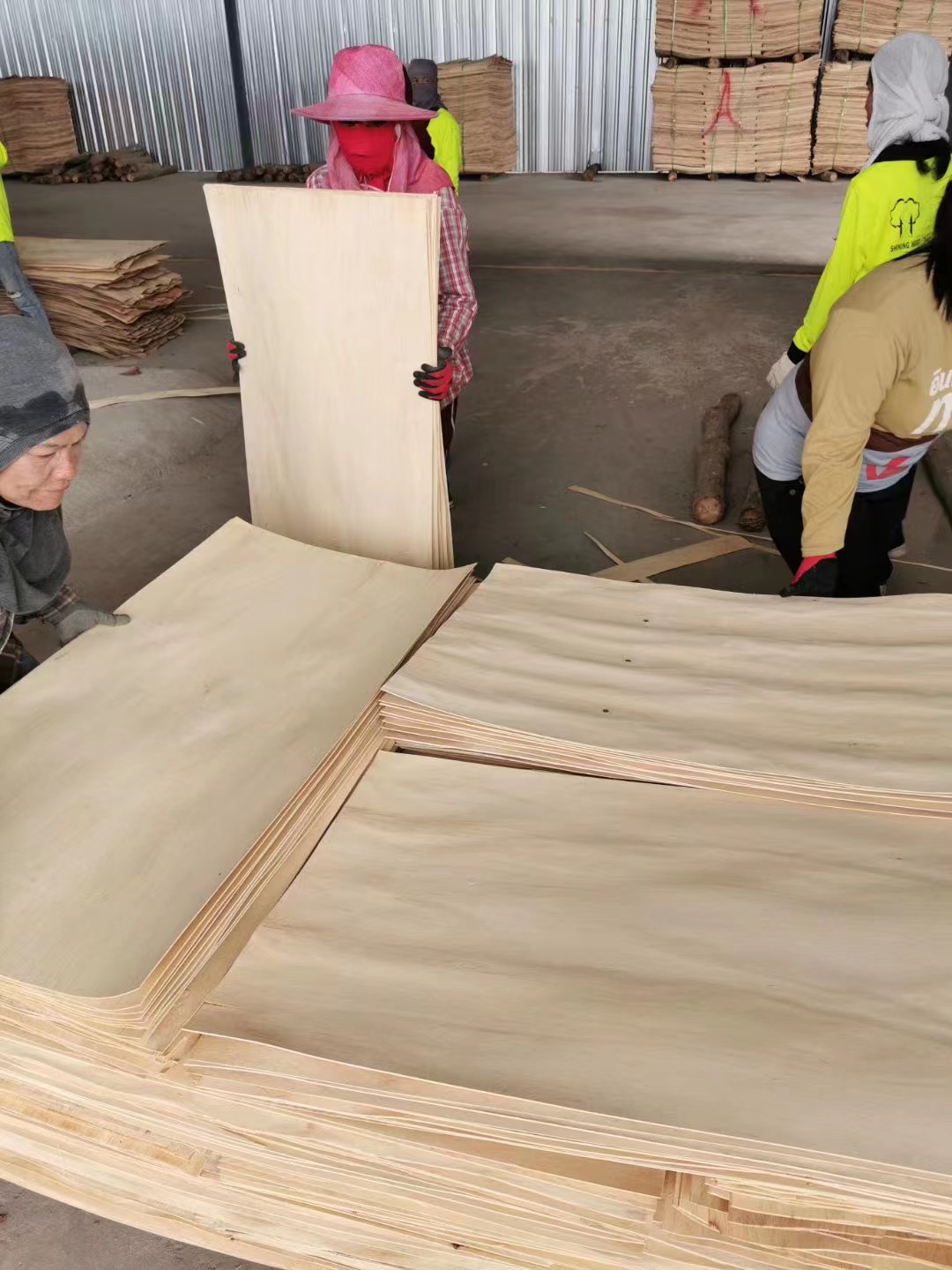
II. Rotary-Cutting Stage: Parameters and Equipment as Key Control Points for Flatness
Many veneers emerge from the rotary-cutting process already lacking flatness. This stage is the primary source of such issues and, fortunately, the area most easily adjusted and improved on the production floor.
1. Condition and Installation Precision of the Rotary-Cutting Knife
If the knife edge is not straight, has become dull, or is ground to an improper angle, it fails to make a clean cut through the fibers—instead, it tears and compresses the wood, creating a wavy surface. Incorrect knife height, deviations in the knife gap, or an improper relief angle (clearance angle) can lead to excessive compression on the underside of the veneer or severe "back-checking" (cracks on the reverse side). Upon release from the log, the compressed fibers spring back, causing the veneer to curl. An excessively large grinding angle tends to increase curling, while an angle that is too small can cause the knife edge to vibrate, resulting in visible ripples on the veneer surface.
2. Imbalanced Pressure from the Pressure Bar (or Pressure Roller)
The pressure applied by the pressure bar is critical for controlling veneer flatness. If the pressure is too high, the underside of the veneer is over-compressed; once the veneer leaves the log, this compressed layer springs back, causing the sheet to curl outward. Conversely, if the pressure is insufficient, the fibers are not cut cleanly, leading to back-checking or loose edges. Furthermore, if the pressure is uneven across the width of the log, the veneer will warp or curl on one side. 3. Issues with Log Centering, Spindle Clamping, and Roller Runout
Inaccurate log centering, slippage at the spindle clamps, worn bearings in the support rollers, or excessive roller runout can cause the log to wobble during the rotary-cutting process. This results in inconsistent veneer thickness—varying between thick and thin—which leads to uneven shrinkage during subsequent stages and a complete loss of flatness control. Stability decreases significantly as the log is cut down toward the core, making the final few sheets of veneer particularly prone to curling and warping.
4. Mismatched Rotary-Cutting Speeds
When the rotational speed and the feed rate are not properly synchronized, the cutting impact becomes unstable, often causing the thin veneer to develop ripples or "chatter marks."
Solutions: Establish a standardized setup and adjustment process. Regularly sharpen the cutting knife to ensure a perfectly straight edge. Standardize parameters—such as the grinding angle, knife height, knife gap, and pressure bar force—based on the specific veneer thickness and wood species. Inspect and maintain spindle clamps, rollers, and bearings to eliminate runout. Ensure precise centering of logs before loading; for curved logs, align them to minimize eccentricity. Use consistent rotary-cutting speeds for logs of the same specifications to reduce cutting impact. Furthermore, do not leave wet, freshly cut veneer exposed to the elements for long periods, as localized air-drying can trigger premature drying stress.
III. Drying Stage: Why Veneer Appears Flat Initially but Warps After Drying
In many factories, veneer may look acceptable immediately after rotary cutting, only to curl or warp upon drying. This is caused by "drying stress" and is a primary stage where flatness issues frequently arise.
1. Uneven Drying Due to Inconsistent Veneer Thickness
Thickness variations originating from the rotary-cutting stage lead to uneven drying. In the dryer, thinner sections lose moisture and shrink more rapidly than thicker sections. Because the shrinkage rates are not synchronized, the veneer is subjected to internal tension, causing it to deform. 2. Improper Drying Temperature, Airflow Velocity, and Zonal Configuration
If the temperature rises too rapidly or is set too high in the initial stage, a hard crust forms quickly on the veneer surface, trapping moisture inside. This creates a significant moisture gradient between the interior and exterior, resulting in intense internal stress. Furthermore, uneven airflow within the dryer—where some areas experience strong drafts while others have little to no airflow—causes inconsistent drying rates across different parts of the same veneer sheet, leading directly to warping.
3. Lack of Moisture Equalization and Stress-Relief Cooling Stages
When veneer exits the high-temperature drying zone immediately, the internal stresses are "locked in" while the material is still hot. As it cools to ambient temperature, these stresses are released unevenly, causing the veneer to continue deforming or curling over time.
Solutions: Utilize a roller-type dryer equipped with zoned temperature control and balanced, dual-sided airflow. The system should incorporate a preheating stage, a primary drying stage, a moisture-equalization stage, and a stress-relief cooling stage. Employ a "slow-drying at lower temperatures" approach to avoid rapid, aggressive heating. Ensure stable pressure from the upper and lower rollers to "set" the veneer while its fibers are in a softened state. After drying, pass the veneer through a moisture-conditioning zone to gradually release internal stress, thereby minimizing "spring-back" during cooling. Where feasible, integrate an in-line moisture content monitoring system to ensure that the final moisture content of each batch of veneer remains within a narrow, consistent range, reducing deformation caused by moisture variability.
IV. Downstream Handling, Stacking, and Conditioning: The Often-Overlooked Causes of Secondary Deformation
Even if the rotary cutting and drying processes are executed perfectly, improper handling or stacking can cause flat veneer to warp once again. Issues such as leaving wet veneer exposed to drafts or sunlight, uneven stacking heights, or inconsistent pressure distribution can lead to localized drying and shrinkage. For dried veneer, exposure to fluctuating ambient temperature and humidity—causing repeated cycles of moisture absorption and desorption—leads to continuous deformation.
Solutions: Wet veneer should be protected from wind and kept moist during short-term storage, with priority given to feeding it into the dryer. Once dried, veneer should be stored in a controlled, enclosed environment, stacked neatly by grade, and protected from one-sided exposure to airflow. Before further processing, allow sufficient time for internal stresses to reach equilibrium, which helps minimize deformation during subsequent manufacturing stages. V. A Management Approach for Ensuring Consistent Veneer Flatness
The inconsistent flatness of rotary-cut veneer stems from a combination of factors: inherent stresses in the raw log, stresses introduced during the rotary-cutting process, and shrinkage stresses that occur during drying. An effective improvement strategy can be implemented as follows:
Step 1: Grade the raw logs and apply a uniform softening/steaming process to eliminate initial variations in moisture content and internal stress.
Step 2: Standardize rotary-cutting operations—including equipment inspection, knife sharpening, pressure bar settings, knife-gap adjustments, and log centering—to ensure uniform veneer thickness and stable cutting conditions from the outset.
Step 3: Utilize drying equipment that features zoned temperature control and integrated moisture-equalizing cooling to manage drying gradients and "lock in" the flat shape of the veneer.
Step 4: Standardize handling, stacking, and storage procedures to prevent subsequent deformation.
Achieving consistent flatness is fundamentally about ensuring that wood fibers experience uniform stress and shrinkage. By establishing standardized parameters for the pre-treatment, rotary-cutting, and drying phases for each batch of logs, manufacturers can significantly reduce warping—even when working with the same timber species—thereby stabilizing veneer quality grades and lowering overall losses in plywood production.