Español
 Русский
 Francés
 Português
 ภาษาไทย
 Indonesia
 Việt
 العربية
 Melayu


Production And Application Of Engineered Wood Veneer
Production And Application Of Engineered Wood Veneer
Engineered wood veneer—also known as reconstituted decorative veneer—is an all-wood surfacing material crafted from fast-growing timber species such as poplar, eucalyptus, and birch. Through the application of biomimetic principles and wood modification technologies, the timber undergoes a systematic reconstruction process. This material retains the warm, natural texture of wood while overcoming the inherent drawbacks of natural timber, such as color inconsistency, knots, insect holes, and a susceptibility to warping or cracking. It can replicate the grain patterns of premium woods—like black walnut, teak, and red oak—or even create unique, bespoke patterns not found in nature. Consequently, it has become a mainstream, eco-friendly surfacing material in the fields of modern furniture and interior design.
I. The Complete Production Process
1. Raw Material Preparation and Rotary Cutting
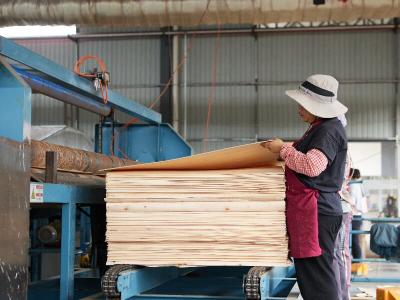
Fast-growing logs, characterized by short growth cycles and uniform material properties, are selected. They undergo a steaming and softening process to reduce hardness and minimize tearing during rotary cutting. A rotary lathe then peels the logs into continuous, uniform thin veneers—typically ranging from 0.15 to 0.6 mm in thickness—which serve as the fundamental building blocks for engineered wood veneer.
2. Bleaching, Dyeing, and Drying
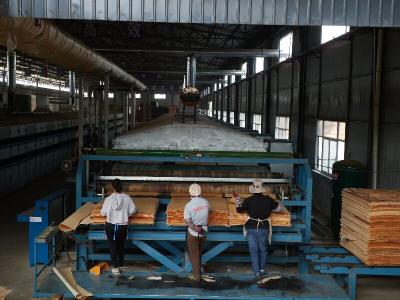
The veneers are placed into high-pressure dyeing vessels. First, they are bleached to create a uniform base color, eliminating any natural irregularities or discolorations. Next, they undergo deep-penetration dyeing based on specific design formulas, ensuring consistent color throughout the entire thickness of the material. Once dyed, the veneers are transferred to a dryer, where moisture content is precisely controlled to prevent future warping; maintaining a stable moisture level is a critical factor in ensuring the quality of the veneer.
3. Veneer Repair and Layup Design
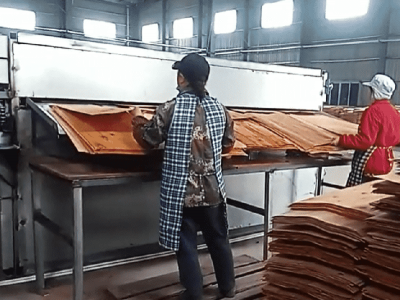
Any cracks, holes, or other imperfections in the veneers are repaired through a combination of manual labor and specialized equipment. Following this, the veneers—now in various colors—are stacked and arranged according to a predetermined grain design. This "layup" stage determines the final orientation of the wood grain and is the core process that allows for the replication and customization of patterns in engineered wood veneer. 4. Gluing and Hot-Pressing into Engineered Timber Blocks
Veneer sheets are evenly coated with eco-friendly adhesive and fed into a hot press. Under controlled temperature and pressure, the adhesive cures, bonding the layers into a dense, solid block of engineered timber. This hot-pressing process ensures a stable structure with balanced internal stress, significantly reducing the risk of future warping.
5. Precision Slicing, Sorting, and Quality Inspection
The cured engineered timber blocks are processed through a horizontal slicer, where they are cut along the direction of the designed grain to produce finished engineered wood veneers. Finally, the veneers undergo sorting, trimming, and quality inspection before being graded, packaged (in rolls or sheets), and placed into storage.
Complete Process Flow: Log steaming and softening → Rotary cutting into veneers → Bleaching and dyeing → Low-temperature drying → Defect repair → Oriented assembly → Gluing and hot-pressing → Conditioning (resting) of timber blocks → Precision slicing → Grading and inspection.
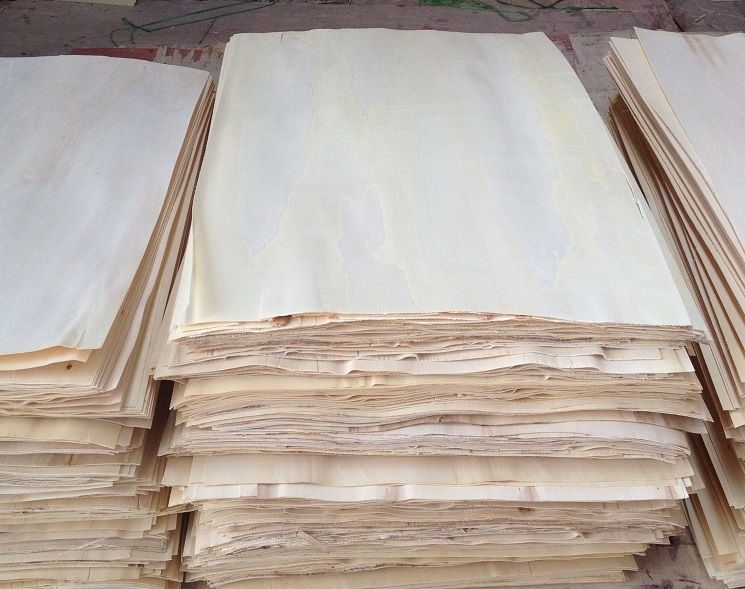
II. Core Advantages
1. Controllable Grain and Color: Patterns and colors are stable and consistent, making them ideal for large-scale, continuous decorative applications. Unlike natural wood, which features random color variations, these products are well-suited for standardized, mass-produced furniture.
2. Stable Performance: Through structural reconfiguration, internal stress is evenly distributed, providing excellent resistance to deformation and cracking—even in environments with high humidity or significant temperature fluctuations.
3. Eco-friendly and Sustainable: By utilizing fast-growing timber species as an alternative to precious hardwoods, the process reduces the need to harvest rare tree species. Compliant products can meet high environmental safety standards.
4. High Cost-Effectiveness: Compared to natural, high-value wood veneers, these products offer lower procurement costs, stable supply, and predictable lead times.
5. Ease of Processing: The material is easy to cut, wrap, and apply to complex, non-linear surfaces—making it perfect for curved door panels, rounded cabinetry, and other intricate designs.
III. Key Application Scenarios
1. Custom and Finished Furniture
Engineered wood veneers are most extensively used in items such as wardrobes, kitchen cabinets, interior doors, tables and chairs, bookcases, office cabinetry, and display cases. High-end custom furniture brands frequently use them as alternatives to natural walnut or red oak, allowing for a consistent, uniform grain pattern throughout an entire interior space. 2. Interior Commercial Decoration
For applications such as wood-veneered feature walls, ceilings, sound-absorbing wall panels, and corridor decorative paneling in hotels, private clubs, office buildings, and exhibition halls, these materials offer superior visual consistency over large surface areas compared to natural wood veneer.
3. Other Specialized Applications
These materials are used for speaker enclosures, musical instrument components, handicrafts, picture frames, wooden doors, and wrapped moldings. They also serve as surface laminates for plywood, medium-density fiberboard (MDF), and multi-layered boards, enhancing the decorative value of the substrates.