Español
 Русский
 Francés
 Português
 ภาษาไทย
 Indonesia
 Việt
Việt
 العربية
 Melayu

How to Match High-Quality Drying Equipment to Automated Production Lines?
How to Match High-Quality Drying Equipment to Automated Production Lines?
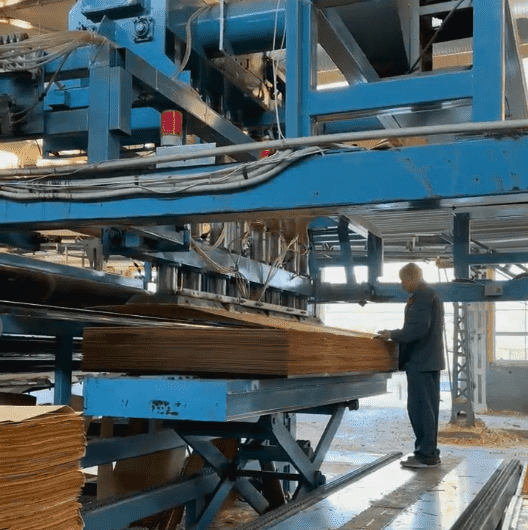
In the global wave of deep transformation towards automation, intelligence, and green practices in the timber processing industry, the degree of automation in veneer production has become a key indicator of a company's core competitiveness. Europe, as a global leader in timber technology, has seen a continuous increase in the automation penetration rate of its production lines. Latvia, with its abundant forest resources and supportive industrial policies, has witnessed steady expansion of its timber industry, with a market size of approximately €1.5 billion in 2025 and projected to reach €2.2-2.5 billion by 2030, with the automation equipment penetration rate expected to rise to 70%. In highly automated veneer production lines, the drying process directly determines board quality, production efficiency, and operating costs. Therefore, matching high-quality drying equipment to automated production lines has become a core issue in the industry.
Shine Machinery's independently developed intelligent roller veneer dryer has been successfully implemented in a high-end timber processing plant in Latvia, perfectly adapting to the local ultra-high automation veneer production line and providing a benchmark solution for automation in the European timber industry.
I. Core Requirements of Automated Veneer Production Lines for Drying Equipment A highly automated veneer production line is characterized by continuous, unmanned, and collaborative processes throughout the entire process. From log veneer cutting, conveying, drying, and trimming to hot pressing, each step is seamlessly connected, ensuring a stable and efficient production cycle. In this model, the drying equipment is no longer an independent unit but a crucial hub of the production line, requiring it to meet four core requirements.
First, seamless automation adaptability. Automated production lines require the drying equipment to be synchronized in speed and communicate with the upstream and downstream veneer cutting, conveying, and veneer collecting equipment to avoid veneer accumulation or flow interruptions. Traditional drying equipment often relies on manual feeding and speed adjustment, which is difficult to match the high-speed cycle of 180 veneers/minute in automated production lines, easily causing production delays and veneer damage. High-quality automated drying equipment needs to be equipped with a variable frequency speed control system and an intelligent linkage control module, capable of receiving real-time output signals from the upstream veneer cutting machine and automatically adjusting the feeding speed and drying parameters to achieve fully automated collaboration throughout the "veneer cutting-drying-collection" process without manual intervention.
Second, precise and stable drying quality control. Automated production lines strive for zero-defect, highly uniform veneer quality, requiring stable moisture content control between 8% and 12%, with an error of ≤±0.5%, eliminating warping, cracking, and deformation. Traditional drying equipment relies on manual temperature and humidity control, easily leading to uneven moisture content, localized over-drying or under-drying, resulting in subsequent hot-pressing delamination and veneer scrap. High-quality drying equipment must be equipped with an intelligent temperature and humidity control system, combined with multi-layer hot air circulation and precise dehumidification design, to achieve dynamic control of drying temperature, humidity, and speed, ensuring uniform moisture content across the entire width and layer of the veneer, increasing the yield rate to over 95%.
Thirdly, efficient and energy-saving continuous production capabilities are essential. Automated production lines emphasize all-weather, high-capacity, and low-cost operation, requiring drying equipment with high drying efficiency, low energy consumption, and long-term stable operation capabilities. With high energy costs and stringent environmental regulations in Europe, energy conservation and emission reduction have become core necessities. High-quality automated drying equipment typically employs high-temperature roller direct contact heat transfer technology, improving thermal efficiency by over 30% compared to traditional drying rooms. Combined with a waste heat recovery system, energy savings exceed 25%. It also supports multiple heat sources such as biomass, natural gas, and steam, and can utilize biomass fuels like waste wood, further reducing operating costs and meeting EU green environmental protection requirements.
Fourthly, it boasts compact and reliable intelligent operation and maintenance capabilities. Automated production lines require minimal human intervention, necessitating compact drying equipment with low failure rates, convenient operation and maintenance, and adaptability to factory layouts. High-quality drying equipment adopts a modular design, occupying a small area and shortening installation and commissioning cycles. Core components are made of high-temperature resistant and corrosion-resistant high-quality steel, suitable for 24-hour continuous operation. It also features an industrial IoT remote monitoring system, enabling real-time monitoring of equipment operating parameters and single-board drying data, achieving fault warnings and remote operation and maintenance, significantly reducing maintenance costs and downtime risks.
II. Latvia Case Study: Shine Machinery's Drying Machine Adapts to High-End Automated Production Lines in Europe
As a major timber-producing region in Europe, Latvia is accelerating its industrial automation upgrade. Leading local timber processing plants are introducing highly automated veneer production lines, placing stringent demands on the compatibility, stability, and energy efficiency of drying equipment. The Chinese-made intelligent roller veneer dryer, with its four core advantages—deep compatibility, precise drying, high energy efficiency, and intelligent operation and maintenance—has successfully integrated into the local ultra-high-automation production line, achieving seamless collaborative operation.
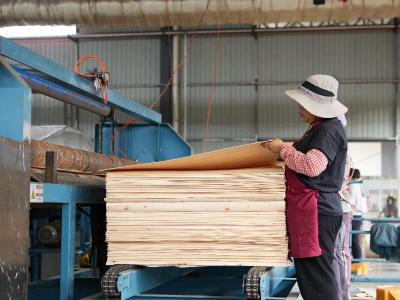
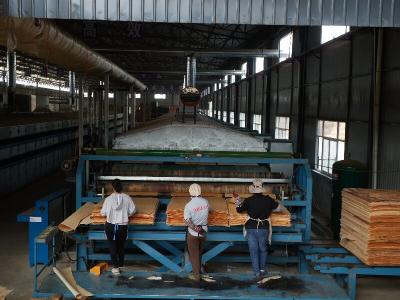
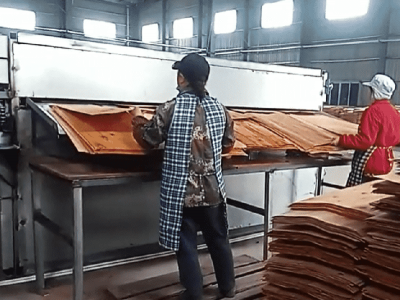
Regarding automation integration, the equipment is equipped with a customized variable frequency speed control system and an industrial-grade communication module. It can directly connect to the existing automated production line control system in the Latvian factory, synchronizing the output speed of the veneer lathe in real time and automatically adjusting the drying feed rate, completely solving the problem of "disconnection" between traditional equipment and automated production lines. The equipment supports fully automated veneer loading, drying, and unloading operations, requiring no manual operation from veneer entry to finished product output, perfectly matching the "less-staffed, unmanned" production model of European factories.
Regarding drying quality control, the equipment is equipped with high-precision temperature and humidity sensors and an intelligent algorithm control system, specifically designed for the characteristics of Latvian birch veneer. This system automatically matches the optimal drying curve based on veneer thickness and initial moisture content, with moisture content error strictly controlled within ±0.5%. The multi-layer roller design ensures uniform heat transfer and a closed-loop hot air circulation system, guaranteeing consistent drying on both sides and in all areas of the veneer. This effectively avoids warping and cracking issues common in birch veneer, resulting in finished veneers with flatness and stability meeting European high-end panel standards, satisfying the needs of high-end applications such as furniture and building materials.
In terms of high efficiency, energy saving, and environmental compliance, the equipment utilizes high-temperature roller direct contact heat transfer technology, resulting in low heat loss and high thermal efficiency, achieving energy savings of over 25% compared to traditional local steam drying rooms. It also supports biomass heat source adaptation, allowing the use of waste wood generated during factory production as fuel, achieving waste recycling and complying with EU sustainable development and environmental emission requirements. Meanwhile, the equipment meets CE certification standards, features a compact design, and occupies only one-third the space of traditional drying rooms, perfectly fitting the existing factory layout in Latvia and significantly reducing investment in factory renovations.
Regarding intelligent operation and stability, the equipment adopts a high-strength modular body design, with core transmission components undergoing precision machining and heat treatment, ensuring long-term stable operation and an extremely low failure rate. Equipped with a remote intelligent monitoring platform, the technical team can remotely view equipment operating data and drying parameters in real time, proactively predict potential faults, and provide technical support, ensuring continuous and stable production 24 hours a day, helping the factory seize orders and increase production capacity.
The Latvian customer stated that they chose China Shenghuai Intelligent's drying equipment primarily because of its deep adaptability to automated production lines, stable drying quality, significant energy-saving effects, and comprehensive after-sales support. After the equipment was put into operation, the overall production line efficiency increased by 20%, the single-board yield rate increased to 99.5%, and energy costs decreased by 25%, significantly enhancing the company's competitiveness in the European high-end board market.
III. Selection and Implementation Recommendations for High-Quality Drying Equipment for Automated Production Lines
As seen in the successful case in Latvia, the key to integrating high-quality drying equipment into automated veneer production lines lies in balancing four dimensions: adaptability, precision, energy efficiency, and stability. Enterprises can refer to three core recommendations for selection and implementation:
First, adhere to the principle of "production line compatibility first," customizing equipment to match the production line's cycle time. When selecting equipment, a comprehensive assessment of the existing automated production line's production cycle time, veneer species, thickness, capacity requirements, and factory conditions is necessary. Prioritize drying equipment with variable frequency linkage, signal interoperability, and modular design to ensure seamless integration into the existing production line without large-scale modifications. It is recommended to prioritize professional manufacturers with overseas project implementation experience and the ability to provide customized solutions to avoid blind procurement leading to compatibility failures.
Second, focus on the "dual cores of quality and energy efficiency," considering long-term operational benefits. The European market has stringent requirements for veneer quality, and drying quality directly determines product premium; simultaneously, with continuously rising energy costs, energy efficiency directly impacts enterprise profit margins. When selecting equipment, key considerations should be given to its moisture content control accuracy, temperature and humidity regulation capabilities, thermal efficiency, and energy consumption. Priority should be given to equipment with a moisture content error ≤ ±1% and an energy saving rate ≥ 20%, balancing initial procurement costs with long-term operating costs.
Thirdly, emphasis should be placed on "intelligent operation and maintenance and after-sales support" to ensure stable and continuous production. Automated production lines have extremely high requirements for equipment stability; any shutdown will paralyze the entire line. When selecting equipment, priority should be given to equipment equipped with remote monitoring, fault early warning, and intelligent diagnostic systems. Simultaneously, the manufacturer's overseas after-sales response capabilities, technical support team strength, and spare parts supply capabilities should be examined to ensure that equipment problems can be resolved quickly, minimizing downtime losses.
Fourth, Chinese intelligent manufacturing empowers the global wood industry's automation upgrade.
Currently, the global wood processing industry is accelerating its automation and intelligent transformation. Demand for high-quality, highly adaptable, and energy-efficient veneer drying equipment continues to grow in Europe and Southeast Asia. Chinese veneer dryer companies, leveraging technological innovation, cost advantages, customized services, and overseas experience, are rapidly emerging as core suppliers of high-end global drying equipment, breaking the long-standing monopoly of European and Japanese companies.
Looking ahead, as the global wood industry continues its transformation towards automation and green practices, Shine Machinery will continue to increase its R&D investment, optimize product performance, and enhance its level of intelligence. With higher-quality products and more comprehensive services, Shine Machinery aims to help global wood processing companies improve quality and efficiency, reduce costs and increase revenue, and promote Chinese intelligent manufacturing to occupy a more important position in the global high-end wood market.