Español
 Русский
 Francés
 Português
 ภาษาไทย
 Indonesia
 Việt
Việt
 العربية
 Melayu



Why Does Dried Veneers Easily Absorb Moisture?
Why Does Dried Veneers Easily Absorb Moisture?
I. Why do freshly kiln-dried veneers absorb moisture after only a few days?
Many plywood manufacturers have encountered this problem: veneers feel dry to the touch and pass moisture content tests immediately after coming out of the dryer, but after being stacked for two or three days, the moisture content in some areas has noticeably increased, sometimes even showing surface dampness and softened edges. During the gluing process, quality problems such as delamination and bubbling are also prone to occur.
Many people's first reaction is that "the dryer wasn't thoroughly dried," but the final moisture content test shows it meets the standards. What exactly is the problem?
In fact, veneer dampness is not as simple as "not being dried properly," but rather a result of the combined effects of the wood's inherent physical properties and environmental humidity. To solve the dampness problem, we must first understand its mechanism.
II. Four Fundamental Reasons for Veneer Moisture Reabsorption
1. Wood's Hygroscopic Nature is a Natural Property
Wood is a porous, hygroscopic material. The cellulose and hemicellulose in its cell walls contain a large number of hydroxyl groups, which actively combine with water molecules in the air. When the relative humidity of the ambient air is higher than the veneer's equilibrium moisture content, the wood absorbs moisture from the air, causing its moisture content to rise—this is what we commonly call "moisture reabsorption."
In other words, as long as veneer is exposed to air, it has the potential to absorb moisture. The difference lies only in the rate and extent of moisture absorption.
2. Uneven Moisture Distribution After Drying, Internal Moisture Migrates Outward
If the temperature rises too quickly during the drying process, and the surface dries much faster than the interior, a "dry outside, wet inside" moisture content gradient will form. After the veneer leaves the machine, the free water and absorbed water inside will continuously migrate to the surface, resulting in an increase in surface moisture content and a damp feel.
This "pseudo-moisture reabsorption" is essentially a release of internal stress caused by an unreasonable drying process, not a problem with the external environment; the root cause lies in the drying process itself. 3. Direct Exposure to High Humidity During Cooling
Fanboards fresh from the dryer are very hot. If they are directly stacked in the workshop to cool naturally, the hot veneers will come into contact with the warm, humid air, causing rapid condensation and moisture absorption on the surface. This phenomenon is especially pronounced during the rainy season in southern China or in coastal areas where air humidity is high.
Many manufacturers focus on the drying process but neglect humidity control during the cooling stage, resulting in wasted effort.
4. Uncontrolled Humidity During Storage
If dried veneers are stored in open warehouses for extended periods, their moisture content will fluctuate due to diurnal temperature variations and humidity fluctuations during the rainy season. Especially for thinner veneers with a larger surface area, the moisture absorption rate is much faster than thicker boards, and a significant increase in moisture content can occur within one or two days.
III. The Dangers of Veneer Moisture Reabsorption Are Greater Than You Imagine
Moisture reabsorption is more than just a "wet feel"; it directly affects subsequent processes and finished product quality:
- Reduced Adhesion Quality: When veneer with excessive moisture content is glued, the glue cures more slowly, reducing bond strength and making defects such as delamination, bubbling, and separation more likely.
- Board Deformation and Cracking: Uneven moisture absorption leads to differences in expansion and contraction in all directions of the veneer, resulting in warping, twisting, and edge cracking, increasing the difficulty of subsequent leveling and the scrap rate.
- Poor Dimensional Stability: Finished plywood continues to absorb moisture and expand during use, affecting the dimensional accuracy of downstream products such as furniture and flooring.
- Increased Production Costs: Severely damp veneer requires secondary drying, wasting energy and labor time, and lengthening the production cycle.
IV. Five Key Measures to Address Veneer Moisture Reabsorption
Measure 1: Control at the Source – Ensure Uniform and Thorough Drying
The first hurdle in solving moisture reabsorption lies in the dryer. A good drying process doesn't just prioritize speed, but rather ensures a uniform moisture content from the surface to the core of the veneer, avoiding the "dry outside, wet inside" phenomenon.
Shine Machinery's roller-type veneer dryer employs step-by-step heat exchange technology, featuring a three-stage temperature zone design: preheating, constant-temperature drying, and balanced cooling. This allows the veneer to gradually dehydrate through a gentle humidity gradient, ensuring drying efficiency while preventing excessive surface crusting and the accumulation of internal moisture. The moisture content deviation of the dried veneer is controlled within ±2%, minimizing the false dampness caused by the outward movement of internal moisture.
Measure Two: Temperature and Humidity Control in the Cooling Process
Veneers should not be directly exposed to the workshop air after leaving the dryer. Manufacturers with the resources can install a slow-cooling chamber, controlling the relative humidity of the cooling environment at 40%~50%, allowing the veneer to gradually cool in a relatively stable temperature and humidity environment, reducing surface condensation and moisture absorption.
The Shenghuai intelligent dryer is equipped with a balanced cooling section at the end, where the veneers undergo gradient cooling before exiting the machine, resulting in an outlet temperature close to room temperature, significantly reducing moisture absorption during the cooling process.
Measure 3: Shorten Veneer Exposure Time and Ensure Sealed Storage
Dried veneers should ideally be moved to the next process within 24 hours to minimize air exposure. If temporary storage is necessary, tightly wrap them with plastic film or moisture-proof cloth and stack them on pallets off the ground to avoid direct contact with ground moisture.
For long-term storage, it is recommended to use a temperature- and humidity-controlled warehouse, maintaining the relative humidity within a range that matches the equilibrium moisture content of the veneers.
Measure 4: Set a Reasonable Final Moisture Content
Do not blindly pursue the lowest possible final moisture content. The final moisture content of the veneers should match the equilibrium moisture content of the downstream usage environment. In areas with high air humidity, the final moisture content can be appropriately increased to 8%~10% to prevent excessive moisture absorption after the veneers leave the machine; in drier areas, it can be controlled at 6%~8%.
Shine Machinery's intelligent temperature control system for its dryers allows for precise setting of temperature and operating speed for each zone. It flexibly adjusts process parameters based on different wood types, thicknesses, and target moisture contents, achieving a "one material, one process" approach.
Measure Five: Choose continuous roller dryers instead of intermittent dryers.
Traditional box-type and chamber-type dryers are intermittent production processes. Loading, heating, drying, cooling, and unloading are all completed within a single chamber, resulting in large temperature and humidity fluctuations. This makes it difficult to guarantee the uniformity of drying for each batch, and increases the likelihood of localized over-drying and under-drying.
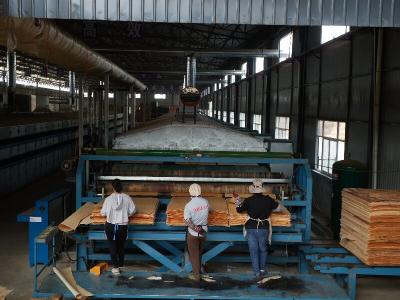
Continuous roller dryers ensure that veneers pass through each temperature zone at a uniform speed, resulting in a completely consistent thermal curve for each veneer. This leads to significantly higher drying uniformity than intermittent equipment. Shine Machinery's intelligent six-layer roller veneer dryer features a six-layer structure operating synchronously, with minimal temperature difference between layers. This results in high uniformity of moisture content within the same batch of veneers, stable batch quality, and prevents the situation of "dry upper layers and damp lower layers."
V. Choosing the Right Dryer Solves Half the Problem of Veneer Moisture Reabsorption
Veve moisture reabsorption is a systemic issue involving multiple stages such as drying, cooling, and storage, but the most crucial variable is the drying quality. Equipment with poor drying uniformity, even with the lowest possible final moisture content, cannot solve the structural problem of internal dampness and external dryness; surface dampness will still occur after the veneer leaves the machine.
Shine Machinery has focused on veneer drying equipment for many years, collaborating with German company Defenberger on technology. Its core products cover a full range of models, including six-layer roller dryers, four-layer roller dryers, fully automatic large-tiling dryers, and single-layer dryers, serving numerous plywood manufacturers both domestically and internationally.
Core Advantages of the Equipment:
- Uniform Drying: Roller drive + step-by-step heat exchange ensures uniform heating of veneers and minimal moisture content deviation.
- Energy Efficiency: Waste heat recovery system maximizes heat utilization and reduces unit drying costs.
- High Automation: Variable frequency speed control and intelligent temperature control minimize human error.
- Wide Applicability: Suitable for drying various wood species including poplar, eucalyptus, pine, and beech, with thicknesses ranging from 0.8mm to 8mm.
- Low Investment, High Output: Small footprint for equivalent capacity, resulting in lower overall operating costs compared to similar equipment.
Good equipment doesn't have to be expensive. Choosing a veneer dryer with uniform drying and stable performance may seem like an investment, but it actually guarantees the quality of every veneer – less moisture return, less waste, and more stable bonding. The savings in rework costs and quality losses far outweigh the price difference.
If your production line is also troubled by veneer moisture return and uneven drying, please contact Shine Machinery. We will provide customized veneer drying solutions based on your wood species, production capacity, and process requirements.