Español
 Русский
 Francés
 Português
 ภาษาไทย
 Indonesia
 Việt
Việt
 العربية
 Melayu

For Which Wood Species Are Veneer Dryers Suitable?
For Which Wood Species Are Veneer Dryers Suitable?
Veneer drying is a core process in the production of plywood, LVL, and decorative veneers. Wet veneers obtained from rotary cutting have extremely high moisture content; if drying is not properly controlled, defects such as warping, cracking, surface discoloration, and uneven moisture distribution can easily occur, directly affecting subsequent hot-press bonding as well as the strength and aesthetic quality of the finished panels. During the equipment selection phase, many panel manufacturers ask: exactly which wood species can a veneer dryer process?
In fact, modern continuous veneer dryers are not designed for a single wood species. Thanks to structural features such as independent temperature control across multiple zones, sectional hot-air circulation, adjustable conveyor speeds, and roller-press restraint—combined with customized drying processes—these machines can handle the vast majority of commercial hardwood and softwood veneers used in the engineered wood industry. Different species present unique drying challenges due to variations in density, fiber structure, and internal constituents (sugars, tannins, resins); consequently, equipment selection and process parameters must be tailored accordingly. Shine Machinery has specialized in the veneer drying sector for years; drawing on extensive practical experience with panel factories both domestically and abroad, the company offers a comprehensive analysis of the drying characteristics and equipment solutions for various common wood species.
I. Mainstream Fast-Growing Hardwoods: Core Raw Materials for Global Plywood Factories
Thanks to stable log supplies and excellent rotary-cutting performance, fast-growing hardwoods are currently the primary raw material for veneers in the global plywood industry and the most widely processed category for veneer dryers.
Eucalyptus
Eucalyptus is the most widely used veneer raw material in panel markets across South China, Southeast Asia, and Africa, encompassing varieties such as *Eucalyptus grandis*, *Eucalyptus dunnii*, and *Eucalyptus pellita*. Eucalyptus wood is characterized by high density and a tight fiber structure, which creates significant resistance to internal moisture migration. The primary challenge in drying is the "dry-outside, wet-inside" phenomenon: surface moisture evaporates rapidly while core moisture cannot escape in time, leading to concentrated drying stress and a high risk of veneer curling and surface cracking. For eucalyptus veneer, a roller-type veneer dryer is the preferred choice; the upper and lower rollers continuously press and constrain the veneer, preventing surface warping and deformation. A multi-zone temperature control strategy and a low-temperature, slow-drying process are employed to gently release drying stresses and balance internal and external moisture content. Eucalyptus veneer is commonly used for plywood cores and face veneers; a stable drying process effectively reduces veneer breakage rates and improves the overall yield of the production line.
Poplar
Poplar is lightweight and soft with a highly porous structure, allowing for rapid moisture migration; it is classified as an easy-to-dry species with outstanding drying productivity. It serves as a mainstream raw material in Northern my country's panel production hubs and is frequently used for the core layers of standard plywood.
The challenge in drying poplar lies not in the rate of water removal, but in the tendency for the veneer surface to become fuzzy under high-temperature, high-speed conditions, and for the veneer to become brittle and crack if over-dried. During production, hot air velocity and line speed can be moderately increased to boost output, provided the maximum drying temperature is strictly controlled to prevent damage to surface fibers. For thin poplar veneers, a mesh-belt dryer may also be used; this option entails lower equipment investment costs while meeting basic production requirements.
Rubberwood
Rubberwood is primarily sourced from retired rubber plantations in Southeast Asia; the veneer features a light color and attractive surface, making it suitable for producing furniture-grade plywood and decorative panels. Rubberwood contains high levels of sugars and proteins; rapid heating during drying can easily foster microbial growth, leading to blue stain or blackening. Additionally, wet veneer has a strong tendency to deform, making the surface prone to wavy warping during the drying process.
The key to drying rubberwood veneer lies in controlling the heating rate and avoiding rapid dehydration, ensuring the final moisture content meets standards while stabilizing the surface color. Given the high added value of rubberwood products and the strict requirements for veneer appearance, a roller dryer equipped with a precision temperature control system is recommended to minimize color variation and deformation issues.
Birch
Birch veneer features a smooth, fine-textured surface and excellent bonding properties, making it a premium raw material for face veneers in high-end plywood, LVL (Laminated Veneer Lumber), and packaging panels. Birch has a medium-to-high density and contains tannins; prolonged exposure to high temperatures triggers oxidation, causing the veneer to yellow and discolor, thereby reducing its value as a decorative surface.
Drying birch requires stable temperature control and a minimized residence time in the high-temperature zone to prioritize the visual quality of the veneer surface. Many birch veneer production lines in Russia and Eastern Europe utilize Shenghuai roller drying equipment equipped with zoned hot-air systems, balancing production output with veneer quality.
II. Other Hardwoods: Materials for High-End Decorative Veneers
In addition to the four mainstream species, hardwoods such as beech, oak, and Southwest birch can also be processed using veneer dryers. These are frequently used for high-end decorative veneers; the resulting products command high added value, necessitating greater precision in the drying process.
Beech: High density and rich in tannins; prone to discoloration at high temperatures. The drying strategy focuses on gentle, low-temperature moisture removal. High precision in temperature zoning is required, and production capacity should not be set too high, prioritizing veneer flatness and the retention of the wood's natural color.
Oak (Red Oak / White Oak): Dense and heavy wood with slow moisture release and significant drying stress, posing a high risk of veneer cracking. Drying requires reduced hot-air velocity, an extended drying cycle, and a multi-stage, gradual moisture removal process. Primarily used for high-end decorative veneers; single-line production capacity is relatively low.
Southwest Birch: Excellent dimensional stability with minimal shrinkage or deformation and a flat surface. The drying process is moderately challenging. It is a premium raw material for high-quality plywood and is compatible with standard roller drying production lines.
III. Softwood Veneers: Common Raw Materials for Construction Formwork and Structural Panels
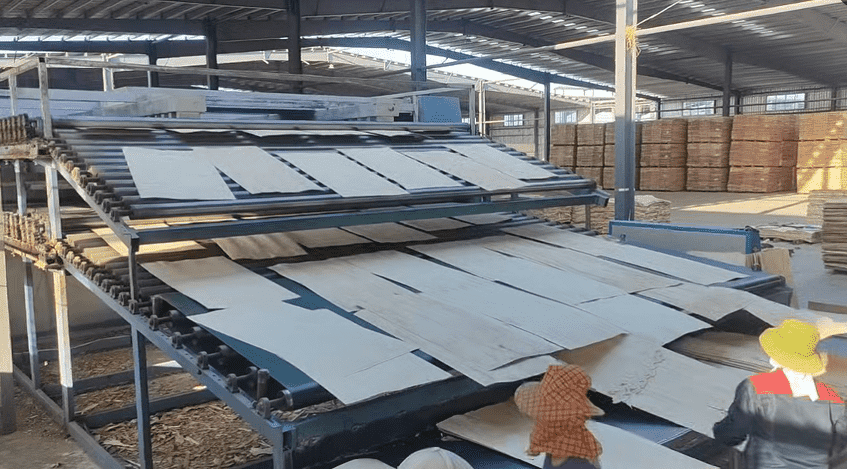
Softwood veneers—such as pine, fir, and spruce—are also suitable for continuous veneer dryers. Softwoods have a looser grain structure and allow for rapid moisture evaporation, enabling them to withstand higher drying temperatures; however, care must be taken to prevent overdrying, which can increase brittleness and cause surface crumbling. Softwood veneers are commonly used for construction formwork, packaging boards, and structural plywood. Pine veneer production can utilize high-temperature airflow for rapid dehydration, maximizing the production capacity of the entire line.
IV. Fundamental Logic for Wood Species Selection: It Is Not About "Can It Be Dried?" But Rather "How Do We Match the Process?"
Many panel manufacturers hold a common misconception: that a specific dryer is limited to drying only one type of wood. In reality, the vast majority of veneer dryers are compatible with multiple wood species; the key differences lie in the process strategy and the choice of machine structure.
Lightweight, fast-growing timber (e.g., poplar): Moisture moves quickly, allowing for higher line speeds and a focus on high output; key concerns include preventing surface fuzzing and brittleness caused by over-drying; both mesh-belt and roller-type dryers are suitable options.
Medium-to-high-density hardwoods (e.g., eucalyptus, rubberwood, birch): Moisture moves slowly, and there is a high risk of veneer curling; roller dryers featuring a roller-pressing mechanism are preferred. Zoned temperature control helps reduce drying stress, addressing issues such as cracking and discoloration.
High-density, premium hardwoods (e.g., oak, beech): These involve significant drying stress and require extremely precise temperature control; drying speeds should be moderated to prioritize the quality of the finished veneer.
When comparing machine types, roller veneer dryers offer superior resistance to warping because the rollers continuously press down on the veneer, making them ideal for species prone to curling, such as eucalyptus and rubberwood. Mesh-belt dryers are better suited for thinner veneers with a lower tendency to deform, such as poplar. Additionally, auxiliary systems—including heat sources (biomass combustion, steam, natural gas), waste heat recovery, and water-film dust removal—should be selected based on a comprehensive assessment of the wood species, local environmental regulations, and fuel costs.
V. Procurement Recommendations: Planning the Drying Line Based on Wood Species
When planning a veneer drying line, panel manufacturers should not focus solely on equipment price quotes. The primary step is to clearly define the plant's core wood species, veneer thickness range, target final moisture content, and hourly production capacity requirements. For facilities processing multiple wood species, it is advisable to incorporate flexibility into the equipment design—such as multi-zone independent temperature control and variable-speed drive systems—to facilitate seamless transitions between processing recipes for eucalyptus, rubberwood, and poplar. Shine Machinery offers comprehensive drying solutions tailored to the client's primary wood species, encompassing equipment customization, production line installation and commissioning, and on-site process training. Numerous projects have already been successfully implemented and are operating stably in regions including Guangxi and Yunnan (China), as well as in Africa, Southeast Asia, and South America.
The veneer dryer is suitable for the vast majority of commercial wood species used in the engineered wood industry. This includes mainstream hardwoods such as eucalyptus, poplar, rubberwood, and birch, as well as softwoods like pine and fir; it also supports the drying of high-end decorative veneers, such as beech and oak.
Equipment serves merely as the hardware platform; consistent veneer quality results from the optimal combination of the right machine model and a customized drying process. Only by designing a drying solution that accounts for the specific characteristics of the wood species being processed can manufacturers consistently produce high-quality veneer—characterized by uniform moisture content, a flat surface, and freedom from cracking or discoloration. This approach minimizes production waste, enhances the quality of the finished plywood, and enables manufacturers to reduce costs while increasing efficiency.