Español
 Русский
 Francés
 Português
 ภาษาไทย
 Indonesia
 Việt
Việt
 العربية
 Melayu



Why Veneer Must Be Dried And Which Veneers Require Immediate Drying After Rotary Cutting
Why Veneer Must Be Dried And Which Veneers Require Immediate Drying After Rotary Cutting
Veneer drying is a core process in plywood manufacturing; it directly determines the pass rate, appearance grade, and dimensional stability of the finished product. Before rotary cutting, logs typically undergo steaming or hydrothermal treatment to soften the wood, facilitating the production of continuous, smooth veneers. However, the resulting wet veneers generally have a moisture content of 60%–80%; without drying, subsequent production stages would face a series of quality issues.
I. Why Veneer Must Be Dried
1. Ensuring Bonding Quality and Preventing Hot-Pressing Defects
If wet veneers with high moisture content are glued and hot-pressed directly, the large amount of free water inside rapidly vaporizes upon heating. If the steam cannot escape in time, it causes blistering, delamination, and bond failure. Furthermore, excess moisture dilutes the adhesive, leading to uneven penetration and starved glue lines; this drastically reduces bonding strength, making the finished plywood prone to debonding and rejection later on. Drying controls the veneer's moisture content within the required processing range (typically 8%–12% for plywood), ensuring stable adhesive curing and enhancing bond strength.
2. Stabilizing Dimensions and Reducing Deformation in Finished Products
Wood exhibits the characteristics of swelling when wet and shrinking when dry. Uneven moisture content across veneers creates internal stresses during hot-pressing. Consequently, finished boards are prone to warping, twisting, and surface cracking when exposed to fluctuating temperature and humidity. Uniform drying ensures consistent moisture content, effectively controlling subsequent deformation and maintaining the board's flatness.
3. Preventing Mold, Blue Stain, and Discoloration
Wet veneers are rich in sugars and starch, creating an environment where mold and staining fungi can proliferate rapidly under high-temperature and high-humidity conditions. Stacking wet veneers for even a few hours can lead to blue stain, blackening, and mold growth, resulting in downgraded quality or total rejection. High-sugar wood species are particularly susceptible to acid-etching discoloration, which ruins the surface appearance and renders the veneer unsuitable for decorative use. Drying reduces the moisture content to below 20%, effectively inhibiting microbial activity and preserving the veneer's natural color.
4. Facilitates sorting, storage, and transport
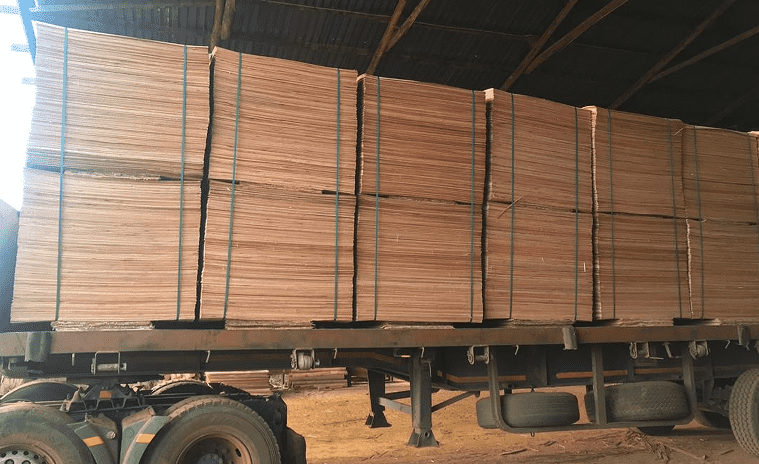
Wet veneers have low strength and a soft texture; they are prone to cracking and surface fuzzing during handling and stacking, and their edges tend to curl or break if stacked for extended periods. Dried veneers possess improved mechanical strength and a flat surface, facilitating automated sorting, splicing, warehousing, and long-distance transport, thereby reducing losses of semi-finished products.
II. Which Veneers Require Immediate Drying After Rotary Cutting?
Not all veneers must enter the dryer immediately after rotary cutting; the decision depends primarily on wood species characteristics, veneer thickness, product grade, and the workshop's temperature and humidity conditions.
1. Veneers that must be dried immediately after rotary cutting
1) Eucalyptus veneer: Eucalyptus wood is high in sugar content and contains many thin-walled cells, making wet veneer highly susceptible to blue stain and mold. In high-temperature summer workshops, blue or black stains can appear if the veneer is stacked for more than 2–4 hours after cutting. Whether for core or face veneers, immediate drying is the priority; eucalyptus is the classic example of a veneer requiring instant drying in plywood factories.
2) Rubberwood veneer: Rubberwood contains latex proteins and soluble sugars. Stacking wet green veneer leads to rapid fermentation and acid corrosion, causing the veneer to turn yellow-brown—a phenomenon known as "board burning." Once discolored, it cannot be restored. Rubberwood veneers intended for furniture-grade decorative plywood must be sent to the dryer immediately after cutting.
3) High-end decorative face veneers and thin veneers: Thin veneers (0.6–1.2 mm thick) serve as the visible surface of the finished product, requiring exceptional color purity. While thin veneers dissipate heat and lose moisture quickly, they are also more prone to mold and localized blackening. When used for high-end decorative panels, immediate drying after cutting is required to preserve the surface color. 4) Tropical wood veneers (e.g., Albasia and other fast-growing softwoods): These woods have a loose texture, high moisture content, and are rich in nutrients. In the high-temperature, high-humidity environments of southern regions and Southeast Asia, wet veneers are highly susceptible to rapid mold growth; they cannot be stored for long periods and must be sent directly to the dryer after rotary cutting.
5) All light-colored veneers during hot and humid summer conditions: High workshop humidity during the rainy season and summer necessitates shorter stacking times—even for ordinary mixed-wood veneers—to prioritize immediate drying and minimize the risk of mold.
2. Veneers suitable for short-term stacking without immediate drying
Thick core veneers made from hard mixed woods with stable texture and low sugar content can be temporarily stacked for short periods (within a few hours) in cool, dry, and well-ventilated workshops, allowing for batch drying. However, ventilation gaps must be maintained during stacking—tight stacking is prohibited—and storage time must be strictly controlled; if ambient temperatures rise, the veneers must still be dried as soon as possible. Such veneers are typically used for standard packaging boards or low-grade core boards, where surface color requirements are not strict.
III. Practical Production Guidelines
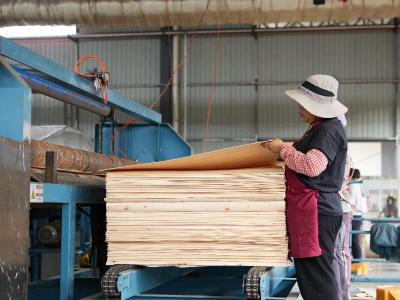
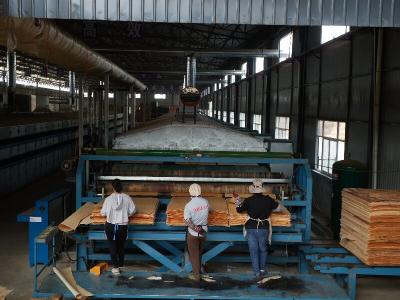
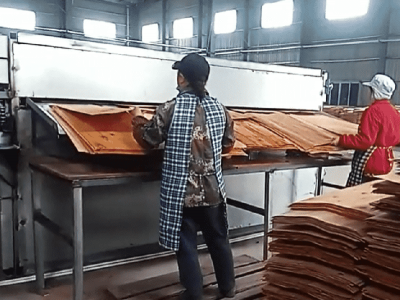
Immediate drying does not mean blindly using high temperatures for rapid drying. For veneer species prone to cracking—such as eucalyptus and rubberwood—a low-temperature, slow-drying process should be employed to balance mold prevention with crack prevention. Both roller dryers and flap-type dryers are suitable for continuous production lines that dry veneers immediately after rotary cutting. Factories must adjust drying curves based on wood species and veneer thickness; the goal is to rapidly reduce moisture content to safe levels to inhibit mold while avoiding excessive drying speeds that could cause cracking or curling.
The essence of veneer drying lies in controlling moisture content to address three key challenges: bonding issues, deformation, and mold growth. Factors such as the wood species' sugar content and the intended grade/use of the veneer determine whether immediate drying after rotary cutting is required. Eucalyptus, rubberwood, and decorative veneers are classified as high-risk categories; the "peel-and-dry" process—drying immediately after rotary peeling—is crucial for ensuring veneer yield and quality grades. Properly matching drying equipment with processing techniques is essential to minimize production losses and ensure consistent plywood quality.