Español
 Русский
 Francés
 Português
 ภาษาไทย
 Indonesia
 Việt
Việt
 العربية
 Melayu



Challenges In Drying Rubberwood Veneer And Solutions Using Roller Dryers
Challenges In Drying Rubberwood Veneer And Solutions Using Roller Dryers
With its light color, uniform grain, and excellent bonding properties, rubberwood is a preferred raw material for producing furniture-grade plywood, decorative panels, and high-end Laminated Veneer Lumber (LVL). It is widely utilized in Southeast Asian regions, including Thailand and Malaysia. However, rubberwood veneer is notoriously difficult to dry. Freshly rotary-cut rubberwood veneer is rich in starch and sugars, and its unique shrinkage characteristics mean that even minor errors in the drying process can lead to defects such as blue stain, surface warping, and uneven moisture content. These issues downgrade the veneer quality and significantly compress profit margins. Drawing on extensive experience from numerous rubberwood veneer production lines across Southeast Asia, Shine Machinery analyzes the core challenges of drying rubberwood veneer and explains how roller-type veneer dryers provide targeted solutions to ensure the consistent production of high-quality rubberwood veneer.
I. Four Core Challenges In Drying Rubberwood Veneer
Freshly rotary-cut rubberwood veneer typically has an initial moisture content of 80%–100%. Unlike poplar or eucalyptus, the primary challenges in drying rubberwood center on two main issues: biological discoloration and drying stress.
1. High Sugar and Starch Content: Susceptibility to Blue Stain, Mold, and Blackening
Rubberwood sapwood contains high levels of sugars and starch. In warm, humid environments, staining fungi proliferate rapidly, causing the veneer to develop blue stains or blacken. If the moisture content of the veneer remains above 20% for an extended period, visible discoloration can occur within just 24 hours. Once the blue stain penetrates the wood fibers, it cannot be removed by subsequent sanding; high-quality veneer—originally suitable for use as a face panel—must then be downgraded to a core veneer, resulting in a significant loss of product value.
A common drawback of natural air-drying or intermittent kiln-drying is the slow initial rate of moisture removal. This leaves the veneer in a high-humidity state for too long, keeping the risk of blue stain consistently high—a problem that is further exacerbated during the rainy season in Southeast Asia. 2. High susceptibility to wavy curling and edge warping during the drying process
Rubberwood veneers exhibit significant lateral drying shrinkage, leading to uneven contraction across the surface during dehydration. In the absence of external restraint, these veneers are highly prone to developing wavy distortions or "wavy edges." Such curled veneers result in poor joint alignment during subsequent edge-gluing or layup processes, leading to internal voids, delamination, or blistering after hot pressing. In severe cases, warped veneers cannot even proceed to the next stage of production and must be discarded. Mesh-belt dryers, which rely solely on a mesh belt to support the veneers—lacking continuous roller pressure—struggle to effectively control the warping and deformation of rubberwood veneers.
3. Rapid temperature increases can cause "case hardening" and moisture imbalances
Due to the unique fiber structure of rubberwood, applying high-temperature, high-intensity hot air at the start of the drying process causes rapid moisture evaporation from the surface. This leads to premature shrinkage of the surface fibers and the closure of wood pores, creating a "hardened shell" (case hardening). This shell traps internal moisture, preventing it from migrating outward and resulting in a state where the exterior is dry while the interior remains damp. Such veneers harbor significant internal drying stress, which can lead to secondary deformation or cracking during storage; finished panels produced from these materials are also highly prone to warping and bond failure. To ensure the required quality, a gradual, multi-stage dehydration process is essential.
4. Strict requirements for moisture uniformity and challenges in color consistency control
Rubberwood is frequently used for furniture-grade plywood, which demands high consistency in both veneer color and moisture content. The final moisture content is typically controlled within the 8%–12% range, with variations across an entire batch kept within ±2%. Excessive fluctuations in moisture content not only compromise bonding strength but also cause uneven coloration across the panel surface, negatively affecting its aesthetic appearance. In traditional static drying kilns, where veneers are stacked, hot-air penetration is poor. This results in significant moisture disparities between individual veneers, making it difficult to consistently meet the stringent requirements for high-end panel production.
II. Roller-Type Veneer Dryer: A Comprehensive Solution Tailored For Rubberwood
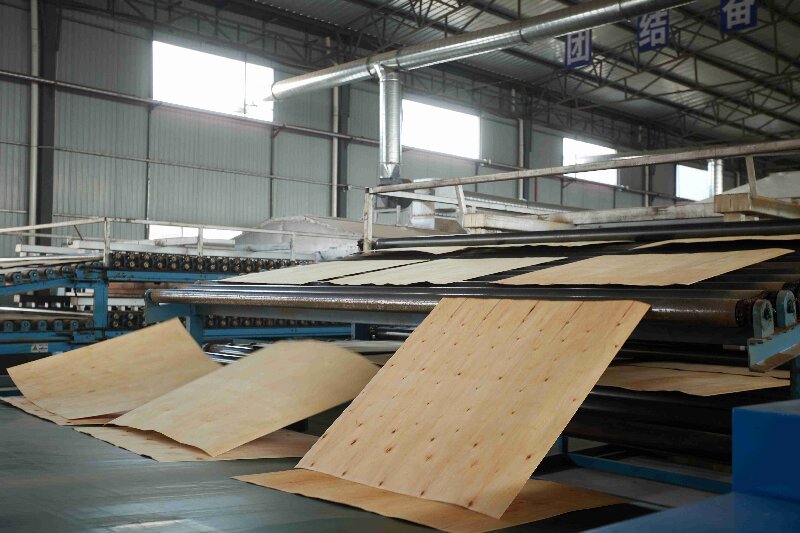
The core advantages of a roller-type veneer dryer—combining roller-press stabilization, multi-zone temperature control, and continuous hot-air circulation—effectively address the primary challenges in drying rubberwood veneer. It has become the preferred choice for rubberwood processing plants across Southeast Asia.
1. Continuous Roller-Press Conveying: Preventing Curling and Wavy Edges
Equipped with pairs of upper and lower pressure rollers, the dryer keeps the veneer surface firmly and evenly compressed throughout the entire drying process. As the veneer loses moisture and shrinks, the rollers restrict free deformation, fundamentally preventing issues like wavy warping or one-sided curling. Even with thin rubberwood veneers, the output remains perfectly flat, ensuring seamless edge-joining and enhancing the density and flatness of the final plywood product.
The pressure applied by the rollers can be flexibly adjusted based on veneer thickness: lower pressure is used for thin veneers to avoid indentation, while higher pressure is applied to thicker veneers, ensuring both a high-quality surface finish and effective shape stabilization.
2. Multi-Zone Temperature Control: Low-Temperature Pre-Drying to Prevent Surface Hardening
The equipment is divided into independent temperature-controlled zones, aligning with the "gradual-to-stable" drying requirements of rubberwood.
The first stage serves as a low-temperature preheating zone, gently removing free surface moisture and rapidly reducing the moisture content to below 20%. This eliminates the conditions necessary for the survival of blue-stain fungi, thereby preventing mold and discoloration. In the middle stages, the temperature is gradually increased to steadily release internal moisture, preventing the surface from drying too quickly—which would otherwise seal the pores and lead to the "dry-outside, wet-inside" problem.
The final stage acts as a constant-temperature equalization zone, balancing the moisture content across the entire veneer and relieving residual drying stress. This multi-stage process avoids aggressive, high-temperature drying, which reduces the risk of cracking. Furthermore, it preserves the natural, light-colored aesthetic of the rubberwood, minimizes color variation, and maintains the high value of the veneer for use as a face layer. 3. Continuous Hot-Air Circulation: Reducing High-Humidity Exposure to Prevent "Blue Stain"
Rubberwood veneers, once rotary-cut, can be fed directly into a roller dryer, eliminating the need for prolonged stacking. Within the enclosed dryer, a continuous flow of hot air rapidly removes moisture from the veneer surfaces. This minimizes the time veneers spend in a high-risk, high-humidity environment—effectively inhibiting sugar oxidation and microbial growth, thereby reducing the likelihood of "blue stain."
The system includes a waste-heat recovery unit that captures heat from the exhaust air to preheat the incoming air, stabilizing the drying process while lowering fuel consumption. Furthermore, the integration of a biomass burner—well-suited to the fuel landscape in Southeast Asian manufacturing hubs—ensures manageable operating costs.
4. Stepless Speed Control & Online Moisture Monitoring: Ensuring Consistent Moisture Content
Equipped with a variable-frequency drive (VFD) for stepless speed control, the dryer allows for flexible adjustment of the veneer’s residence time based on factors such as log quality, veneer thickness, and initial moisture content. An integrated online moisture-monitoring module tracks the moisture levels of the veneers as they exit the machine. The system dynamically fine-tunes temperatures and conveyor speeds across different zones, keeping moisture-content variance within strict process specifications and minimizing the errors often associated with manual sampling.
III. Practical Advice For Selecting Rubberwood Drying Equipment
Opt for a roller-type veneer dryer: Because rubberwood is highly prone to warping, mesh-belt dryers—which are better suited for wood species with lower deformation risks—are not recommended as the primary drying solution for rubberwood veneer production lines.
Process Configuration: Prioritize equipment that features independent temperature control across multiple zones, and ensure the inclusion of a low-temperature pre-drying section; avoid the common pitfall of prioritizing high temperatures solely to increase processing speed.
Managing the Rainy Season: In Southeast Asia, high ambient humidity during the rainy season necessitates an optimized hot-air circulation and exhaust system to prevent veneers from re-absorbing moisture after exiting the dryer.
Heat Source Selection: Biomass burners are the industry standard for rubberwood processing plants overseas. When paired with a water-film dust removal system, they ensure compliance with local environmental emission regulations.
IV. Overall Value: Drying Quality Determines The Grade Of Rubberwood Veneers
The profit margins for rubberwood products are primarily driven by the grade of the veneers. There is a significant price gap between standard core veneers and furniture-grade panels. If the drying process is inadequate, issues such as blue stain, warping, and uneven moisture content can occur, forcing the product to be downgraded and sold at a lower price. In contrast, a stable roller-drying process can drastically reduce waste, preserve the original color and flatness of rubberwood veneers, and provide the necessary quality for high-end furniture panel production.
Shine Machinery has successfully implemented projects across various rubberwood-producing regions in Thailand and Malaysia. Beyond supplying drying equipment, the company provides specialized process tuning for rubberwood and on-site staff training, helping manufacturers minimize veneer defects and increase yield.
The primary challenges in drying rubberwood veneers lie in preventing blue stain, controlling warping, and ensuring uniform moisture content. Traditional methods—such as air-drying or intermittent kiln-drying—cannot simultaneously meet the requirements for continuous production capacity, surface flatness, and color consistency. Roller-type veneer dryers address these issues through a combination of continuous roller-pressing (which sets the shape), multi-zone temperature control, and consistent hot-air drying. This approach is specifically tailored to the drying characteristics of rubberwood: it shortens the time veneers spend in high-humidity conditions, inhibits blue stain and warping, evenly releases drying stress, and ensures a stable output of high-quality veneers.
For enterprises establishing production lines for rubberwood furniture panels, selecting a roller-type veneer dryer optimized for rubberwood processing is a critical step toward maintaining high veneer grades, reducing production losses, and increasing the value-added potential of the final products.