Español
 Русский
 Francés
 Português
 ภาษาไทย
 Indonesia
 Việt
Việt
 العربية
 Melayu

Is Increasing Automation Level Simply About Saving Labor?
Is Increasing Automation Level Simply About Saving Labor?
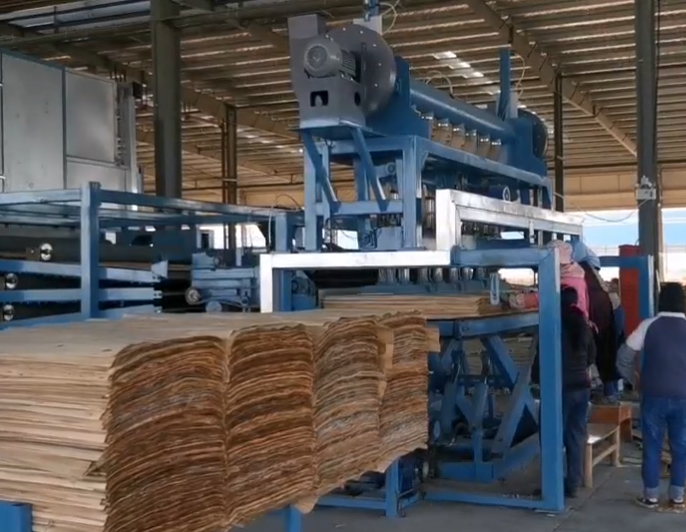
Improving the automation level of veneer dryers goes beyond simply saving labor; it's a core upgrade for board quality and production efficiency.
We often hear customers say, "Isn't adding automation to veneer dryers just about hiring fewer workers and saving on labor costs?" As a manufacturer specializing in the R&D, production, and customization of veneer drying equipment, we firmly believe this is the most superficial and one-sided understanding of veneer drying automation upgrades. Veneer drying is a crucial link in the wood processing industry chain, directly determining the yield, flatness, bonding strength, and subsequent processing value of boards. The core of automation upgrades is never simply replacing manual labor, but rather solving the various problems inherent in traditional manual drying. From four dimensions—quality stability, energy consumption control, production efficiency, and risk prevention—we build a solid foundation for the profitability of wood processing plants and board manufacturers. This is the original intention behind our focus on developing highly automated veneer dryers.
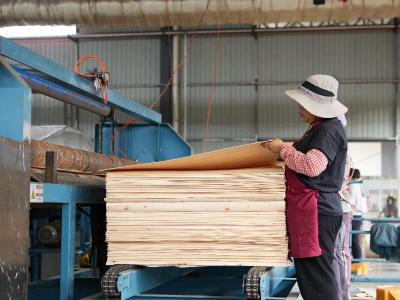
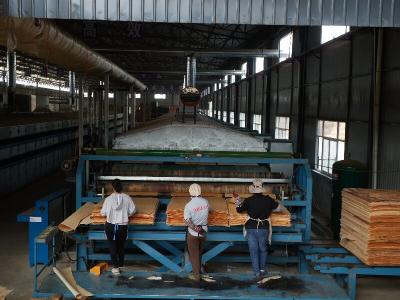
Undeniably, saving labor costs is the most direct and obvious advantage of veneer dryer automation upgrades, but it is by no means the core value. Traditional veneer drying relies entirely on manual operation, a typical labor-intensive process: manual loading and unloading, manual adjustment of drying temperature and humidity, timed plate turning for temperature control, and constant monitoring. A medium-sized veneer drying kiln requires at least 2-3 skilled workers working in shifts, while large production lines require dedicated drying teams. Labor costs, accommodation, and management expenses remain high throughout the year. Shortages of skilled workers and staff turnover can directly disrupt production schedules. Automated veneer dryers completely break the traditional "man-to-kiln, man-to-machine" model. From veneer feeding, stacking and conveying, closed-loop temperature and humidity control, dehumidification and ventilation, drying completion and automatic shutdown, the entire process is unmanned and automated. Small and medium-sized veneer factories can directly reduce 1-2 dedicated drying workers, and large-scale production line teams can be reduced by half. This not only saves significant fixed labor costs but also completely solves the production problems caused by difficulty in recruiting skilled workers and staff turnover. This is just the basic benefit of automation; it is far from its full value.
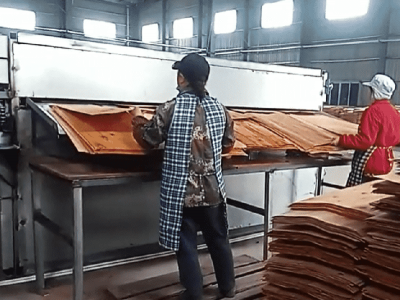
For the veneer drying industry, the core significance of automation upgrades lies in achieving standardized drying quality throughout the entire process, completely eliminating board loss caused by manual operation—a level of stability that manual operation can never achieve. Due to the unique properties of wood veneer, the control of moisture content, temperature gradient, and dehumidification rhythm directly impacts the quality of the finished product. Traditional manual drying relies entirely on the experience of experienced workers, lacking standardized processes and resulting in significant errors: the drying effect of the same batch of veneer differs significantly between day and night, and the pass rate of finished products varies greatly depending on the worker's operation; inaccurate temperature control can easily lead to veneer cracking, deformation, warping, and excessive internal stress; untimely dehumidification can cause veneer to mold and become damp; and insufficient moisture content prevents subsequent gluing and pressing processes, requiring either scrapping or rework, significantly increasing production costs.
Shine Machinery's highly automated veneer dryer is equipped with a dedicated intelligent drying control system and high-precision temperature, humidity, and moisture content sensors. It features preset drying process curves tailored to the characteristics of various wood veneers such as pine, poplar, and eucalyptus, achieving precise closed-loop control throughout the entire process. Temperature control error is kept within ±1℃, and moisture content adjustment accuracy reaches ±1%. The equipment automatically adjusts heating power, dehumidification frequency, and fan speed based on the real-time moisture content of the veneer and the temperature inside the dryer, avoiding sudden temperature changes, over-drying, or under-drying. No manual intervention is required throughout the process. This standardized process ensures that each batch of veneers has uniform moisture content, a flat surface, and is free of cracks and deformation. The finished product qualification rate is increased from 75%-85% with traditional manual drying to over 98%, significantly reducing waste and substandard boards. A single unit can reduce economic losses from board waste by tens of thousands of yuan annually. This is the core incremental value that automation creates for customers.
Automation upgrades further enable precise energy consumption optimization and a doubling of production capacity, solving the industry pain points of "high energy consumption and low efficiency" in veneer drying. Veneer drying itself is energy-intensive, and traditional manual operation often results in energy waste: untimely manual adjustments lead to excessively high internal temperatures and excessive dehumidification, causing significant waste of gas, electricity, and heat; chaotic manual loading and unloading rhythms result in long periods of equipment idling and intermittent downtime, prolonging the drying cycle and hindering capacity growth. Data shows that traditional manual veneer dryers account for 20%-30% of ineffective energy consumption, with long drying cycles and low unit capacity directly squeezing company profits.
Automated, interconnected loading, unloading, and conveying equipment enables 24-hour continuous operation, eliminating idle time for manual material changes and parameter adjustments. Veneer drying cycles are shortened by 20%-40%, and daily drying capacity increases by over 30% with the same space and number of equipment. Especially during peak seasons for veneer processing, it allows for rapid response to order demands, avoiding delivery delays due to low drying efficiency and helping companies seize market share.
Furthermore, automation upgrades strengthen production safety, achieve digital upgrades in production management, and mitigate various potential risks. Traditional veneer drying relies on manual supervision. Abnormalities such as excessively high kiln temperatures, gas leaks, material jams, and fan malfunctions are difficult for humans to detect in time. These can range from minor damage to drying equipment and burning of veneers to serious safety accidents causing significant economic losses. Automated veneer dryers, on the other hand, have a built-in comprehensive safety early warning and protection system that monitors equipment operating parameters, kiln conditions, gas concentration, and material transport status in real time. Once an abnormality is detected, an audible and visual alarm is triggered, preventing over 90% of production risks and reducing equipment maintenance and material waste.
For large-scale veneer manufacturers, automated veneer dryers are also equipped with cloud-based data management. The drying time, temperature and humidity parameters, moisture content data, and energy consumption for each batch of veneers are automatically recorded and stored. Production reports can be exported at any time, facilitating cost accounting, quality control, and production traceability. Multiple machines can be remotely and centrally managed, eliminating the need for on-site personnel and making production management more standardized and efficient, completely eliminating the extensive management model of traditional manual drying.
As a professional veneer dryer manufacturer, Shine Machinery's development of automated equipment is not merely a gimmick to create "unmanned" operations, but rather a genuine focus on addressing the actual production pain points of wood processing enterprises. We use technological upgrades to solve four major problems: unstable quality, high energy consumption, low efficiency, and reliance on manual labor. We have seen too many panel manufacturers suffer from high losses and defective products due to large errors in manual drying; their profits are constantly squeezed due to high energy consumption; and they miss out on large orders due to insufficient efficiency. Highly automated veneer dryers are the core solution to these dilemmas.
Saving labor is merely an added advantage of automation. Its true value lies in making veneer drying quality more stable, production costs lower, capacity efficiency higher, and production operations safer. In the future, we will customize automated drying equipment to better meet the needs of different wood materials and production scales, helping every wood processing customer achieve quality improvement, cost reduction, and efficiency enhancement through technological upgrades, thus gaining a long-term competitive advantage in the industry.