Español
 Русский
 Francés
 Português
 ภาษาไทย
 Indonesia
 Việt
Việt
 العربية
 Melayu

How A Veneer Dryer Works?
Many customers only know that veneer dryers can dry and dehydrate wet veneers, but they are unclear about the internal operating logic, drying principle, and complete workflow of the equipment. As a professional veneer dryer manufacturer, today we will provide a simple and comprehensive breakdown of the working principle and operation process of a veneer dryer, allowing you to thoroughly understand how wet veneers are dried efficiently, evenly, and without deformation.
Simply put, the core working logic of a veneer dryer is continuous hot air convection dehydration. Relying on precise mechanical transmission, hot air circulation, and temperature-controlled exhaust systems, it achieves automated closed-loop operation with uniform feeding of wet veneers, uniform heating on both sides, rapid moisture evaporation, and timely removal of moisture. This completely solves industry pain points such as low efficiency, uneven moisture content, veneer cracking and deformation, and significant susceptibility to weather conditions associated with traditional sun-drying.
I. Core Working Principle of the Equipment
The veneer dryer abandons the traditional static drying mode and adopts dynamic double-sided hot air jet drying technology. The equipment heats air through a heat source system, then a high-pressure centrifugal fan delivers the constant-temperature hot air to the upper and lower air chambers of the machine. This hot air is then sprayed vertically at a constant speed onto the upper and lower surfaces of a uniformly moving veneer through dense, precise nozzles.
The high-speed, high-temperature hot air quickly breaks through the saturated water vapor layer on the veneer surface, disrupting the moisture balance and allowing heat to rapidly penetrate the veneer's interior. This promotes the evaporation of free and adsorbed water layer by layer. Simultaneously, the equipment's exhaust system continuously removes high-humidity exhaust gas from the machine, further reducing the humidity within the drying chamber and creating a high-temperature, low-humidity, highly efficient drying environment. This fundamentally improves drying efficiency and ensures uniform moisture content in the veneers.
To adapt to different board characteristics, the equipment can precisely control the hot air temperature, wind speed, and transmission speed based on veneer thickness, wood species, and initial moisture content. This avoids problems such as veneer cracking, warping, and surface hardening caused by high-temperature rapid drying, achieving flexible drying operations.
II. Four Core Systems Supporting Stable Drying Operations
The efficient operation of the veneer dryer relies on the coordinated efforts of four core systems. Each system has a clear division of labor and operates in tandem, forming a complete drying system:
1. Heat Source Supply System
As the energy core of the drying operation, mainstream veneer dryers are compatible with various heating methods, including steam heating, thermal oil heating, natural gas heating, biomass heating, and electric heating, meeting the energy configuration needs of different plant areas. The system is equipped with steel-aluminum composite rolled radiators, which offer high heat exchange efficiency, rapid heating, and uniform heat distribution, continuously providing a stable heat source to the drying chamber, ensuring a constant drying temperature and avoiding drying defects caused by excessive temperature differences.
2. Uniform Speed Transmission System
Utilizing an upper and lower roller transmission structure, the system relies on a chain to drive the roller group synchronously. The upper roller's own weight applies pressure, while the lower roller provides fixed support, allowing for stable clamping and uniform forward conveying of the veneers. The transmission speed supports stepless speed regulation, which avoids incomplete drying due to excessive speed and over-drying of the boards due to excessive slow speed, resulting in wasted time and energy. This ensures that each board receives consistent heating time in the drying chamber, guaranteeing uniform batch drying quality.
3. Hot Air Circulation Drying System
This is the core functional system of the drying operation. A high-pressure centrifugal fan precisely delivers the heated air to the upper and lower air chambers, forming a full-coverage hot air layer through densely distributed nozzles, achieving double-sided heating of the boards without dead angles. The equipment adopts a straight airflow circulation design, resulting in extremely high hot air utilization and effectively reducing heat loss. Simultaneously, the high-speed airflow continuously removes moisture evaporated from the board surface, accelerating the dehydration process.
4. Intelligent Temperature and Exhaust System
Equipped with an intelligent electronic control system, it can monitor the temperature and humidity data inside the drying chamber in real time and automatically adjust the heating power and exhaust valve opening. When the humidity inside the machine is too high, the exhaust fan automatically increases to quickly remove humid exhaust gas; when the temperature is too low, it automatically replenishes heat, always maintaining optimal drying conditions. Frequent manual intervention and adjustment are unnecessary, significantly reducing labor costs.
III. Complete Workflow: From Wet Veneer to Finished Dry Veneer
The veneer dryer operates fully automatically and continuously, with a simple and smooth process, specifically divided into four main steps:
1. Standardized Feeding and Uniform Conveying
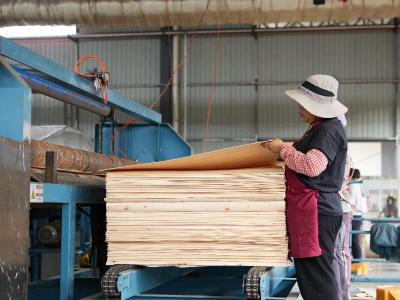
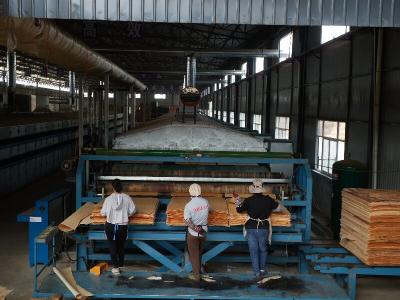
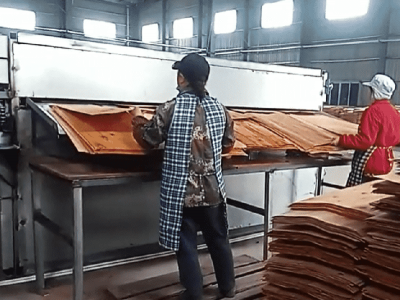
Workers lay the cut wet veneers flat at the equipment's feed end. No complex fixing is required; the upper and lower drive rollers automatically clamp the veneers and smoothly feed them into the drying chamber. The equipment supports continuous feeding, enabling uninterrupted production line operation and adapting to the needs of large-volume board drying production.
2. Preheating and Penetrating Heat Conduction
After entering the drying chamber, the veneers first enter the preheating stage. Gentle hot air gradually raises the overall temperature of the veneer, softening the wood fibers and preventing rapid surface drying and internal moisture buildup caused by sudden high temperatures. This avoids problems like cracking and uneven drying, laying the groundwork for subsequent deep dehydration.
3. Constant Temperature Dehydration and Rapid Air Drying
This is the core stage of drying. Constant temperature hot air continuously sprays the veneer from both sides, rapidly vaporizing the internal moisture while the surface moisture is quickly carried away by the high-speed hot air. For veneers of different thicknesses and wood species, the equipment automatically matches the constant temperature drying parameters, precisely controlling the dehydration speed to ensure simultaneous evaporation of moisture inside and outside the veneer, resulting in a uniform moisture content.
4. Cooling and Unloading, Finished Product Formation
After drying, the veneers are conveyed to the unloading end by the transmission system. After natural cooling and shaping, they are unloaded. The finished veneers have a uniform moisture content, a flat surface, and are free of cracks and warping. They can be directly processed into subsequent steps such as gluing, hot pressing, and splicing, effectively improving the quality and utilization rate of the finished product.
In summary, the essence of a veneer dryer is to achieve automated dehydration of wood veneers at a uniform speed, in a gentle manner, and with high efficiency through the precise coordination of mechanical transmission, hot air circulation, and intelligent temperature control. The entire workflow balances drying efficiency and board quality, making it perfectly suited for various wood processing scenarios, including plywood, furniture veneer, and construction formwork.