Español
 Русский
 Francés
 Português
 ภาษาไทย
 Indonesia
 Việt
Việt
 العربية
 Melayu

Why Are More And More Companies Transitioning From Natural Sun-drying To Using Veneer Dryers?
In the wood processing industry, including plywood, construction formwork, and furniture panels, veneer drying is a core process that determines product quality, production efficiency, and company profits. In the past, small and medium-sized panel manufacturers generally used natural sun-drying, which became the mainstream choice due to its zero equipment investment and simple operation. However, with the development of the panel industry towards large-scale, standardized, and refined production, market competition has become increasingly fierce. Coupled with tightening environmental policies and higher delivery requirements, the shortcomings of the traditional natural sun-drying method have become increasingly apparent. Today, more and more wood companies are proactively phasing out traditional sun-drying processes and fully switching to industrial veneer dryers for drying operations. This is not only an upgrade of production equipment but also an inevitable trend for high-quality development in the industry.
I. Inherent Shortcomings of Traditional Natural Sun-Drying, Restricting the Large-Scale Development of Enterprises
Natural sun-drying relies on sunlight, wind, and natural airflow to evaporate moisture from the veneer. It requires no energy-consuming equipment and seems to be low-cost, but it has many unavoidable inherent defects and is no longer suitable for the needs of modern panel production, becoming a core bottleneck for enterprise development.
First, production efficiency is extremely low, entirely dependent on weather conditions. Freshly rotary-cut veneers have a moisture content as high as 60%–80%, requiring several days or even weeks under natural conditions to reach the production standard moisture content. The drying speed is entirely determined by sunlight, temperature, humidity, and wind. During rainy seasons, cloudy days, and cold autumn and winter weather, high air humidity and slow evaporation significantly extend the drying period, sometimes even resulting in prolonged periods without drying. This extreme uncertainty makes it impossible for companies to develop stable production plans, frequently leading to order delays and production halts, severely restricting capacity release. Especially in rainy southern regions and frigid northern winters, natural drying experiences several months of inefficiency or even shutdown each year, resulting in a significant waste of factory space and human resources.
Second, poor drying uniformity leads to a persistently high product defect rate. Natural drying is an uncontrolled drying method, resulting in uneven exposure to sunlight and wind for the veneers, with significant differences in moisture evaporation rates between the surface and interior, and between the edges and center. Excessive drying on the sun-facing side and delayed drying on the shaded side can easily cause stress imbalance within the veneer, ultimately leading to quality problems such as warping, deformation, cracking, and bulging. Furthermore, the initial moisture content of different logs and veneers from different batches can vary drastically by a ratio of 2:1. Natural drying cannot specifically adapt to drying requirements, resulting in inconsistent moisture content in the finished veneer and extremely poor stability. Veneer with substandard moisture content, when used for gluing and pressing, will cause problems such as uneven glue penetration, insufficient curing, and insufficient bond strength, directly reducing the quality of the plywood and formwork, and increasing rework and scrap costs.
In addition, there are high site and labor costs and significant resource waste. Natural drying requires large open-air areas for stacking veneers; large-scale production enterprises need to occupy several acres or even tens of acres of land, resulting in extremely low site utilization. At the same time, drying, turning, collecting, and rain protection all rely on manual labor, which is labor-intensive and costly. In the event of sudden rainfall, if the veneers are not collected in time, they will become damp, moldy, blackened, and deteriorate, rendering them unusable and resulting in raw material losses. Furthermore, prolonged exposure to the open air and storage makes the veneers prone to dust and impurities, fostering mold growth and further affecting product appearance and lifespan.
Finally, it does not meet environmental protection and standardized production requirements. Traditional open-air drying easily leads to veneers soaking in wastewater and accumulating dust, failing to meet factory clean production standards. With increasingly stringent environmental regulations, the extensive drying method has been gradually standardized and rectified, becoming a major hidden danger for enterprises' compliant production.
II. Industrial Drying Machines: Solving Industry Pain Points and Reshaping Production Advantages
Compared to the passive production of natural drying, veneer dryers achieve automated, controllable, and standardized drying. From multiple dimensions such as efficiency, quality, cost, and compliance, they completely solve the drawbacks of traditional processes, becoming an essential piece of equipment for modern panel manufacturers. Biomass veneer dryers, in particular, are widely recognized in the industry due to their low energy consumption and high capacity.
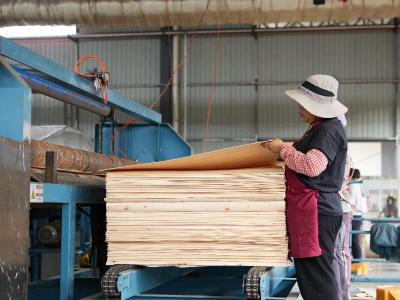
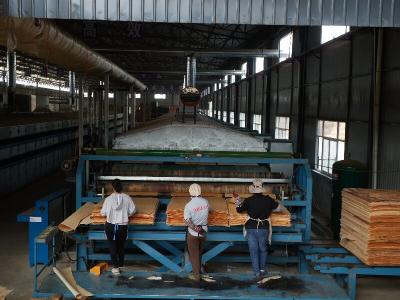
In terms of production efficiency, dryers completely eliminate the constraints of weather. The equipment utilizes a constant temperature and humidity circulating hot air system to controllably accelerate the evaporation of moisture from veneers, compressing the drying cycle from several days to tens of minutes. This allows for continuous 24-hour production, unaffected by seasons, weather, or day/night cycles. The equipment boasts an hourly capacity of 2-5 tons, significantly increasing production line throughput, completely eliminating capacity bottlenecks in the drying process, ensuring on-time order delivery, and facilitating large-scale production for enterprises.
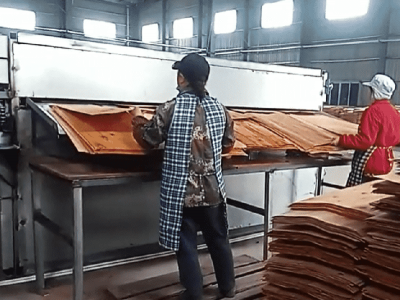
Regarding product quality, the dryer achieves precise and uniform drying. The modern veneer dryer employs a closed-loop hot air circulation structure, ensuring uniform and stable temperature, humidity, and airflow within the furnace. Drying parameters can be precisely adjusted based on veneer thickness, wood material, and initial moisture content. The equipment evenly removes internal moisture from the veneer, avoiding uneven drying and effectively preventing defects such as warping, cracking, deformation, and mold. This ensures that the moisture content of each batch of veneer is consistently controlled within the standard range of 6%-10%. This uniform and stable moisture content significantly improves the bonding performance of the boards, enhancing the strength and stability of the finished boards, helping enterprises produce high-quality, high-specification products, and improving market competitiveness.
In terms of operating costs, the dryer achieves long-term cost reduction and efficiency improvement. On the one hand, the equipment is highly automated, eliminating the need for extensive manual handling of boards, significantly reducing labor costs; it also eliminates the need for large drying areas, greatly saving factory land resources and improving site utilization. On the other hand, energy-saving equipment, represented by biomass dryers, relies on low-cost biomass fuel for heating, resulting in energy costs far lower than traditional drying equipment and extremely low overall operating costs. Simultaneously, the precise and controllable drying mode significantly reduces board scrap rates and raw material loss, leading to long-term comprehensive economic benefits far exceeding those of natural sun drying.
Regarding production compliance and management, the closed-loop drying mode is clean and environmentally friendly, producing no wastewater or dust pollution, meeting environmental production standards, and helping enterprises pass environmental acceptance and achieve standardized production. The standardized equipment operation mode makes the production process controllable and quality traceable, adapting to the standardized and refined management needs of the modern board industry.
III. Industry Upgrading is an Inevitable Trend, and Drying Equipment Becomes a Core Competitive Advantage for Enterprises
Currently, the wood-based panel industry has long since moved beyond the extensive, small-workshop production model. Market demands for precision, stability, and environmental friendliness in wood-based panels continue to rise, shifting industry competition from "capacity competition" to "quality and efficiency competition." The randomness, inefficiency, and low-quality defects of natural sun-drying are no longer suitable for the production needs of high-end wood-based panels, nor can they support the long-term stable development of enterprises.
The widespread adoption of veneer dryers represents not only an upgrade in production technology but also an enhancement of core competitiveness for enterprises. Stable quality, high-efficiency capacity, controllable costs, and compliant production models help enterprises accurately connect with high-end orders, stabilize customer resources, and gain an advantage in fierce market competition. In particular, biomass veneer dryers, balancing high-efficiency capacity, high-quality output, and energy conservation, perfectly meet the production needs of large and medium-sized plywood production lines, becoming the mainstream choice for industry upgrading.
The shift from natural sun-drying to mechanical drying is an inevitable result of the iterative upgrading of the wood processing industry. Traditional sun-drying, with its uncertainties, high losses, and low efficiency, is no longer suitable for modern production. Veneer dryers, on the other hand, perfectly address these industry pain points with their multiple advantages: all-weather operation, uniform drying, high-quality finished products, cost reduction and efficiency improvement, and green compliance. In the future, as industry standardization continues to improve, mechanical veneer drying technology will fully replace traditional sun-drying, becoming a core guarantee for stable production, improved quality, increased efficiency, and long-term development for panel manufacturers.