Español
 Русский
 Francés
 Português
 ภาษาไทย
 Indonesia
 Việt
Việt
 العربية
 Melayu


Shine Veneer Dryer’s Waste Heat Recovery System: A Game-Changer in Energy Efficiency and Cost Reduction
In the competitive world of wood processing, where energy costs and environmental regulations are tightening like never before, innovation is no longer a luxury—it is a necessity. One company that has taken this challenge head-on is Shine Machinery, a leading manufacturer of wood drying solutions. Their latest advancement—the Shine Veneer Dryer’s integrated waste heat recovery system—is turning heads across the timber, plywood, and engineered wood industries.
While many dryers on the market rely solely on biomass combustion or fossil fuels, Shine has gone a step further. In addition to its own high-efficiency biomass burner, the Shine Veneer Dryer now comes standard with a closed-loop thermal recycling system that captures, filters, and reuses the residual heat from the veneer drying process itself. The result? Dramatically reduced operating costs, lower carbon emissions, and a faster return on investment for manufacturers worldwide.
This article explores the technology behind Shine’s heat recovery system, its economic and environmental impact, real-world performance data, and why industry experts are calling it “the most sensible innovation in veneer drying in a decade.”
1. The High Cost of Drying: A Persistent Industry Problem
Drying green veneer—freshly peeled from logs—is one of the most energy-intensive steps in wood panel production. Veneer typically enters the dryer with a moisture content of 80–120% (dry basis) and must exit at 8–12% for gluing and pressing. Achieving this reduction requires enormous amounts of heat, traditionally supplied by:
Biomass boilers (burning bark, sawdust, or wood chips)
Natural gas or propane burners
Thermal oil or steam systems
In conventional veneer dryers, a large portion of that heat—often 40% to 60%—is simply exhausted into the atmosphere as hot, humid air. This is not only wasteful but also adds to the facility’s carbon footprint and operating budget.
“For years, the industry accepted that drying heat is single-use,” says Mark Hanford, a senior process engineer with 25 years in wood products. “You burn fuel, you heat air, you dry the veneer, and you vent the moist, warm air out a stack. No one seriously tried to recover that heat because of the challenges—corrosion, fouling from wood resins, and low-temperature differentials.”
Shine Machinery has now proven that those challenges can be overcome.
2. The Shine Veneer Dryer: Built for Efficiency from the Ground Up
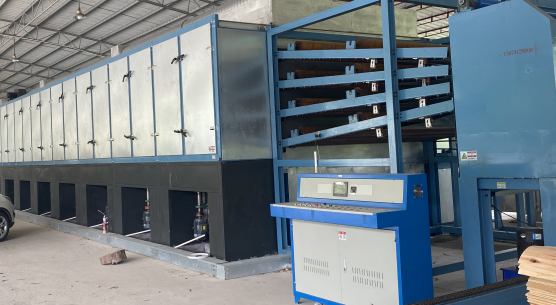
Before examining the heat recovery system, it is important to understand the base platform. The Shine Veneer Dryer is a multi-zone, jet-impingement dryer designed for high-capacity production lines (typically 20,000–80,000 m³/year). Key features include:
Modular design (lengths from 8 to 40 meters)
Stainless steel internal components for corrosion resistance
Variable-speed fans for precise airflow control
PLC-based automation with remote monitoring
Unlike retrofit solutions, Shine’s heat recovery system is fully integrated into the dryer’s original design. This means that every duct, fan, and heat exchanger is sized and positioned to maximize recovery without compromising drying uniformity or speed.
2.1 The Biomass Burner Foundation
The dryer’s primary heat source is Shine’s own biomass burner, which can run on wood residues with a moisture content of up to 45%. The burner feeds heated air into the dryer’s multiple zones at temperatures ranging from 160°C to 220°C (320°F–428°F), depending on veneer thickness and species.
This alone is more efficient than gas or oil, but Shine did not stop there. The engineering team realized that even after the hot air passes through the veneer and becomes saturated with moisture, it still carries significant sensible and latent heat—typically 90°C to 120°C (194°F–248°F) at the exhaust.
Capturing that heat is the essence of the Shine system.
3. How the Shine Heat Recovery System Works
The waste heat recovery system on the Shine Veneer Dryer is a recuperative indirect heat exchanger network. It consists of four main stages:
Stage 1: Exhaust Collection and Filtration
Warm, moisture-laden air from the dryer’s final zone is drawn through a multicyclone filter to remove wood dust, resin particles, and fiber fragments. This step is critical because unfiltered exhaust would quickly foul heat exchanger surfaces.
Stage 2: Primary Heat Exchanger (Air-to-Air)
The filtered exhaust passes through a cross-flow or finned-tube heat exchanger, where it transfers heat to fresh incoming ambient air. This preheated fresh air is then sent to the biomass burner’s combustion air intake, reducing the fuel needed to reach target drying temperatures.
Performance data from Shine’s in-house tests show that this preheating alone reduces biomass consumption by 12–18%.
Stage 3: Secondary Heat Exchanger (Air-to-Water or Air-to-Thermal Oil)
For facilities with additional heat demands (e.g., veneer preheating, building heating, or hot water for glue preparation), Shine offers an optional liquid-coupled recovery loop. Here, the exhaust air (still at 60–80°C after the first exchanger) heats water or thermal oil, which can be stored in insulated tanks for later use.
This secondary recovery can capture an additional 20–25% of the exhaust’s original energy content.
Stage 4: Recirculation Control Logic
A smart damper system, governed by the dryer’s PLC, decides how much exhaust air is recirculated versus exhausted. During cold startup or when drying thin veneer (which requires less moisture removal), more heat is recirculated. During high-moisture loads, the system prioritizes fresh air intake to maintain drying speed.
This dynamic balancing ensures that the heat recovery never interferes with product quality.
“It’s not just about slapping a heat exchanger on the exhaust stack,” explains Dennis, Chief Engineer at Shine Machinery. “We had to model airflow, moisture saturation, and resin condensation risks. The result is a system that recovers heat without causing corrosion, mold growth, or uneven drying.”
4. Quantifying the Savings: Real-World Performance Data
To validate the system, Shine conducted six-month trials at a plywood plant in Guangxi, China, producing 3.2mm eucalyptus veneer. The dryer was a 24-meter Shine model with the full heat recovery package.
*Note: Costs based on local biomass price of $60/ton (approx. 2.8 tons per m³ veneer).*
The plant manager, Dennis, reported: “We expected some savings, but not a 30% drop in fuel use. The biggest surprise was how stable the drying quality remained—even with recirculation, moisture variation across the veneer sheet stayed under ±0.8%.”
For a medium-sized mill producing 50,000 m³ of veneer per year, the annual fuel saving exceeds $120,000 at current global biomass prices. When including reduced maintenance (cleaner exhaust means less stack corrosion) and potential carbon credits, the total benefit can reach $180,000–$220,000 per year.
5. Environmental Impact: Cutting CO₂ Without Cutting Corners
The wood products industry faces growing pressure from both regulators and end customers (e.g., furniture brands, construction firms) to lower embodied carbon. The Shine heat recovery system directly addresses this.
Using the Guangxi plant as an example:
CO₂ reduction from biomass saved: 114 tons/year (assuming 1.5 kg CO₂ per kg dry biomass, biogenic but still emitting when burned)
Avoided fossil fuel backup usage: 18,000 liters of diesel equivalent (not used because recovery maintains temperature)
Total emission reduction: ~156 tons CO₂e per year for a single dryer line
Over a 10-year dryer lifespan, that’s more than 1,500 tons of CO₂ avoided—equivalent to taking 325 passenger cars off the road for one year.
Moreover, because the system recovers latent heat (the energy that was previously wasted as water vapor), the dryer’s overall thermal efficiency rises above 80%. Few veneer dryers on the market today exceed 65% efficiency.
Shine has also submitted the system for verification under ISO 14064 (greenhouse gas accounting) and is pursuing ENERGY STAR certification for industrial drying equipment.
6. Overcoming Technical Hurdles: Resin, Moisture, and Maintenance
One might ask: If heat recovery is so beneficial, why hasn’t it been widely adopted before? The answer lies in three persistent problems that Shine has engineered around.
Problem 1: Resin Condensation and Fouling
Wood resins vaporize at drying temperatures and condense on cooler surfaces. In a heat exchanger, this creates a sticky, flammable coating that reduces heat transfer and can lead to fires.
Shine’s solution: The primary heat exchanger is made of smooth stainless steel tubes with a hydrophilic coating, and an automated pneumatic rapping mechanism vibrates the tubes periodically to dislodge deposits. Additionally, the exhaust is never cooled below 55°C, which is above the dew point of most wood resins (typically 40–50°C).
Problem 2: Corrosion from Organic Acids
Acetic acid and formic acid, released from hemicellulose breakdown, can attack ordinary carbon steel.
Shine’s solution: All wetted surfaces in the heat recovery loop are 316L stainless steel or copper-nickel alloy, which resist acidic corrosion. The system also includes a condensate drain to remove acidic liquid before it accumulates.
Problem 3: Pressure Drop and Fan Energy
Adding heat exchangers increases airflow resistance, requiring more powerful fans.
Shine’s solution: Computational fluid dynamics (CFD) optimization reduced pressure drop to just 180 Pa (less than 5% of total system pressure). The additional fan power is only 4%, far outweighed by the thermal savings.
“Our competitors have tried heat recovery and given up because of fouling,” notes Hanford. “Shine didn’t give up. They designed for the real-world conditions of wood drying, not ideal lab conditions.”
7. Economic Analysis for Mill Owners: ROI and Total Cost of Ownership
For a typical plywood or LVL mill, purchasing a new veneer dryer with integrated heat recovery has a higher upfront cost than a conventional dryer—typically 15–20% more. However, Shine has structured the offering to make the decision financially compelling.
Base Case Assumptions (2026 market):
Shine dryer with biomass burner + heat recovery: $680,000 (24m length, installed)
Conventional dryer (comparable capacity, no recovery): $560,000
Annual biomass consumption (conventional): 2,500 tons @ $70/ton = $175,000
Annual biomass consumption (Shine with recovery): 1,750 tons = $122,500
Annual savings in fuel alone: $52,500
Additional savings: reduced stack maintenance ($8,000/year), fewer burner cycles ($5,000/year)
Net annual saving: ~$65,500
Payback period on the $120,000 premium: 1.85 years
Over a 10-year life, the total benefit (including residual value) exceeds $500,000 in net present value (NPV) at a 10% discount rate.
For mills that also use the secondary hot water loop for preheating or space heating, payback can drop below 12 months.
Shine offers financing packages and performance guarantees—if the heat recovery system fails to achieve at least 25% biomass reduction in the first year, Shine will refund the cost of the recovery components.
8. Case Study: Fujian Veneer Products Co., Ltd.
To further illustrate real-world results, consider Fujian Veneer Products, a mid-sized manufacturer of poplar plywood for packaging. In late 2024, they replaced a 15-year-old gas-fired jet dryer with a Shine SH-VD-28 model (28 meters long, full heat recovery).
Before (old gas dryer):
Natural gas consumption: 28 m³/m³ veneer
Annual gas cost: $210,000
Exhaust temperature: 155°C
Frequent downtime for cleaning (resin buildup)
After (Shine dryer with recovery):
Biomass consumption: 32 kg/m³ veneer (using own mill waste)
Annual biomass cost: $42,000 (mostly internal transfer pricing)
Exhaust temperature: 62°C
Downtime reduced by 70%
Resulting savings: $168,000 per year in energy alone. The new dryer paid for itself in 14 months.
Plant manager Chen Lihua comments: “We were skeptical about heat recovery because a consultant told us it wouldn’t work with poplar resin. But Shine’s coating and rapping system have kept the heat exchanger clean for over a year. We are now installing a second Shine dryer.”
9. Comparison with Other Drying Technologies
How does Shine’s approach stack up against alternatives?
Thermal Efficiency | Fuel Type | Heat Recovery? | Typical Payback | |
Conventional steam-heated dryer | 55–60% | Biomass/gas | No | N/A |
Gas-fired direct dryer | 50–55% | Natural gas | Rare | 3–5 years (if added) |
Electric infrared dryer | 65–70% | Electricity | No | Poor (high OPEX) |
Shine with biomass + heat recovery | 80–85% | Biomass | Yes, integrated | <2 years |
The Shine system also offers lower emissions (no fossil CO₂) and fuel flexibility—the biomass burner can accept up to 15% non-wood materials (e.g., nut shells, agricultural residues) without modification.
10. Future Developments and Industry Implications
Shine Machinery is not resting on its success. The company’s R&D team is currently testing two enhancements:
Phase-change material (PCM) storage – Using salts or paraffin wax to store recovered heat during low-demand periods and release it during startup or high-moisture events. This could boost overall efficiency to 90%+.
Machine learning predictive control – An AI module that learns each wood species’ drying curve and adjusts recirculation ratios in real time, further optimizing fuel use.
If these developments succeed, Shine estimates another 10–15% reduction in biomass consumption by 2028.
Broader Industry Impact
The adoption of heat recovery in veneer drying could have ripple effects across the wood products sector:
Lower barrier to entry for small mills – Reduced operating costs make plywood production viable in regions with expensive biomass.
Carbon credit generation – Verified emission reductions could be sold on voluntary markets (e.g., Verra, Gold Standard).
Regulatory tailwinds – The EU’s revised Industrial Emissions Directive and similar laws in North America favor best-available techniques (BAT) for energy recovery.
Shine has already filed patents for the heat recovery design in China, the US, Germany, and Brazil—key markets for veneer production.
11. Conclusion: A Smart Investment for a Sustainable Future
The Shine Veneer Dryer with integrated waste heat recovery represents a rare convergence: lower cost, higher efficiency, and reduced environmental impact. In an industry where margins are often razor-thin, a 30% reduction in fuel consumption is not an incremental improvement—it is transformative.
By engineering solutions to the historical problems of resin fouling, corrosion, and pressure drop, Shine has made heat recovery practical, reliable, and profitable. For mill owners still using conventional dryers, the question is no longer “Can we afford to upgrade?” but rather “Can we afford not to?”
As global demand for wood products continues to rise—driven by sustainable construction, bio-based materials, and packaging—the pressure to produce more with less energy will only intensify. Shine Machinery has positioned itself at the forefront of this transition, proving that industrial drying can be both high-performance and resource-smart.
For more information, visit Shine Machinery’s official website or contact their engineering team for a customized energy savings analysis.