Español
 Русский
 Francés
 Português
 ภาษาไทย
 Indonesia
 Việt
Việt
 العربية
 Melayu



The Global Veneer Industry Is Undergoing A Green And Intelligent Transformation
The Global Veneer Industry Is Undergoing A Green And Intelligent Transformation
Recently, with the advancement of global "dual carbon" goals and the upgrading of downstream demand for high-end home furnishings and green building materials, the global veneer industry is accelerating its transformation from traditional extensive production to green, intelligent, and customized methods. As a core piece of equipment in engineered wood production, the technological iteration and export performance of veneer dryers have become a focus of industry attention.
According to industry data, the global market size for veneer-related equipment is expected to steadily increase by 2025. Among them, the veneer dryer market, driven by stricter environmental policies and the need for technological upgrades, is growing significantly faster than the industry average. On the policy front, the EU's ESPR regulations, the US CARB regulations, and the global carbon tariff mechanism have been implemented, imposing stringent requirements on the energy consumption and emissions of veneer drying equipment. Traditional coal-fired and oil-fired drying equipment is gradually being phased out, while environmentally friendly equipment such as biomass furnace drying and waste heat recovery are becoming the mainstream choices in the market. Data shows that dryers using CO₂ transcritical technology reduce energy consumption by 30%-40% compared to traditional equipment, and their emissions fully comply with international and national standards.
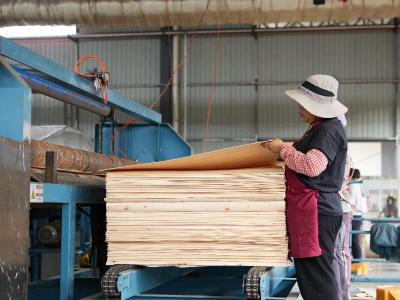
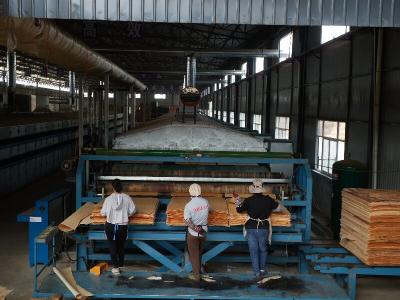
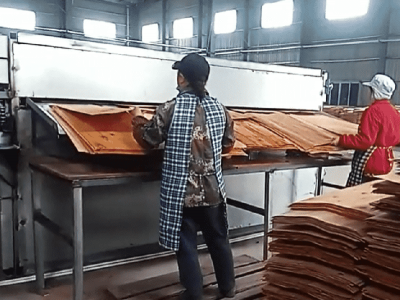
Intelligent upgrades have become a major highlight in the veneer industry. Currently, AI temperature control algorithms, remote monitoring, and digital twin technologies are widely used in high-end veneer dryers. These technologies automatically optimize drying parameters, controlling veneer moisture content within ±1% and deformation rate within ≤0.5%, increasing veneer pass rate to over 98% and significantly reducing maintenance costs and losses for overseas customers. Simultaneously, they address the processing differences of different tree species (poplar, pine) and veneer thicknesses (1-3mm).
Technological upgrades have become the core driving force for the high-quality development of the veneer industry. Digital and intelligent technologies are widely applied in veneer production, effectively improving veneer utilization and reducing production losses. The implementation of new technologies such as bio-based adhesives and nano-coatings further optimizes the weather resistance and practicality of veneers, driving the upgrading of veneer products towards multi-functionality. Demand for functional engineering veneers with fire resistance, moisture resistance, and antibacterial properties continues to grow, and application scenarios are constantly expanding.
The global veneer market is currently experiencing steady growth. Environmental policies are tightening in various countries, with the EU, the US, and other regions introducing regulations that place higher demands on the environmental friendliness and sustainability of veneer products. Traditional high-pollution, low-value-added veneer products are gradually being phased out, while green, environmentally friendly, and recyclable veneer products are becoming the market mainstream. Simultaneously, the concept of sustainable supply chains is gaining popularity, and the market acceptance of various environmentally certified veneers is continuously increasing, further driving the industry's green transformation.
From a product classification and regional market perspective, the global veneer industry exhibits a diversified development pattern. Solid wood veneer, composite veneer, decorative veneer, and engineered wood veneer are developing in tandem. Solid wood veneer, with its natural grain advantages, is highly favored in high-end sectors; composite veneer, relying on its excellent mechanical properties, is widely used in construction, sports equipment, and other applications. Regionally, North America and Europe remain core markets, focusing on high-end demand; the Asia-Pacific region is experiencing rapid growth, becoming the engine of industry growth; Latin America and Africa, with their abundant forestry resources, are emerging markets with huge potential.
The industry's competitive landscape exhibits a coexistence of concentration among leading companies and innovation in niche segments. Leading companies, leveraging their advantages in supply chain integration and technological innovation, have continuously increased market concentration, while small and medium-sized enterprises (SMEs) are gradually being eliminated due to outdated technology and failure to meet environmental standards. Meanwhile, emerging brands are achieving breakthroughs in niche markets through differentiated design, driving industry innovation. Industry analysts point out that the veneer industry is currently facing a dual opportunity of capacity optimization and technological upgrading, with technological innovation and environmental upgrades becoming core competitive advantages for companies.
In the future, with the continuous upgrading of the global veneer industry, the expansion of emerging markets, and the improvement of the technological strength and brand influence of Chinese veneer companies, the global veneer industry will usher in a new wave of growth. From a regional market perspective, the global veneer industry presents a differentiated development pattern. North America, driven by infrastructure legislation and the reshoring of manufacturing, is experiencing a surge in demand for large-size, high-precision veneer drying equipment; Europe, relying on stringent environmental policies, has become a core market for high-end environmentally friendly drying equipment; the Asia-Pacific region, leveraging China's technological upgrades and Southeast Asia's capacity absorption, forms a dual-core growth pole, while Latin America and Africa, relying on abundant plantation resources, have become emerging markets with huge potential.
As a core enterprise deeply rooted in the export sector of veneer dryers, Shenghuai Intelligent Equipment actively responds to the global trend of green transformation, increases its R&D investment, and launches intelligent veneer dryers that not only meet international environmental and quality standards but also possess advantages such as low energy consumption, convenient operation and maintenance, and strong adaptability. These dryers are widely used in downstream sectors such as plywood, veneer panels, and high-end furniture, gaining widespread recognition from overseas customers. In the future, with the continuous upgrading of the global veneer industry and the ongoing expansion of emerging markets, the export of veneer dryers is expected to usher in a new wave of growth, injecting new momentum into the green and high-quality development of the global wood processing industry.