Español
 Русский
 Francés
 Português
 ภาษาไทย
 Indonesia
 Việt
Việt
 العربية
 Melayu



A Comprehensive Guide to Selecting Veneer Dryers in Today’s Market
The veneer manufacturing industry stands at a critical juncture, where efficiency, quality, and environmental stewardship are no longer competing priorities but interconnected necessities. At the heart of this transformation lies a crucial piece of equipment: the veneer dryer. The process of selecting the appropriate dryer technology is more complex and consequential than ever before. With evolving regulations, volatile energy markets, and heightened demand for premium, consistent products, manufacturers must navigate a sophisticated landscape of options. This guide provides a comprehensive, 2000-word analysis of the key considerations, available technologies, and strategic factors defining the current selection process for veneer drying systems.
1. The Core Imperative: Why Dryer Selection Matters More Than Ever
Veneer drying is not merely a step in production; it is the definitive stage that controls final product quality, yield, and profitability. Improper drying leads to defects like cracking, warping, discoloration, and residual stresses that compromise downstream lamination and finishing. In today’s competitive market, such inconsistencies are unacceptable. Furthermore, drying is typically the most energy-intensive operation in a veneer mill, accounting for up to 70% of total thermal energy consumption. Therefore, the choice of dryer directly dictates operational costs, carbon footprint, and long-term resilience against energy price fluctuations. Selecting the right system is a strategic capital investment with multi-decade implications.
2. Pre-Selection Audit: Foundational Questions
Before evaluating equipment, mills must conduct an internal audit:
Veneer Specifications: Species mix (dense hardwoods vs. softwoods), thickness (sliced, peeled, from 0.3mm to 4mm+), initial and target moisture content (often from 60-120% down to 5-10%).
Production Capacity: Required throughput in cubic meters or square meters per shift, defining dryer size and number of zones.
Heat Source Availability & Cost: Access to natural gas, propane, biomass (sawdust, wood waste), steam (from boilers), or electricity. Local energy economics are paramount.
Floor Space & Layout: Constraints on dryer length, width, and height.
Environmental Regulations: Local emissions limits for particulate matter (PM), volatile organic compounds (VOCs), and nitrogen oxides (NOx), which directly influence burner and air system design.
3. Prevailing Dryer Technologies: A Comparative Analysis
The market is dominated by several established technologies, each with distinct advantages.
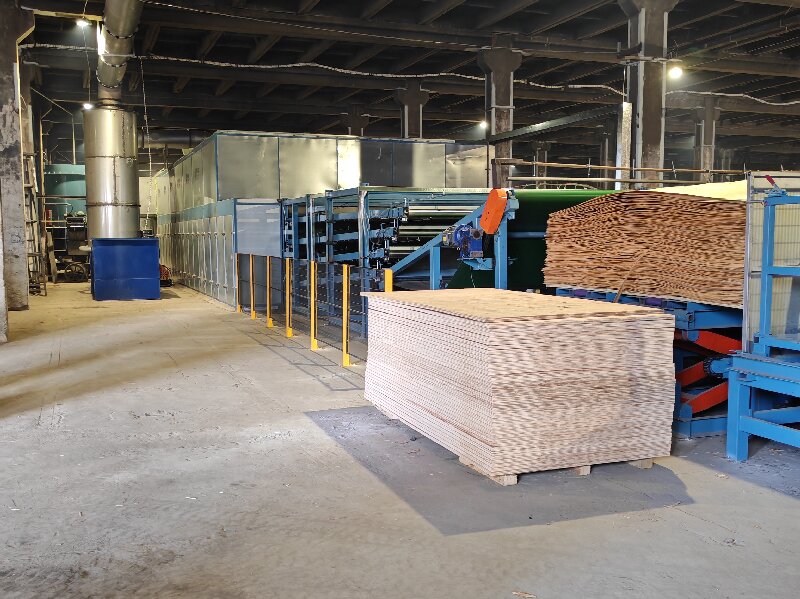
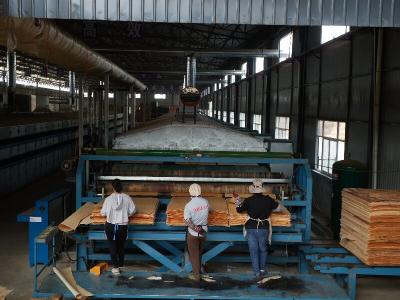
Jet Dryers (Longitudinal & Cross-Flow): The industry workhorse. High-velocity hot air jets impinge on veneer sheets conveyed on rollers or mesh belts.
Pros: Excellent for high-volume, continuous production. Handles a wide range of thicknesses. Modern designs offer precise zone control for temperature, humidity, and airflow. Good for color retention.
Cons: High capital cost. Can be energy-intensive if not well-insulated or equipped with heat recovery. Floor space requirements are significant.
Modern Variant: High-Frequency (RF) Assisted Jet Dryers. These hybrid systems use radio-frequency energy to generate heat within the veneer, drastically reducing drying times for thicker, refractory species and minimizing case hardening. They represent a premium investment for high-value products.
Roller Dryers (Drum Dryers): Veneer is pressed between heated, rotating metal drums.
Pros: Compact footprint. Efficient conductive heat transfer can be energy-effective for thin veneers. Provides a smoothing effect.
Cons: Risk of marking or crushing delicate veneers. Less effective for thicker sheets, where heat penetration is slower. Typically, lower capacity than jet dryers.
Continuous Belt Dryers (Mat Dryers): Often used for drying shredded veneer for engineered products like LVL or for small, clipped pieces. Veneer is conveyed as a mat on a permeable belt through heated chambers.
Pros: Gentle handling, uniform air flow through the mat. Ideal for non-sheet veneer products.
Cons: Not suitable for full sheets requiring intact, cosmetic quality.
Vacuum Dryers: Veneer is sealed in a chamber where reduced pressure lowers the boiling point of water, accelerating drying at lower temperatures.
Pros: Extremely fast for thick veneers (e.g., timber flooring). Superior color preservation and reduced degradation of heat-sensitive species. Minimal emissions.
Cons: Very high capital and maintenance costs. Batch process, limiting continuous throughput. Higher operational complexity.
4. The Deciding Factors: Beyond the Basic Type
Choosing between these technologies is just the start. The "devil is in the details" of the system's features and integration.
Energy Efficiency & Heat Recovery: This is the #1 operational cost driver. Leading manufacturers now offer:
Advanced Heat Recovery Systems: Condensing economizers that extract latent heat from the exhaust steam, pre-heating incoming fresh air, or process water. This can improve thermal efficiency by 15-30%.
Automatic Exhaust Humidity Control: Sensors modulate exhaust damper positions to maintain optimal humidity in each zone, minimizing wasted heat.
Biomass Compatibility: Systems designed for wood gas or pellet burners offer energy independence and carbon-neutral operation, aligning with ESG goals.
Control & Automation Sophistication: Modern dryers are data hubs. Look for:
Fully Automated Control Systems: PLC-based systems with touchscreen HMIs that store recipes for different species/thickness.
Moisture Content (MC) Feedback Control: In-line moisture meters at the dryer exit provide real-time data to automatically adjust zone temperatures and conveyor speed, ensuring consistent target MC.
IoT Connectivity: Remote monitoring, predictive maintenance alerts, and integration with plant-wide MES (Manufacturing Execution Systems) for data-driven optimization.
Material Handling & Integration: The dryer must seamlessly connect to clipping, splicing, and lay-up lines. Consider automated feeding/unloading systems, moisture-sorting gates post-dryer, and minimized transfer points to reduce breakage.
Sustainability & Emission Control: Regulatory compliance is non-negotiable. Key features include:
Low-NOx Burners: Essential for meeting air quality standards.
Thermal Oxidizers or RTOs (Regenerative Thermal Oxidizers): For destroying VOCs and hazardous air pollutants (HAPs) from certain species, converting them to heat energy for the dryer.
Efficient Dust & Particulate Arrestors: Baghouses or cyclones integrated into the air circulation system.
5. The Supplier Ecosystem & Total Cost of Ownership (TCO)
The market features global giants and specialized regional players. Evaluation must extend beyond the initial quote:
Reputation & References: Seek client testimonials, especially from mills with similar raw materials.
Technical Support & Spare Parts: Availability of local service engineers and a robust parts inventory is critical for minimizing downtime.
TCO Calculation: Factor in: Capital Cost + Installation + Energy Consumption (projected over 10 years) + Maintenance Costs + Potential Financing Costs. A more expensive, high-efficiency dryer may have a dramatically lower TCO due to energy savings and higher yield.
6. Future-Proofing the Investment
The selected dryer should offer flexibility for:
Changing Raw Materials: Ability to handle new or mixed species.
Capacity Expansion: Modular designs that allow for future lengthening.
Regulatory Changes: Upgradable emission control systems.
Energy Transition: Dual-fuel burner capabilities or readiness to integrate with future solar thermal or heat pump systems.
Conclusion: A Strategic, Holistic Decision
The selection of a veneer dryer in 2026 is a multidisciplinary strategic decision, involving production, engineering, financial, and sustainability teams. There is no universal "best" dryer, only the optimal solution for a specific mill's unique conditions and strategic goals.
The trend is unequivocally toward smarter, greener, and more integrated systems. The upfront investment in advanced technology—particularly in energy recovery, precise automation, and clean combustion—is proving to be the most prudent path. It ensures compliance, shields operations from energy volatility, guarantees the superior product quality the market demands, and future-proofs the asset for the challenges and opportunities of the coming decade. In the modern wood products industry, the dryer is no longer just a machine; it is the core engine of value creation, efficiency, and environmental responsibility. Choosing wisely is paramount to sustainable success.