Español
 Русский
 Francés
 Português
 ภาษาไทย
 Indonesia
 Việt
Việt
 العربية
 Melayu



Do You Understand The Plywood Production Process?
Do You Understand The Plywood Production Process?
In many fields such as construction formwork, furniture manufacturing, shipbuilding, automobiles, packaging, and exhibitions, plywood has become an indispensable core material due to its high strength, good stability, and high wood utilization rate. However, many people know very little about the production process of this "all-purpose board." As a manufacturer with many years of experience in plywood equipment research and development, I will break down the complete process from logs to finished products, revealing the technical secrets and equipment support behind high-quality plywood.
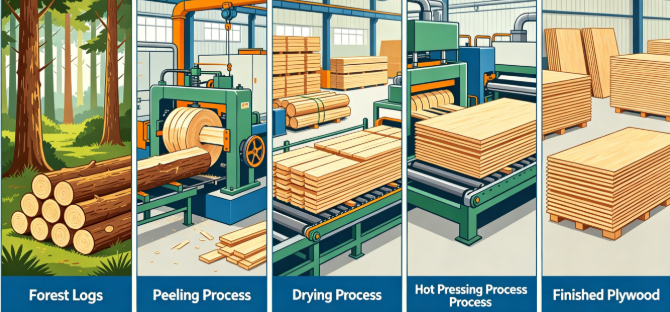
Plywood production is not simply the splicing of wood, but a series of interconnected, highly precise, and efficient systems engineering projects. It follows nine core processes: "material preparation → rotary (planing) → drying → veneer finishing → glue preparation and application → assembly → pre-pressing → hot pressing → post-treatment." Each step relies on the precise assistance of specialized equipment, and any oversight in any link can affect the quality of the final product.
The first step in production is material preparation, which is the foundation of plywood quality. Workers first need to screen the logs, removing rotten, insect-infested, and cracked materials. Then, through cutting and peeling, the logs are processed into uniformly sized segments. This step requires specialized log cutting and peeling machines to ensure precise segment dimensions and a clean surface, preparing the logs for the subsequent rotary veneer process. High-quality preparation equipment significantly improves raw material utilization and reduces wood waste.
Varicele cutting (planing) is the crucial step in converting log segments into veneer and is a core test of equipment precision. Through the high-speed operation of the veneer machine, sharp blades evenly slice the log segments into thin veneers, much like "sharpening a pencil." The uniformity of veneer thickness directly determines the flatness and bonding strength of the plywood. Shine Machinery's veneer veneer veneer veneer veneer can control veneer thickness errors to a very small range, and with automatic sorting functions, it significantly improves production efficiency.
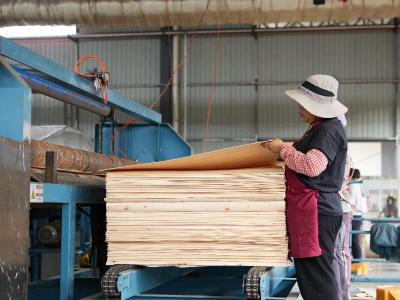
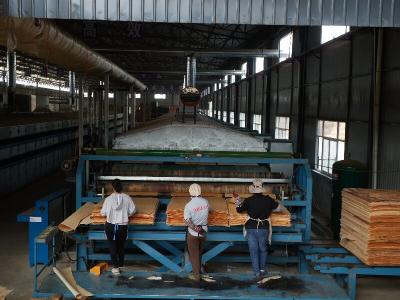
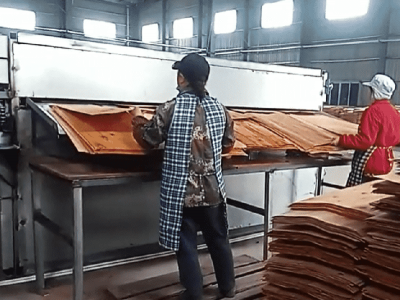
The veneer after rotary cutting contains a large amount of moisture. If used directly for gluing, it will lead to later delamination, separation, and mold growth in the plywood. Therefore, a drying process is essential. Veneer drying requires precise control of moisture content within a reasonable range (typically below 10%), necessitating the use of specialized veneer dryers. Currently, the market offers various types of drying equipment, including roller dryers, mesh belt dryers, and pressure dryers, allowing for flexible selection based on manufacturer capacity and factory size. Shine Machinery's intelligent dryers feature automatic feeding, intelligent moisture content monitoring, and a daily processing capacity of up to 300 cubic meters, improving efficiency by over 30% compared to traditional equipment.
After drying, the veneers undergo finishing, repair, and shearing processes to remove edge defects and adjust dimensions, ensuring a smooth surface and uniform specifications. This seemingly simple step effectively improves the overall quality of the plywood. Following this, the adhesive mixing and application stages begin. The adhesive ratio and application uniformity directly affect the bonding strength and environmental performance of the plywood. Professional adhesive applicators can achieve uniform application on both sides, ensuring bonding effectiveness while minimizing adhesive waste, aligning with current environmentally friendly production requirements.
The final assembly is the core process determining the structural stability of the plywood. Workers must adhere to the principle of "adjacent veneer fibers perpendicular to each other" when layering the glued veneers to form a plywood blank. This structure effectively counteracts the expansion and contraction of the wood, ensuring the plywood maintains dimensional stability under varying temperature and humidity conditions and preventing cracking and deformation. After assembly, the blank is pre-compacted using a pre-press to expel air and ensure even adhesive penetration, laying the foundation for subsequent hot pressing. The precision of the pre-press's pressure control directly affects the bonding effect and reduces the risk of delamination later.
Hot pressing is a crucial step in plywood forming and demands the highest equipment performance. The pre-pressed blank is fed into the hot press, where the adhesive rapidly cures under high temperature and pressure, firmly bonding the veneer layers together to form a sturdy finished plywood. A high-quality hot press must possess uniform and constant temperature and stable pressure, with the surface temperature difference controlled within ±1℃ to prevent delamination, separation, and blistering, while also shortening the hot pressing cycle and increasing production capacity. Shine Machinery's hot presses feature intelligent temperature and pressure control, adapting to the production of plywood of varying thicknesses and specifications to meet diverse market demands.
After hot pressing, the plywood undergoes post-processing before leaving the factory. Workers use edge saws to cut the edges of the boards to meet dimensional standards, then sand the surface to remove burrs and imperfections, resulting in a smoother, more even surface. Finally, the boards undergo inspection, grading, and packaging before being stored, completing the entire plywood production process. In the post-processing stage, the cutting precision of the edge saw and the sanding effect directly impact the product's appearance and market competitiveness.
From logs to finished products, the creation of every high-quality piece of plywood relies on meticulous control of each process and the powerful support of specialized equipment. As a leading manufacturer specializing in the R&D, production, and sales of plywood equipment, we have been deeply involved in the industry for many years, closely following industry trends and focusing on the needs of environmentally friendly, efficient, and intelligent production. We provide customers with complete plywood production solutions, including veneer dryers, glue applicators, pre-presses, hot presses, edge saws, and other complete sets of equipment, covering the entire plywood production process. This not only meets the production needs of manufacturers of different sizes but also helps them improve production efficiency, reduce energy consumption, and optimize product quality, thus assisting enterprises in achieving quality and efficiency improvements.
With increasingly stringent environmental policies and rising market demands for plywood quality, intelligent, environmentally friendly, and efficient production has become the mainstream development trend in the plywood production industry. In the future, we will continue to increase R&D investment, build a professional R&D team, overcome core equipment technologies, optimize equipment performance, and improve our after-sales service system to provide plywood companies with more competitive complete equipment solutions. At the same time, we will continue to popularize plywood production process knowledge, contributing to the standardization and high-quality development of the industry, allowing more people to understand the technology and craftsmanship behind plywood.