Español
 Русский
 Francés
 Português
 ภาษาไทย
 Indonesia
 Việt
Việt
 العربية
 Melayu

Why Is Veneer Drying Equipment Essential For Eucalyptus Flooring Substrate Production?
Why Is Veneer Drying Equipment Essential For Eucalyptus Flooring Substrate Production?
In the production of engineered wood flooring and multi-layer flooring substrates, eucalyptus wood, with its uniform grain, dense structure, high toughness, and cost-effectiveness, has become a core raw material for flooring substrates. However, many substrate manufacturers have found through long-term production practice that eucalyptus veneers cannot meet production standards through natural sun drying or simple air drying. Professional veneer drying equipment is an essential core piece of equipment for the standardized and high-quality production of eucalyptus flooring substrates, not an optional auxiliary device. This is fundamentally determined by the inherent material characteristics of eucalyptus, the stringent process standards for flooring substrates, and the demands of large-scale production.
I. Special Material Characteristics of Eucalyptus: Naturally High Moisture Content Leads to Deformation; Natural Drying Cannot Meet Standards
Eucalyptus is a fast-growing hardwood with long fibers and high wood toughness, suitable for the pressure-bearing and wear-resistant requirements of flooring substrates. However, it also possesses the fatal characteristics of extremely high initial moisture content, high internal stress, and a tendency to crack and warp. The moisture content of freshly rotary-cut eucalyptus veneers generally reaches 40%-60%, far exceeding the acceptable moisture content standard for flooring substrate production.
Traditional natural sun-drying and open-air air-drying methods are completely unsuitable for the characteristics of eucalyptus wood. Firstly, natural drying is greatly affected by weather, temperature, humidity, and season, resulting in inconsistent drying speeds. The edges of the veneer lose moisture rapidly while the core remains highly moist, creating a significant moisture content difference. Secondly, the drying process is uncontrollable, leading to uneven shrinkage of eucalyptus fibers and continuous release of internal stress, directly causing problems such as warping, twisting, surface cracking, and bulging. Thirdly, in humid and rainy southern regions, natural sun-drying takes 7-15 days, and prolonged open-air exposure allows mold growth, blue stain, and decay, rendering the veneer unusable.
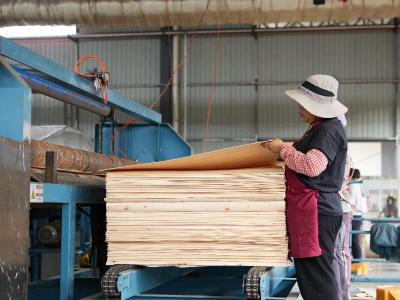
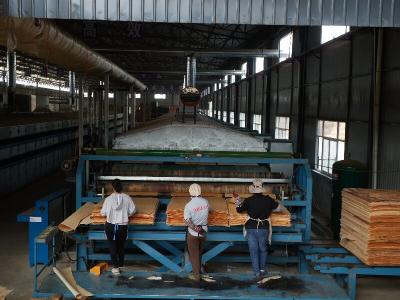
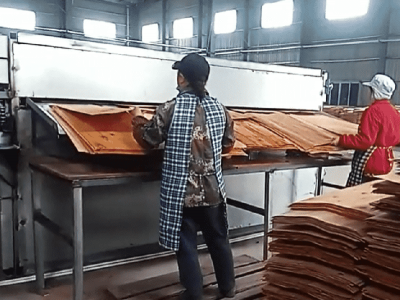
In contrast, specialized veneer drying equipment is specifically developed for eucalyptus wood. Through a constant temperature and humidity closed-loop hot air circulation system, it achieves simultaneous and uniform moisture removal from both the inside and outside of the veneer, precisely dissipating internal stress and fundamentally solving the problems of deformation, cracking, and mold growth in eucalyptus veneer. This is the only standardized drying solution suitable for eucalyptus wood.
II. Ensuring Substrate Quality: Precise Moisture Control to Eliminate Potential Quality Issues in Finished Flooring
The stability, bonding strength, and lifespan of flooring substrates hinge on the precise control of veneer moisture content. Industry standards explicitly require that the moisture content of eucalyptus flooring substrate veneers be consistently controlled between 8% and 12%. This precision can only be achieved with professional veneer drying equipment and is the core guarantee that finished flooring will not crack, delaminate, or warp.
If the professional drying process is omitted, and eucalyptus veneers with substandard moisture content are used to produce the substrate, a series of irreversible quality problems will arise. Veneers with excessively high moisture content will experience residual moisture vaporization during hot pressing and gluing, which cannot be expelled in time, causing internal hollowing, delamination, and glue separation, significantly reducing bonding strength. Furthermore, after the finished flooring is put into use, it will continuously absorb and lose moisture with changes in ambient temperature and humidity, leading to problems such as warping, edge curling, cracking, and abnormal noise, severely impacting product reputation and after-sales service.
Conversely, veneer drying equipment can precisely control drying temperature, air speed, and drying time, ensuring that each eucalyptus veneer has a uniform moisture content and is flat and stable. Veneers that have undergone drying treatment have tighter hot-press bonding and more even stress distribution, significantly improving the structural stability of the substrate. The finished flooring meets all standards for wear resistance, compressive strength, and weather resistance, completely avoiding batch quality defects.
III. Adapting to Production Processes: Standardized Drying, Streamlining the Entire Production Line
Eucalyptus flooring substrate is a precision-processed product made by gluing and pressing multiple layers of veneers. The precision of each process is interconnected. Veneer drying is a crucial pre-process connecting rotary cutting, hot pressing, and gluing, directly determining the smooth progress of subsequent production.
Eucalyptus veneers that have not undergone professional drying have poor flatness and large fluctuations in moisture content. This not only leads to uneven gluing and incomplete glue curing, resulting in adhesive failure and localized delamination, but also causes pressure imbalance during the hot pressing process, excessive thickness deviations, and significantly increased repair and rework costs. The standardized veneers output by veneer drying equipment are flat, have uniform moisture content, and stable wood structure. They are perfectly compatible with automated gluing, continuous hot pressing, sanding, and cutting equipment, ensuring a stable production line rhythm and consistent processes, eliminating process continuity failures.
Simultaneously, professional drying equipment has high-temperature sterilization and mold removal functions, which can completely kill insect eggs and mold spores attached to eucalyptus veneers, preventing mold and insect infestation problems at the source, improving the anti-corrosion and moisture-proof performance of the flooring substrate, and meeting the production process requirements of high-end flooring substrates.
IV. Cost Reduction, Efficiency Improvement, and Quality Enhancement: Adapting to Large-Scale Mass Production and Enhancing Enterprise Competitiveness
For eucalyptus flooring substrate manufacturers, abandoning veneer drying equipment and relying on natural drying may seem to save on equipment investment, but in reality, it causes significant hidden losses. Natural drying requires a large area, has a long turnover cycle, and requires a large space to store veneers, resulting in extremely low capital and material turnover efficiency, which cannot meet the needs of large-scale mass production. Furthermore, natural drying has a high scrap rate and rework rate, leading to continuously rising material waste and labor costs. With the addition of professional veneer drying equipment, continuous drying production can be achieved around the clock, unaffected by weather or season. The drying cycle is shortened to a few hours, significantly improving production efficiency and reducing space requirements. Simultaneously, the precise and controllable drying mode minimizes veneer scrap rates, greatly reducing raw material waste and after-sales rework costs. Standardized drying processes ensure a stable output of high-quality substrate products, helping companies maintain consistent product quality and enhance market competitiveness. In the long run, this can lead to cost reduction, efficiency improvement, and increased revenue for enterprises.
V. Industry Compliance Necessity: Meeting Quality Inspection Standards and Avoiding Market Elimination
Currently, quality inspection standards in the wood flooring industry are becoming increasingly stringent. Moisture content, stability, environmental friendliness, and corrosion resistance are all core testing indicators. Eucalyptus wood flooring substrates that have not undergone professional drying have substandard moisture content and unstable structures, making them completely unable to pass formal product quality inspections and thus unable to enter the mainstream engineering and home decoration markets.
Standardized drying processes in veneer drying equipment are essential for eucalyptus wood flooring substrates to meet industry production standards and pass quality inspections. They are also a core guarantee for enterprises to comply with production regulations and avoid failing product sampling inspections and being eliminated from the market. In conclusion, the necessity of veneer drying equipment for eucalyptus flooring substrate production is not an industry gimmick, but a fundamental requirement determined by the characteristics of eucalyptus wood, product quality standards, production process requirements, and the demands of large-scale production and compliant operation. Natural drying cannot solve the core problems of eucalyptus wood, such as high humidity, easy deformation, and mold growth. Only professional veneer drying equipment can achieve precise humidity control, stabilize board performance, ensure finished product quality, and improve production efficiency. It is the core equipment for eucalyptus flooring substrate companies to maintain quality, reduce costs, and seize market share.
As a professional veneer dryer manufacturer, we have been deeply involved in the wood drying field for many years. We have developed customized veneer drying equipment specifically for the unique characteristics of eucalyptus wood. Our equipment features uniform drying, precise temperature control, energy efficiency, and suitability for mass production. It can comprehensively meet the production needs of eucalyptus flooring substrate factories of all sizes, helping companies create high-quality substrate products and enhance their core market competitiveness.