Español
 Русский
 Francés
 Português
 ภาษาไทย
 Indonesia
 Việt
Việt
 العربية
 Melayu


Uganda Plans to Ease Veneer Export Ban in September
Uganda Plans to Ease Veneer Export Ban in September
According to internal sources from Uganda's Ministry of Trade and Industry and the National Forestry Authority (NFA), the comprehensive ban on veneer exports, implemented since June 2023, is planned to be temporarily eased starting in September 2026. This would allow qualified companies to export limited quantities of eucalyptus veneer for a period of six months, aiming to balance local processing capacity pressures with export earnings needs. This news has attracted significant attention from the East African timber trade community and the Chinese import market.
I. Policy Background: From Comprehensive Ban to Expected Easing
On June 21, 2023, Ugandan President Museveni issued a presidential decree, citing the need to curb deforestation and promote local value-added processing, completely banning the export of logs, sawn timber, and veneer. Only plywood, furniture, and other processed products were permitted to be exported with permits. Starting in July of the same year, police, in conjunction with the NFA and customs, conducted strict inspections along the entire border. Exporting veneer without a permit was classified as a criminal offense, and all existing export licenses were revoked.
Over the three years since the ban was implemented, Uganda's domestic plywood production capacity has expanded rapidly. However, there has been a backlog of rotary-cut veneer inventory, putting pressure on small and medium-sized processing plants. Meanwhile, traditional import markets such as China are experiencing tight supply and significant price fluctuations. In the second quarter of 2026, the Uganda Timber Processing Industry Association repeatedly petitioned the government, suggesting a temporary relaxation of veneer export restrictions to alleviate cash flow pressure on businesses. This was ultimately approved in principle by high-level officials, with September designated as the window for easing restrictions.
II. Core Details of the September Easing (Official Draft)
This easing is a temporary and conditional relaxation, not a permanent lifting of the ban. The core provisions are as follows:
Implementation Period: September 1, 2026 – February 28, 2027, for a period of 6 months. Renewal will be assessed based on the effectiveness of implementation upon expiration.
Scope of Permit: Only eucalyptus veneer (1.5-3mm thick) is permitted. Export of logs, sawn timber, and mixed hardwood veneer remains prohibited.
Company Qualifications: ① A rotary-cutting processing plant registered in Uganda for at least two years, possessing a complete Environmental Impact Assessment (EIA) and sustainable logging plan; ② No record of illegal logging or smuggling in the past year, and has already constructed veneer drying or plywood production lines; ③ A temporary veneer export license must be applied for from the Ministry of Trade and Industry, issued after review by the NFA. Exporting without a license is still illegal.
Export Quota: The total quota is controlled at 50,000 cubic meters per month, allocated according to company capacity and compliance records, prioritizing the digestion of inventory by small and medium-sized processing plants.
Tariffs and Supervision: The export tariff remains unchanged at **12%**. Customs will conduct full traceability and strictly investigate "smuggling logs under the guise of veneer" or "declaring counterfeit plywood."
III. Reactions from Multiple Parties: Industry Expectations and Cautious Observation Coexist
1. Ugandan Local Enterprises
Small and medium-sized veneer cutting plants generally welcomed the move, believing that the easing of restrictions would effectively alleviate inventory backlogs and tight cash flow, preventing idle capacity and bankruptcies. Large plywood companies, however, remained cautious, worried that the lifting of veneer export restrictions would drive up local raw material prices, squeezing plywood profit margins.
2. China's Import Market
China was once Uganda's largest buyer of veneer, accounting for approximately 80% of its exports. After the ban, domestic imports shifted to Guangxi, Kenya, and Tanzania, resulting in persistently high prices. Merchants in timber markets in Linyi, Shandong, and Shunde, Guangdong, reported that the news of the easing of restrictions in September triggered a surge in inquiries, with expectations of increased veneer arrivals and price declines in the fourth quarter, which would benefit downstream furniture and flooring companies by reducing costs.
3. Industry Expert Opinions
A Ugandan forestry consultant stated that this easing of restrictions is a short-term balancing measure, with the core objective remaining to promote local deep processing; a full liberalization is unlikely in the long term. Experts from the China Timber Distribution Association remind companies to obtain qualifications and secure supplies in advance, while also being wary of policy reversals and avoiding blind stockpiling.
IV. Market Outlook for 2026
As of June 2026, Uganda's veneer inventory is approximately 300,000 cubic meters. Following the easing in September, this inventory is expected to be released rapidly, with arrivals from the Chinese market potentially increasing by 40%-50% quarter-on-quarter in the fourth quarter. In the long term, the core of Uganda's policy remains "banning raw materials, supporting processing". After a period of easing, the policy may gradually tighten, guiding the industry towards high-value-added products such as plywood and furniture.
Currently, the Ugandan Ministry of Trade and Industry has initiated pre-approval for temporary export license applications, with the first batch of approved companies expected to be announced in mid-August, and the easing policy officially implemented on September 1st.
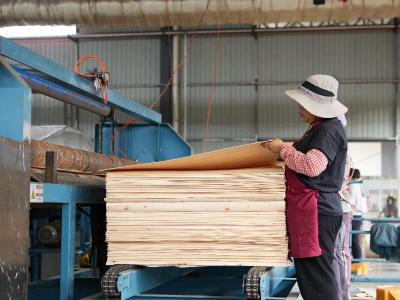
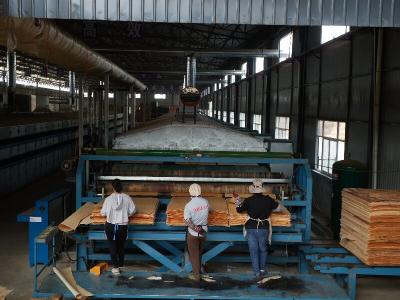
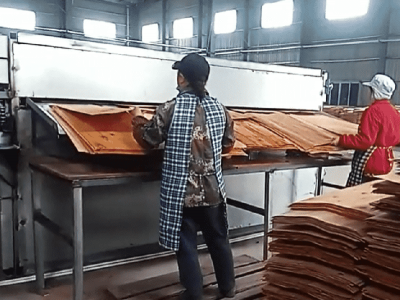
Shine Machinery has developed an intelligent veneer drying production line tailored to the characteristics of Ugandan eucalyptus veneer, local climate conditions, and export quality standards, perfectly matching the compliance upgrade needs of local processing plants. The equipment can precisely control the moisture content of the veneer within export standards, resulting in smooth, flat, and consistently high-quality dried veneer that fully meets Ugandan export inspection and international market quality requirements. The equipment supports stable 24-hour continuous operation, boasts a high degree of automation, simple maintenance, and a low failure rate, making it suitable for large-scale production in Ugandan factories. Production lines with different numbers of layers and lengths can be customized to meet the production capacity needs of enterprises, quickly helping local processing plants complete their deep processing facilities, successfully apply for export qualifications, and seize the policy benefits window in September.