Español
 Русский
 Francés
 Português
 ภาษาไทย
 Indonesia
 Việt
Việt
 العربية
 Melayu

What Factors Affect the Drying Effect of Veneer Dryers?
What Factors Affect the Drying Effect of Veneer Dryers?
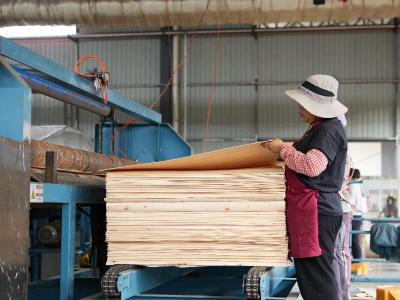
Veneer drying is a core process in the production of plywood, blockboard, and other engineered wood products. The drying quality directly determines the flatness of the veneer, the uniformity of moisture content, the bonding strength of the boards, and the finished product qualification rate. It also affects the production line efficiency and energy costs. In actual production, problems such as uneven drying and wetting of veneers, surface cracking, warping, blackening and dampness, and over-drying and brittleness often occur. These are mostly not caused by a single equipment malfunction, but are influenced by multiple factors including the veneer's own properties, equipment parameters, operating conditions, operating processes, and the production environment. This article will comprehensively analyze the core reasons affecting the drying effect of veneer dryers, dissect the essence of the problems, and provide corresponding improvement directions, offering a reference for improving the quality and efficiency of board production.
I. Veneer Material and Initial State (Basic Core Factors)
The material characteristics, specification differences, and initial moisture content of the veneer itself are the foundation for determining the drying effect and are also the most easily overlooked preliminary influencing factors, directly determining the adaptation threshold of the drying process.
First, there is the difference in wood species. Different tree species exhibit significant differences in wood structure, fiber density, and porosity, resulting in drastically different rates of moisture diffusion. Softwoods such as poplar and paulownia have a loose texture, leading to rapid moisture evaporation and easy drying, but they are prone to cracking and fuzzing at high temperatures. Hardwoods such as birch, eucalyptus, and oak have dense fibers, resulting in high resistance to moisture penetration and slow internal moisture migration. If conventional drying parameters are used, uneven drying, with the surface becoming over-dry and the internal moisture content exceeding the standard, is highly likely to occur.
Secondly, there are differences in veneer specifications and appearance. During production, veneer thickness, flatness, and integrity vary considerably. Even a thickness deviation of only 0.2mm can significantly affect the heat and time required for drying. Thin veneers heat up and lose moisture quickly, making them prone to over-drying, becoming brittle, and cracking; thick veneers, after rapid surface moisture evaporation, form a dense dry layer, hindering internal moisture diffusion and leading to excessive internal residual moisture. Meanwhile, bent, wrinkled, and layered veneers experience uneven heating and airflow during drying. Moisture cannot escape from the wrinkled areas in time, easily leading to quality defects such as localized dampness, blackening, and dry spots.
Finally, there is the difference in initial moisture content. The moisture content of veneers after rotary cutting of logs fluctuates greatly, influenced by the log's storage time, ambient humidity, and the rotary cutting process. Without graded drying, veneers with high moisture content will retain moisture due to insufficient drying time, while veneers with low moisture content will become over-dried and warped. Ultimately, this results in extremely poor consistency in moisture content across the entire batch of veneers, severely impacting subsequent hot-pressing and gluing processes.
II. Drying Equipment Operating Parameters (Core Key Factors)
The three core parameters of the veneer dryer—temperature, humidity, and conveyor speed—are crucial for controlling the drying effect. Imbalance in parameter matching is a major cause of drying quality problems; these three parameters are interdependent and indispensable.
1. Improper Drying Temperature Temperature is the core driving force accelerating the evaporation of moisture from the wood. When the temperature is too low, the rate of moisture evaporation decreases significantly, reducing drying efficiency. This results in incomplete drying of the veneer, excessive residual moisture, and subsequent problems such as delamination, blistering, and separation in the boards. Conversely, when the temperature is too high, the surface moisture of the veneer evaporates rapidly, while the internal moisture migration rate cannot keep up. This uneven shrinkage stress directly leads to cracking, warping, yellowing or blackening of the surface, and brittleness of the wood, significantly reducing veneer utilization. Furthermore, improper temperature gradient settings in multi-stage dryers, such as excessively rapid heating in the initial stage and insufficient temperature stability in the later stage, can also cause uneven drying of the veneer.
2. Imbalanced Internal Humidity and Poor Dehumidification: The relative humidity inside the dryer directly determines the moisture evaporation efficiency. Under constant temperature and airflow, the higher the internal humidity, the slower the moisture evaporation rate on the veneer surface. During production, the dryer continuously evaporates a large amount of water vapor. If the dehumidification system is insufficient, the dehumidification duct is blocked, or the damper is improperly adjusted, water vapor will accumulate inside the machine, creating a high-humidity environment. This will not only significantly reduce the drying speed but also prevent the surface moisture of the veneer from evaporating properly, resulting in problems such as dampness, stickiness, and dull color. Especially in the cooling section of the equipment, the accumulation of moisture can easily cause the veneer to absorb moisture again. Conversely, excessively rapid dehumidification and excessively low humidity inside the machine will cause the surface to lose moisture and crack rapidly.
3. Mismatched Conveyor Speed The conveyor belt speed determines the drying time of the veneer. Speeds that are too fast or too slow will cause quality problems. If the conveyor speed is too fast, the veneer will not stay in the drying chamber long enough, and the internal moisture cannot be fully extracted, resulting in incomplete drying and high moisture content. If the conveyor speed is too slow, the veneer will be in a high-temperature drying environment for a long time, leading to excessive moisture loss and problems such as over-drying, brittleness, and severe deformation. This not only reduces production efficiency but also increases raw material loss. Meanwhile, unstable conveyor belt speed and fluctuations in speed can lead to inconsistent drying levels of veneers within the same batch, resulting in extremely poor product quality stability.
III. Equipment Operating Conditions and Hardware Failures (Common Hidden Factors)
Aging equipment hardware, component failures, and inadequate maintenance can lead to uneven drying environments, a hidden danger causing unstable drying results. Most batch-related drying problems stem from abnormal equipment operating conditions.
1. Uneven Hot Air Circulation Dryers rely on hot air circulation for uniform drying. If the internal fan malfunctions, airflow is insufficient, the air ducts are clogged with dust, the air nozzles are blocked, or the airflow is unevenly distributed, it will cause large differences in local hot air flow within the drying chamber, creating "high-temperature zones and no-airflow zones." Veneers in no-airflow or weak-airflow zones cannot evaporate moisture in time, resulting in incomplete drying; veneers in high-temperature, strong-airflow zones lose excessive moisture, ultimately causing uneven drying and significant color differences among veneers in the same furnace.
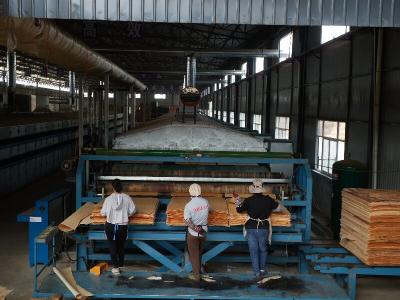
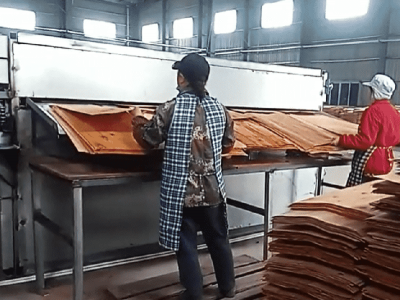
2. Malfunctions in Transmission and Laying Equipment: Uneven feeding and laying of veneers is a frequent problem. Inconsistent density in manual veneer laying, veneer layering, misalignment, or insufficient precision in automatic veneer laying equipment can lead to localized veneer stacking and gaps. In stacked areas, hot air cannot penetrate, moisture remains, and drying is incomplete; in gaps, hot air blows without penetrating, causing over-drying of adjacent veneer edges, resulting in edge cracking and warping. Simultaneously, worn or unevenly tensioned conveyor belt rollers can cause veneer conveying vibration and misalignment, further exacerbating drying deviations.
3. Equipment Sealing and Aging Issues: Aging of the dryer cavity sealing strips, improperly closed furnace doors, and air leaks in the machine body allow cold air to enter and hot air to escape. This disrupts the constant temperature and humidity within the cavity, creating an unbalanced drying environment, reducing overall drying efficiency, and resulting in inconsistent veneer drying quality. Furthermore, accumulated sawdust and dust from long-term production in the air ducts, heating pipes, and exhaust vents continuously affect hot air circulation and dehumidification, creating persistent drying quality problems.
IV. Production Operations and Process Control
(Human-Controllable Factors) Standardized operating procedures and process control are crucial for ensuring stable drying results. Non-standard operations, rigid processes, and lack of control are the main human factors causing quality fluctuations in production.
First, a one-size-fits-all approach to process parameters. Some production lines fail to dynamically adjust parameters based on veneer species, thickness, and initial moisture content. Using fixed temperature, speed, and dehumidification parameters regardless of material specifications fails to adapt to the drying needs of different veneers, inevitably leading to drying defects. For example, using rapid drying parameters for thin softwood veneers on thick hardwood veneers easily results in incomplete drying; using high-temperature, slow-speed parameters for thin veneers easily leads to cracking and brittleness.
Second, non-standard feeding operations. Inconsistent feeding speeds, misaligned veneer placement, overlapping or missing veneers, and unreasonable spacing all disrupt drying uniformity. Furthermore, failure to pre-sort high-moisture-content and damaged veneers allows substandard veneers to mix with normal batches, lowering the overall drying pass rate.
Third, inadequate post-production control. Failure to promptly seal and stack dried veneers, along with inadequate humidity control in the cooling environment, led to rapid secondary moisture absorption in the damp workshop, causing a rebound in the target moisture content. While seemingly indicating substandard drying, this was actually due to improper storage and management.
V. External Factors of the Workshop Environment (Auxiliary Influencing Factors)
External environmental factors such as workshop temperature, humidity, and ventilation indirectly affect drying efficiency and the final moisture content of the veneers, especially during seasonal changes. The equilibrium moisture content of the air varies significantly across different regions and seasons. For example, the equilibrium moisture content is higher in humid southern regions and lower in drier northern regions. Failure to adjust the target moisture content according to region and season can easily lead to veneer compatibility issues.
During the rainy season and plum rain season, high workshop humidity increases the dehumidification pressure of the dryer, making it difficult to quickly remove moisture from the machine, reducing drying efficiency, and making veneers prone to re-dampening. In winter, low workshop temperatures and cold air intrusion into the equipment slow down the heating rate, increase heat loss, and reduce drying uniformity. Simultaneously, excessive ventilation leads to heat loss from the equipment, while insufficient ventilation causes moisture accumulation, all of which indirectly affect the veneer drying effect. VI. Summary and Optimization Suggestions
In summary, the factors affecting the drying effect of veneer dryers encompass five dimensions: veneer material, equipment parameters, hardware conditions, operating processes, and production environment. These factors are interconnected and mutually influential. To consistently improve drying quality, a systematic management and control system needs to be established: First, ensure proper pre-sorting of veneers, classifying them by tree species, thickness, and moisture content for drying; second, accurately match equipment parameters, implementing multi-stage temperature and humidity gradient control to adapt to the needs of different veneer types; third, regularly maintain the equipment, cleaning air ducts, fans, and dehumidification systems to ensure smooth hot air circulation and dehumidification, and ensuring proper equipment sealing and maintenance; fourth, standardize operating procedures, eliminating problems such as non-standard material feeding and arbitrary parameter adjustments; fifth, dynamically fine-tune the drying process according to seasonal and regional environments, and strictly control the finished product storage environment.
Through comprehensive investigation and targeted optimization of various influencing factors, problems such as uneven drying and wetting of veneers, cracking and deformation, blackening and dampness can be effectively solved, significantly improving the veneer drying qualification rate and production efficiency, reducing raw material loss and production costs, and laying a solid quality foundation for subsequent wood-based panel production.