Español
 Русский
 Francés
 Português
 ภาษาไทย
 Indonesia
 Việt
Việt
 العربية
 Melayu



How to Improve Plywood Density?
How To Improve Plywood Density? Industry Process Upgrades Boost Board Quality
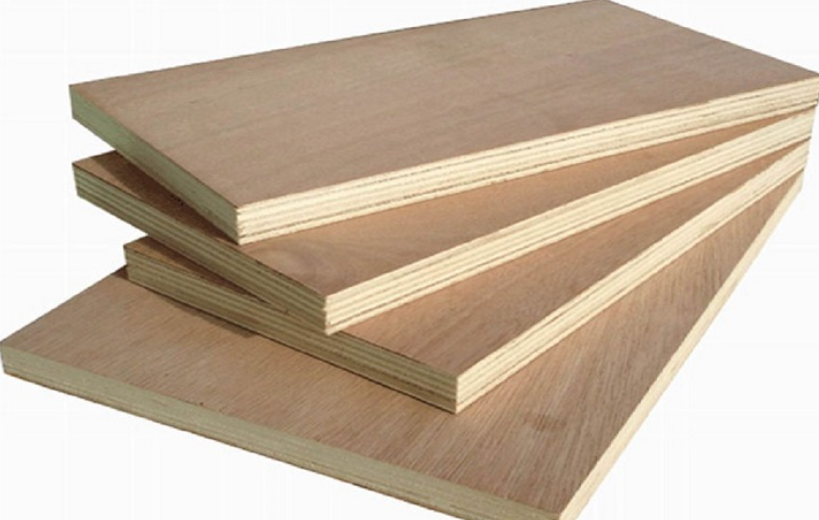
Recently, with the continuous upgrading of performance requirements for boards in fields such as building decoration, high-end furniture, and container manufacturing, plywood density has become a core indicator for measuring the load-bearing capacity, stability, and durability of boards. High-density plywood, with its advantages of compact structure, pressure resistance, wear resistance, and resistance to deformation, has seen a widening supply-demand gap in the market. To address the common pain points in the industry, such as loose boards, uneven density, and insufficient strength, domestic wood processing enterprises, in conjunction with research institutions, have optimized production processes and developed a scientific, efficient, and practical solution for improving plywood density, helping the wood industry improve quality and efficiency, and transform and upgrade.
The core reasons for low plywood density and large batch-to-batch variations are concentrated in four major issues: loose veneer raw materials, numerous internal voids in the boards, non-standard hot-pressing processes, and unreasonable gluing processes. Under the traditional production model, most small and medium-sized enterprises rely on extensive processing, resulting in finished plywood densities generally below 0.6 g/cm³, making it difficult to meet the standards for high-end engineering and industrial materials. In response, the industry has focused on four key dimensions: raw material pretreatment, core hot-pressing processes, adhesive optimization, and post-processing modification, to comprehensively improve the density and uniformity of plywood.
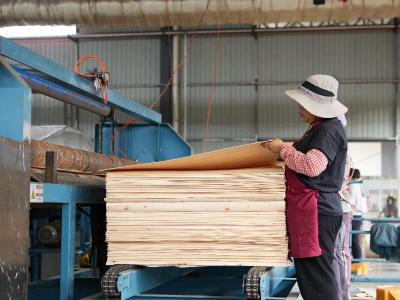
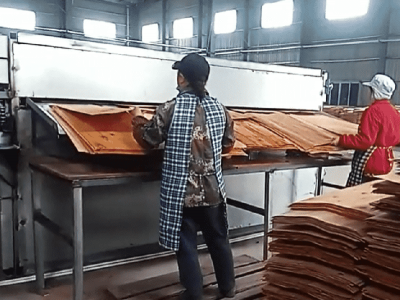
Raw material optimization and pretreatment are fundamental to improving plywood density. Currently, the loose texture and large gaps between wood fibers in the mainstream fast-growing timber are the root causes of insufficient density in finished products. To address this issue, companies first optimize material selection standards, prioritizing the use of hardwood veneers with tight grain and stable moisture content to replace low-density fast-growing mixed woods. Simultaneously, they have introduced high-temperature saturated steam softening pretreatment technology, softening the veneer with saturated steam at 150-175℃ for more than 3 minutes in a sealed environment. This softens the lignin and cellulose in the wood cell walls, reduces fiber hardness, and gives the veneer better compression bonding properties, reducing internal cavity defects in the board from the source. Furthermore, strict control of veneer moisture content, precisely maintaining it within the optimal range of 2.2%-6%, avoids problems such as bubbling during hot pressing due to excessive moisture content and insufficient compaction due to excessive moisture content, thus laying a solid foundation for high-density molding.
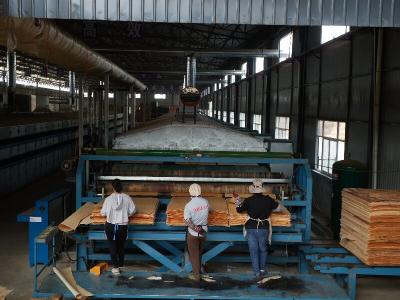
Refined control of hot pressing process parameters is the core process for improving plywood density. Through the synergistic effect of heat and pressure, the hot pressing process compresses the wood cell cavities and eliminates interlayer voids, resulting in a stable 10%-15% increase in overall board density. Industry standardized processes indicate that companies need to abandon traditional fixed-parameter processing methods and implement customized hot pressing solutions: Regarding pressure, conventional plywood uses a constant pressure of 2MPa for 3 minutes, while for thicker boards and industrial boards, the pressure is appropriately increased to ensure full reorganization and bonding of veneer fibers; regarding temperature, precise temperature control is achieved according to the type of adhesive used, with urea-formaldehyde resin suitable for 120-150℃ and phenolic resin suitable for 180-210℃. High temperatures accelerate lignin softening and adhesive curing, improving board density. Simultaneously, the pre-pressing process is standardized, using 10%-20% of the hot-pressing pressure for 1-3 minutes to pre-press the loose slab to 1.5-2 times the finished thickness. This prevents slab displacement and delamination during hot pressing, ensuring uniform and consistent board density.
The adhesive application process has been upgraded to effectively solidify the density stability of the board. As the core bonding material between plywood layers, insufficient adhesive application or uneven adhesive distribution directly leads to gaps between layers, reducing overall density and structural strength. Current high-end production lines have comprehensively optimized adhesive application standards, employing a precise adhesive application process using modified resin adhesive. With melamine-modified urea-formaldehyde resin as the core adhesive, the adhesive application amount on each side is consistently controlled above 130g/m², ensuring the adhesive layer fully fills the gaps in the veneer texture and between layers. Simultaneously, fully automated roller gluing equipment replaces manual gluing, achieving full and uniform glue coverage, eliminating localized glue shortages and thin glue areas. This ensures complete interlayer bonding under pressure, further improving overall density and structural integrity, and effectively preventing later quality issues such as delamination and deformation.
New board modification technology has been implemented, achieving a significant increase in density. With the iteration of wood industry technology, thermomechanical densification modification technology has gradually been industrialized, becoming a key means of improving the quality of high-end plywood. This technology pre-densifies the veneer through low-temperature thermal softening and vertical fiber high-pressure compression, controlling the veneer thickness compression ratio to around 50%, reshaping the wood fiber structure, and significantly increasing the veneer's base density. Plywood produced using alternating layers of densified and ordinary veneers not only has a uniform and controllable overall density, but also significantly improves core properties such as surface hardness, screw holding power, and compressive strength, making it precisely suited for high-end applications such as container flooring, high-end outdoor building materials, and heavy-duty furniture.
Industry insiders say that increasing plywood density is not simply about raising the numerical value, but rather about achieving a synergistic improvement in density, stability, and environmental friendliness through standardized, refined, and technologically advanced production processes. Currently, plywood with optimized processes can achieve a stable density control of 0.6-0.8 g/cm³, with minimal overall density deviation, fully meeting national standards for high-end wood-based panels. In the future, with the continued adoption of intelligent manufacturing and new modification technologies in the wood industry, high-density, high-performance, and high-stability plywood will gradually replace traditional low-end panels, driving the domestic wood industry towards refinement, high-end quality, and superior performance.