Español
 Русский
 Francés
 Português
 ภาษาไทย
 Indonesia
 Việt
Việt
 العربية
 Melayu



How to Use a Veneer Dryer Scientifically
How to Use a Veneer Dryer Scientifically
In the production process of plywood, blockboard, and other engineered wood products, veneer drying is a core process that determines the quality, production efficiency, and production cost of the finished product. As a specialized core piece of equipment, the scientific use of the veneer dryer directly affects the uniformity of veneer moisture content, flatness, and cracking/deformation rate, and is also related to the equipment's lifespan, energy consumption costs, and production line capacity stability.
Many panel processing plants often experience problems such as incomplete veneer drying, uneven drying, surface cracking, warping, or high equipment energy consumption, frequent malfunctions, and low drying efficiency. These problems are mostly not due to equipment quality issues, but rather to improper operation, unreasonable parameter settings, and inadequate maintenance. As a professional veneer dryer manufacturer, this article, combining the equipment's working principles with front-line production experience, comprehensively explains the scientific use of veneer dryers, covering the entire process from start-up preparation, parameter adjustment, standardized operation, categorized drying, daily maintenance, and troubleshooting, helping companies improve quality, increase efficiency, and reduce costs.
I. Standardized Preparations Before Start-up:
Laying a Solid Foundation for Drying The core principle of scientifically using a single-plate dryer is to inspect before feeding materials and then operate it. Avoid starting the machine with faults or blindly feeding materials, thus preventing drying defects and equipment malfunctions from the source.
1. Comprehensive Equipment Inspection Before starting the machine, a thorough inspection of the core components is necessary: First, check key components such as the hydraulic system, drive rollers, conveyor belt, fan, and heating coils. Ensure the conveyor belt is properly tensioned and free from misalignment or damage; the rollers rotate smoothly without jamming; the fan operates without abnormal noise; and the air outlet is unobstructed. Second, check the sealing structure, ensuring the equipment's inlet/outlet and body seals are intact to prevent hot air leakage that could lead to energy waste and uneven drying temperatures. Finally, check the electrical system, ensuring the wiring, switches, and temperature control instruments are normal; and that the water shortage, over-temperature, and overload protection devices are sensitive and effective to ensure safe equipment operation.
2. Operating Environment and Material Pre-treatment
Maintain good ventilation in the equipment operating area, free from debris accumulation, and ensure unobstructed drainage and dehumidification pipes to prevent excessive humidity from affecting drying efficiency. Simultaneously, pre-treat the veneers to be dried: screen and remove damaged, moldy, or excessively thick boards; sort and stack veneers according to tree species, thickness, and initial moisture content to avoid uneven drying caused by mixed materials; clean sawdust and debris from the veneer surface to prevent impurities from clogging the equipment's air ducts and affecting hot air circulation efficiency.
3. Equipment Preheating and Debugging
Do not feed materials immediately after startup; preheat under no-load conditions is required. Set basic preheating parameters according to the veneer material to stabilize the internal temperature and hot air circulation, eliminating temperature differences within the machine and preventing surface hardening and internal moisture buildup caused by low-temperature feeding, thus reducing the risk of cracking from the outset. The preheating time should be adjusted according to equipment specifications: 15-20 minutes for large continuous dryers and 10 minutes for small intermittent dryers.
II. Standardized Operation, Controlling the Core Drying Process The standardized operation of a veneer dryer directly determines the uniformity of drying. Whether it's a roller dryer, mesh belt dryer, or contact dryer, standardized feeding, temperature control, humidity control, and discharge processes must be followed, and arbitrary operation must be avoided.
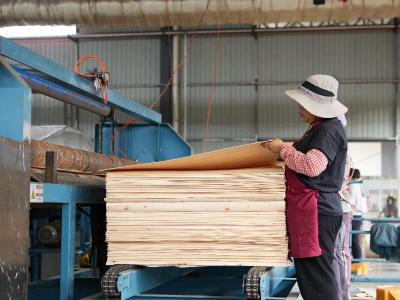
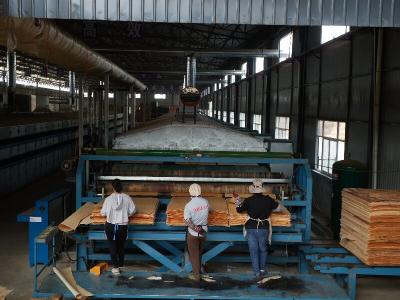
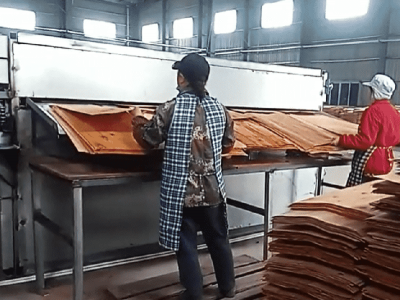
1. Uniform and Standardized Feeding When feeding, follow the principles of "flat and neat laying, uniform spacing, no overlap, and no gaps." The veneers should be laid flat on the mesh belt or roller, with reasonable ventilation gaps between the boards to ensure that hot air penetrates the boards from all directions, avoiding localized accumulation that leads to drying dead zones. For a whole batch of veneers, the feeding speed must be kept uniform and stable. Sudden changes in speed or concentrated batch feeding are strictly prohibited to prevent inconsistent drying times and excessive moisture content deviations between batches. For thinner, easily deformed softwood veneers, the feeding speed can be appropriately reduced to minimize mechanical stretching and deformation.
2. Segmented Gradient Drying, Eliminating High-Temperature Rapid Drying
The core challenge in wood drying is the uneven evaporation rate of moisture inside and outside the veneer. Scientific segmented gradient drying is key to avoiding deformation and cracking. The entire process is divided into three core stages, suitable for the drying needs of most solid wood veneers:
Stage 1: Preheating and Equilibrium Period. Continuing with the initial preheating parameters, this stage primarily softens the wood fibers, balances the temperature and moisture inside and outside the veneer, and opens the wood capillaries to prevent surface cracking caused by subsequent high-temperature rapid drying. The duration is adjusted according to the veneer thickness, generally 3-8 minutes.
Stage 2: High-Efficiency Dehydration Period. Gradually increasing the temperature to 85-105℃, fine-tuning the temperature according to the wood species and thickness, while simultaneously turning on the fan and adjusting the airflow speed to an economical 1-2 m/s. This ensures dehydration efficiency while avoiding excessively high airflow speeds that increase energy consumption and damage the veneer. This stage rapidly evaporates the free and adsorbed water inside the veneer and is the core of the drying process. For core board drying, the temperature can be appropriately increased to above 100℃ to improve production efficiency.
Stage 3: Stress Release Period. During the final stage of drying, the temperature is gradually reduced to around 50℃, and the strong hot air drying is stopped. The residual heat of the equipment is used to balance the moisture content of the veneer, releasing internal stress in the wood and ensuring completely uniform moisture and temperature throughout the veneer. Moisture content fluctuations are controlled within ±1.5%, significantly reducing the probability of warping and deformation later.
3. Scientific Dehumidification and Wind Speed Adjustment
During the drying process, the dehumidification system needs to be activated periodically to promptly remove high-humidity hot air from the equipment, preventing excessive humidity inside the machine from causing the veneer to become damp again and not dry thoroughly. Dehumidification is increased in the early and middle stages of drying to quickly remove evaporated moisture; dehumidification is reduced in the later stages to maintain stable humidity inside the machine. Simultaneously, the wind speed is adjusted according to the veneer material; excessively high wind speeds increase energy consumption, while excessively low wind speeds slow down dehydration.
III. Matching Parameters to Adapt to Different Veneer Drying Needs
Veneers of different tree species, thicknesses, and uses vary greatly in wood structure, moisture content, and heat resistance. General parameters cannot achieve optimal drying results; precise matching of specific process parameters is crucial for scientific machine use.
1. Matching Parameters by Tree Species: Softwoods like poplar veneer are porous and dehydrate quickly, with a target moisture content of around 12%, so a standard drying speed is sufficient. Birch veneer is fine-grained and prone to cracking and warping, requiring a low-temperature, slow-drying method to extend stress release time. Hardwoods like eucalyptus and mixed hardwood veneers are dense and moisture evaporates slowly, so the drying time can be appropriately extended to ensure complete removal of internal moisture.
2. Fine-tuning by Board Thickness and Intended Use: Thin veneers (1-3mm) have poor heat resistance, so low-temperature, low-speed drying is used to avoid high-temperature scorching and warping. Thicker veneers (over 3mm) require gradual temperature increases and extended dehydration time to ensure consistent drying throughout. Decorative veneers require lower maximum temperatures and a slower drying pace to protect the board's texture and color, preventing discoloration and graying. Industrial core boards can have their temperature appropriately increased and feeding speed accelerated, balancing drying quality and production efficiency.
IV. Standardized Shutdown and Equipment Maintenance Scientific machine use involves more than just operation; standardized shutdown and timely maintenance effectively extend equipment lifespan, ensure long-term stable and efficient operation, and reduce downtime costs.
1. Orderly Shutdown Operation After drying operations are completed, it is strictly forbidden to directly cut off the power to shut down the machine. First, stop feeding material and wait until all single boards have been completely discharged from the equipment. Then, turn off the heating system, but keep the fan and dehumidification system running for 5-10 minutes to dissipate residual heat and moisture, preventing high-temperature moisture residue from corroding the machine body and damaging components. Finally, turn off the hydraulic system and electrical power, reset all operating buttons and push rod devices, and complete the single operation process.
2. Daily Cleaning and Maintenance
After each day's operation, clean the conveyor belt, air ducts, and furnace to remove sawdust, dust, and residual debris. Prevent impurities from clogging air ducts, causing mold growth, and affecting hot air circulation and drying accuracy. Regularly inspect transmission components, bearings, and chains, and add lubricating oil as needed to ensure smooth operation. Weekly inspect heating coils, fans, and sealing strips, and replace any aged or damaged parts. Monthly calibrate temperature and humidity control instruments to ensure accurate parameter display and prevent drying defects caused by parameter deviations.
3. Long-Term Shutdown Protection
Before long-term shutdown, thoroughly clean the machine body of debris and accumulated water, keep the inside of the equipment dry, apply rust prevention treatment to metal parts, close equipment doors and windows, cover with dustproof materials, and disconnect the main power supply to prevent damage from moisture, dust accumulation, and rust.
V. Common Problem Avoidance and Scientific Machine Use Taboos
Based on millions of production cases, this article summarizes frequently violated user operating procedures and drying problems to help companies avoid production losses:
1. Avoid high-temperature rapid drying and low-temperature prolonged drying: Directly starting the machine at high temperatures will cause the veneer surface to dry rapidly and lock in internal moisture, leading to cracking and warping later. Prolonged low-temperature drying is not only extremely inefficient but also causes the veneer moisture content to exceed the standard, affecting subsequent gluing processes.
2. Avoid mixed materials and haphazard speed operation: Mixing veneers of different species and thicknesses for drying, and inconsistent feeding speeds, are the main causes of uneven drying and batch scrapping. Drying must be done by category, with uniform feeding speed.
3. Avoid operating with faults or without protection: Forcing the machine to start when the equipment's air ducts are blocked, the conveyor belt is misaligned, or the temperature control is malfunctioning will not only result in substandard drying quality but also increase equipment wear, cause overload and overheating malfunctions, and increase maintenance costs.
4. Never Neglect Moisture Content Testing: After drying, a professional moisture meter must be used to randomly check the moisture content of the boards. Based on the finished product data, equipment parameters should be fine-tuned to form a standardized closed-loop operation, ensuring stable batch product quality.
VI. Summary The core of scientific use of veneer dryers lies in standardized operation + precise parameter matching + routine maintenance. Abandoning extensive and experience-based operations, strictly implementing the full-process standards of start-up inspection, gradient drying, classified operation, and standardized maintenance can thoroughly solve quality problems such as veneer cracking, deformation, and uneven drying, steadily improving the finished product qualification rate. It also maximizes equipment performance, reduces energy consumption, and extends equipment lifespan, helping board processing enterprises achieve efficient, stable, and low-cost large-scale production.
As a professional veneer dryer manufacturer, we have been deeply involved in the research and development and production of drying equipment for many years. Our equipment is adapted to the drying needs of multiple tree species and specifications of veneer. Equipped with intelligent temperature control and automatic dehumidification systems, it is simple to operate, energy-efficient, and highly effective. We also provide customers with one-stop services such as customized drying process guidance and equipment operation and maintenance training to help enterprises improve quality and efficiency.