Español
 Русский
 Francés
 Português
 ภาษาไทย
 Indonesia
 Việt
Việt
 العربية
 Melayu


How To Choose A Wood Veneers Drying Machine?
How To Choose A Wood Veneers Drying Machine?
In the production of artificial veneerss such as plywood, fine wood panel, and decorative veneer, the drying of veneers is a key and crucial process that determines the quality, production efficiency, and production cost of the finished veneerss. Uneven moisture content of veneers, cracking during drying, veneers surface deformation, and inability to keep up with the production line speed are the most troublesome problems for most veneers factories during their initial operation.
When many purchasing customers choose veneer drying machines, they tend to only compare prices and only look at the size of the equipment, ignoring the matching degree of veneer material, thickness, moisture content, veneers entry process and equipment. Eventually, problems such as veneers surface cracking, warping, non-compliance with moisture content standards, high energy consumption, and equipment jamming or deviation occur, directly affecting the qualified rate of finished veneerss and causing a large amount of raw material loss.
As a professional manufacturer of single veneers drying machines, having deeply engaged in the research and production of veneers drying equipment for many years, we have sorted out a set of precise, practical, and error-free methods for selecting single veneers drying machines, based on the drying characteristics of various single veneerss such as poplar, eucalyptus, pine, and rubberwood. This helps veneers enterprises select according to their needs, stabilize production, and reduce costs while increasing efficiency.
1. Selecting based on veneer material and thickness is the basic core.
Different types of wood and different thicknesses of veneers have completely different water absorption properties, heat resistance levels, and shrinkage ratios. There is no universal model that can be adapted to all veneers. The first step in selection must be to benchmark the parameters of the veneers produced by oneself.
Selecting based on wood type
Softwood veneers: Soft texture, large wood fiber pores, fast dehydration speed, but prone to surface rapid drying, internal water retention, veneers surface blistering, and cracking problems. It is suitable to use low-temperature uniform-speed drying, hot air circulation uniform net belt type single veneers drying machines, with gentle temperature control and simultaneous internal and external dehydration, maximizing the protection of veneers surface integrity.
Hardwood veneers: Hard wood, dense structure, difficult dehydration during drying. During the drying process, it is prone to dry shrinkage and deformation. It is necessary to select equipment with large air volume, strong heat penetration, and sufficient drying stroke, combined with layered temperature control process, to ensure thorough drying of deep moisture and prevent finished veneerss from re-humidifying and cracking.
Select based on veneers thickness
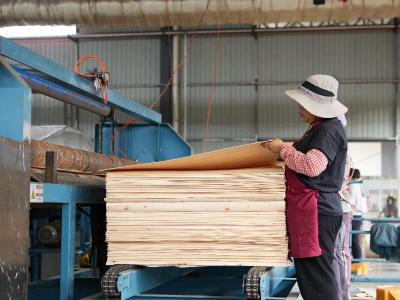
Bottom thickness veneerss: Extremely thin veneerss have poor toughness, are prone to damage and deviation, and are likely to get stuck on the conveyor. Therefore, a drying machine with precise speed control, flexible feeding, and anti-deviation devices must be selected. The conveying should be smooth and the wind speed gentle to avoid pulling and tearing the veneerss.
High thickness veneerss: Thick veneerss have a large water storage capacity and a slow dehydration process. They require a longer drying journey and a stronger hot air circulation system. It is recommended to use multi-layer and extended drying machines to ensure thorough drying of the veneerss and that the moisture content meets the standard uniformly.
II. Clarify production capacity requirements and match the production line rhythm
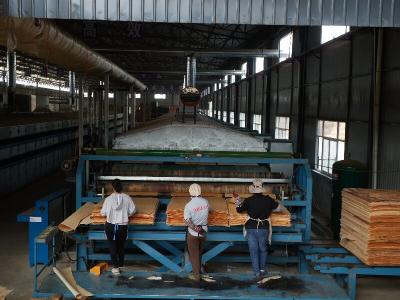
The veneers drying machine is a supporting equipment for the assembly line. The selection must be in line with the production capacity of the entire plywood production line to avoid situations where "small equipment cannot drive a large production line" or "large equipment is idle and wasted".
When selecting, focus on confirming two key data: First, the daily production volume/hour throughput of the veneers. Determine the number of layers and the length of the machine body based on the factory's assembly line capacity and order volume. Second, the initial moisture content of the veneers and the target moisture content. The moisture content of the wet veneerss after rotary cutting of logs is generally between 50% - 80%, and the standard moisture content for veneers production should be controlled at 8% - 12%. The greater the moisture difference, the longer the drying time required.
General selection suggestions: When the production line is operating at full capacity, reserve 10%–20% of capacity margin for the equipment to cope with situations such as higher moisture content of the veneerss during the rainy season and urgent production needs during peak seasons. This will prevent the equipment from operating at full capacity for a long time, reduce the probability of equipment failure and downtime, and ensure the continuous and stable operation of the production line.
III. Focus on the uniformity of drying, determining the finished product rate of the veneerss
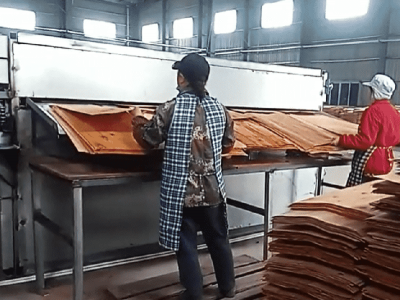
For veneers drying, the uniformity of drying is the core criterion for evaluating the quality of the equipment. If the ends of the veneerss are not dry or the moisture content on the front and back surfaces varies greatly, it will directly lead to uneven gluing, delamination during pressing, and warping and deformation of the veneerss, significantly reducing the qualified rate of the finished products.
Shine Machinery's veneers drying machine must have three core configurations to ensure uniform drying:
1. Control the internal temperature of the drying machine to be stable to avoid rapid heating and cracking. The temperature control accuracy of Shine Machinery's drying machine is within ±5℃.
2. All-round hot air circulation structure: Adopt a design of upward and downward bidirectional hot air supply, with strong heat penetration, no drying dead zones, ensuring consistent dehydration speed on both the front and back surfaces, and the error of the overall veneers moisture content is controlled in an extremely low range.
3. Precise speed regulation and conveying system: Adjust the conveying speed according to the material and thickness of the veneers, and the drying time is precisely controllable, eliminating problems such as burning thin veneerss and not drying thick veneerss.
IV. Select a reliable heat source to balance energy consumption and environmental protection
The energy consumption of drying is one of the main costs in veneers production, and compliance with environmental protection regulations is the prerequisite for the factory to continue production. When selecting, it is necessary to combine local environmental protection policies, production scale, and operating costs to choose the heat source.
1. Biomass heat source: The most cost-effective, stable heating, low energy consumption cost, is the mainstream choice for small and medium-sized veneers factories. Combined with professional dust removal equipment, it can meet emission standards, suitable for large-scale continuous drying of veneerss.
2. Air energy heat source: Clean zero emissions, constant temperature drying, good veneers surface effect, no smoke and dust pollution, suitable for areas with strict environmental protection regulations. The initial investment is slightly higher, but the long-term energy-saving effect is significant, suitable for high-quality decorative veneers drying.
3. Natural gas heat source: Fast heating, stable temperature, high drying efficiency, no impurities and pollution, suitable for medium-sized and large-scale veneers production lines, balancing efficiency and environmental protection.
4. Electric heating heat source: Precise temperature control, simple operation, no pollution, suitable for small-scale high-precision veneers drying scenarios. The operating cost is relatively high and is not suitable for large-scale mass production.
V. Verify the equipment process and details to ensure stability and durability
The veneers drying machine is a heavy-load equipment that operates 24 hours a day. The equipment process and material details directly determine the failure rate and service life. Low-quality and low-priced equipment is prone to problems such as veneers running off, carding, deformation of the conveyor belt, and severe heat leakage, which seriously affect the production rhythm. When purchasing, pay special attention to the following details:
1. Body insulation and sealing process: High-quality equipment uses thick and high-density insulation layers, the entire machine is sealed tightly, reducing heat loss, and significantly reducing energy consumption loss; the body frame is thickened and reinforced, not deformed or shaken under long-term high-temperature operation.
2. Anti-skid, anti-carding design: Equipped with professional deviation correction system and limit guide wheels to solve the problems of veneers running off, carding, and tearing of thin and narrow veneerss, reducing raw material loss.
3. Quality of core components: Conveyor belts, motors, temperature controllers, and air supply fans, etc., use industrial-grade quality, resistant to high temperatures, wear and tear, and have strong stability, suitable for long-term continuous production.
4. Automation configuration: Fully automatic models support one-click start and stop, intelligent constant temperature, automatic speed regulation, fault alarm, no need for dedicated personnel to monitor, significantly reducing labor costs, and the drying parameters can be stored to ensure the uniform quality of each batch of veneerss.
VI. Select a reliable manufacturer, refuse low-price tricks
The veneers drying machine is a customized industrial equipment, not a standardized universal product. The research and development strength, implementation experience, and after-sales guarantee of the manufacturer are crucial. Many middlemen and small workshops offer equipment at low prices, but they often have problems such as backward technology, false parameter marking, poor compatibility, and lack of after-sales service. The cost of later maintenance and renovation is extremely high.
When making a purchase, it is advisable to choose the original entity manufacturers that focus on veneers drying: Firstly, they have their own production workshops and can customize equipment according to the customer's veneers specifications, site size, and production capacity requirements; Secondly, they have rich case studies in the veneers industry and are familiar with the drying pain points of various veneerss, and can provide targeted process solutions; Thirdly, they offer a complete pre-sale, mid-sale, and after-sale system, including free on-site planning, installation and commissioning, worker technical training, whole-machine warranty, lifetime maintenance, rapid response to equipment failures, and minimizing downtime losses to the greatest extent. Summary
When choosing a wood veneers drying machine, the key factor is not to select the one with the lowest price and the largest body size, but to match it with your specific wood veneers material, thickness, production capacity, site conditions and environmental protection requirements. Prioritize ensuring uniform drying and the finished rate of the veneers surface, then take into account the equipment energy consumption, stability and service life. Finally, rely on the technical and after-sales support from a reputable original equipment manufacturer to truly achieve efficient production and cost reduction and efficiency improvement.
If you have specific requirements for wood veneers material, thickness, and daily production volume, please feel free to contact us. Our professional technical team will provide you with a customized wood veneers drying solution at no cost, offering one-stop services including process optimization, site planning, and equipment selection!