Español
 Русский
 Francés
 Português
 ภาษาไทย
 Indonesia
 Việt
Việt
 العربية
 Melayu


How Does A Veneer Dryer Work?
How Does a Veneer Dryer Work?
In plywood and wood veneer production lines, veneer drying is a critical process that determines the quality, yield rate, and production cost of the finished product. Wet veneers fresh from the rotary lathe have extremely high moisture content; proceeding directly to gluing and hot pressing often leads to issues such as delamination, deformation, cracking, and blistering. The function of a veneer dryer is to reliably dry these wet veneers to a standard moisture content of 6%–12%, providing suitable base material for subsequent gluing and hot-pressing stages. While many processing plants know the equipment works, they may not fully understand the drying principles or the specific advantages that set the equipment apart. This article breaks down the complete workflow of veneer dryers and details the core competitive strengths of our equipment.
I. Complete Working Principle of Veneer Dryers
Current mainstream veneer dryers fall into three categories: roller-type, mesh-belt type, and flip-plate type. Although their conveying mechanisms differ, they all share the same core working principle: heat and mass exchange via hot air circulation. Operating continuously and automatically, the process consists of four core stages, ensuring stable and consistent drying.
1. Automatic, Uniform Feeding and Stable Conveying to Prevent Damage
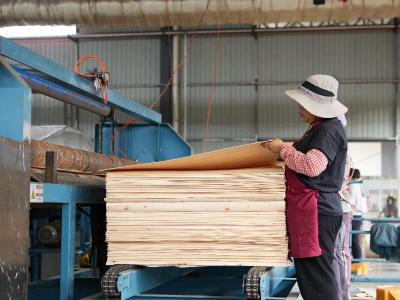
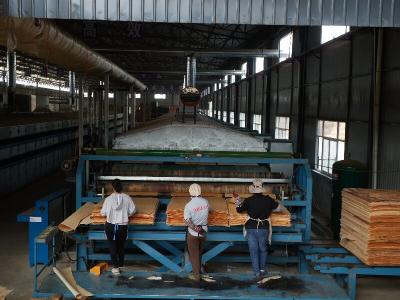
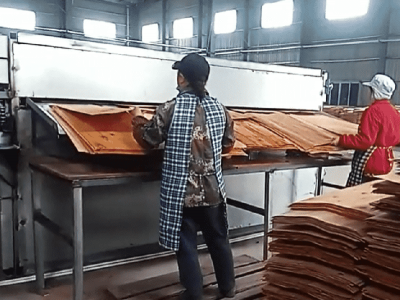
Wet veneers are automatically fed into the main drying unit. Depending on the specific model, they move forward at a uniform speed—held between upper and lower rollers, carried on a mesh belt, or transported via a multi-layer reciprocating flip-plate system. The entire conveying system operates smoothly, effectively preventing issues such as misalignment, wrinkling, overlapping, or jamming. Roller-type models offer the added benefit of lightly pressing the veneer surface during transport, correcting minor warping beforehand and laying the groundwork for uniform drying. The process requires minimal manual intervention, significantly reducing material waste caused by human error.
2. Zoned Temperature Control and Gradient Dehydration to Prevent Cracking
The equipment features a dedicated heat source system. Heated air is driven into the drying chamber by circulation fans and blasted at high speed vertically onto both the top and bottom surfaces of the veneer, facilitating comprehensive heat exchange. The drying chamber utilizes a three-stage gradient drying design, effectively eliminating the drawbacks associated with traditional single-stage high-temperature drying:
Preheating Stage: Gently preheats the wet veneer to soften wood fibers, preventing surface cracking or discoloration caused by sudden exposure to high heat;
Constant-Rate Drying Stage: The primary dehydration zone; rapidly evaporates free moisture from the veneer's surface and subsurface layers, significantly boosting drying efficiency;
Falling-Rate Drying Stage: Moderately lowers the temperature to slowly release bound moisture from within the wood, balancing internal and external moisture content; this fundamentally minimizes issues such as deformation, warping, and internal stress.
3. Intelligent Moisture Exhaust and Ventilation for an Optimized Drying Environment
High-humidity exhaust air generated during drying is continuously and evenly vented from the chamber via a dedicated system. This maintains a low-humidity internal environment in real-time, preventing moisture retention that could lead to re-dampening or uneven drying. Additionally, the equipment features a waste heat recovery system that recycles heat and minimizes loss, balancing drying performance with energy efficiency and environmental sustainability.
4. Cooling & Stabilization + Precision Moisture Detection for Compliant Output
After drying, the veneer enters a cooling stage for thermal stabilization, setting the veneer's shape and moisture content. An integrated online moisture detection system monitors every sheet in real-time, ensuring uniform compliance with moisture standards. Compliant veneers are automatically discharged for the next production step, enabling a fully automated, closed-loop process.
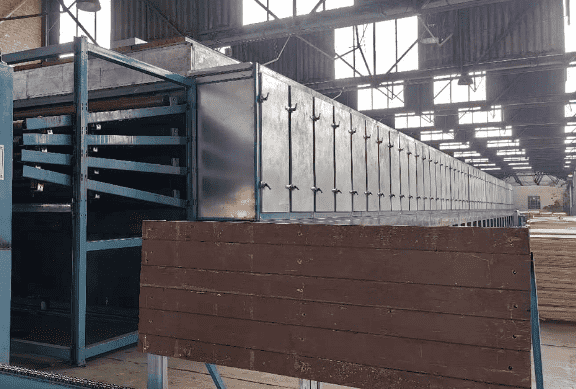
II. Core Differentiating Advantages Of Our Veneer Dryer
Standard dryers on the market often suffer from high energy consumption, uneven drying, high veneer breakage rates, poor adaptability, and high labor costs. Drawing on years of expertise in the R&D and manufacturing of wood drying equipment, we have optimized our technology to address these industry challenges. Our equipment offers five core advantages—high efficiency, low energy consumption, superior quality, high intelligence, and broad adaptability—making it ideal for large-scale production in veneer processing plants. 1. Energy Efficiency and Cost Reduction: Lower Production Costs, Higher Profit Margins
Equipped with a patented biomass combustion system, the equipment directly burns factory waste—such as scrap wood, sawdust, and offcuts—turning waste into a valuable resource. This replaces traditional heat sources like coal, steam, or thermal oil, drastically cutting fuel costs. It utilizes a combination of high-temperature roller contact heat transfer and dual-sided hot air circulation, achieving thermal efficiency exceeding 85%—an energy saving of over 30% compared to conventional dryers. With an overall drying cost of just 40–70 RMB per cubic meter, it significantly reduces long-term production expenses and boosts profit margins. Integrated waste heat recovery and dust removal systems ensure no heat is wasted while maintaining compliance with environmental standards.
2. Precision Intelligent Temperature Control: Uniform Drying and Superior Product Quality
Featuring a PLC intelligent control system and a touchscreen interface, the equipment offers temperature control precision within ±5°C and a stable operating range of 140°C–180°C. It automatically adjusts conveyor speed, hot air temperature, and exhaust airflow based on veneer thickness, initial moisture content, and wood species, ensuring intelligent, precise drying. A three-stage gradient drying process effectively eliminates common issues found in standard equipment—such as surface scorching, incomplete internal drying, cracking, warping, discoloration, and honeycomb structural defects. The resulting veneer boasts uniform, stable moisture content and a flat, wrinkle-free surface with excellent bonding properties, significantly increasing the qualified product rate.
3. Flexible Adaptation Across Specifications: Efficient Production Switching with Zero Downtime
The equipment offers exceptional compatibility, flexibly handling veneers ranging from 0.8mm to 8mm in thickness and reliably drying common wood species such as pine, poplar, and mixed hardwoods. No tooling changes or equipment recalibration are required, allowing for zero-downtime production switching and perfectly meeting the needs of diverse product categories and specifications. Multiple models—including roller, mesh belt, and flipper types—are available for flexible configuration based on factory size, capacity requirements, and veneer specifications, making it suitable for everything from compact workshops to large-scale production lines. 4. High level of automation: saves labor and boosts capacity
The entire machine operates via a fully automated process—including automatic feeding, drying, moisture exhaust, cooling, and discharging—eliminating the need for constant manual supervision and significantly reducing labor costs. The equipment runs reliably without tray jams or material blockages; its robust continuous operation capability increases production efficiency by over 40% compared to traditional equipment. Optional AI visual sorting and servo stacking modules enable automatic separation of high- and low-quality veneers and neat stacking without surface impact or damage, further enhancing automation levels and the quality of the finished product.
5. Rugged, durable, and low-maintenance
Constructed from thickened industrial-grade steel, the machine features a stable, heat-resistant, and wear-resistant body designed for long-term, high-intensity factory operations. Core components—including the drive system, airflow mechanism, and temperature controls—have been optimized for stability and ultra-low failure rates, effectively preventing issues such as tracking misalignment, air leakage, or temperature control malfunctions. The equipment’s rational structural design simplifies assembly, disassembly, and routine maintenance, drastically reducing long-term operating costs and losses from downtime; its extended service life offers superior cost-performance compared to similar products.
The core operating principle of a veneer dryer involves a scientific process of gradient heating, hot air circulation, real-time moisture exhaust, and cooling/stabilization to achieve efficient, uniform dewatering of wet veneer. Building upon these fundamental drying principles, our veneer dryer incorporates five major upgrades—intelligent temperature control, energy-efficient heat sourcing, flexible adaptability, automation enhancements, and quality optimization—to comprehensively resolve the pain points associated with traditional drying equipment. It ensures consistent drying quality and high pass rates while effectively reducing energy consumption, labor, and maintenance costs, making it the premier choice for plywood and wood veneer processing enterprises seeking to improve quality, boost efficiency, cut costs, and increase revenue.