Español
 Русский
 Francés
 Português
 ภาษาไทย
 Indonesia
 Việt
Việt
 العربية
 Melayu



Current State Of The Plywood And Wood Veneer Industry (2026)
Current State Of The Plywood And Wood Veneer Industry (2026)
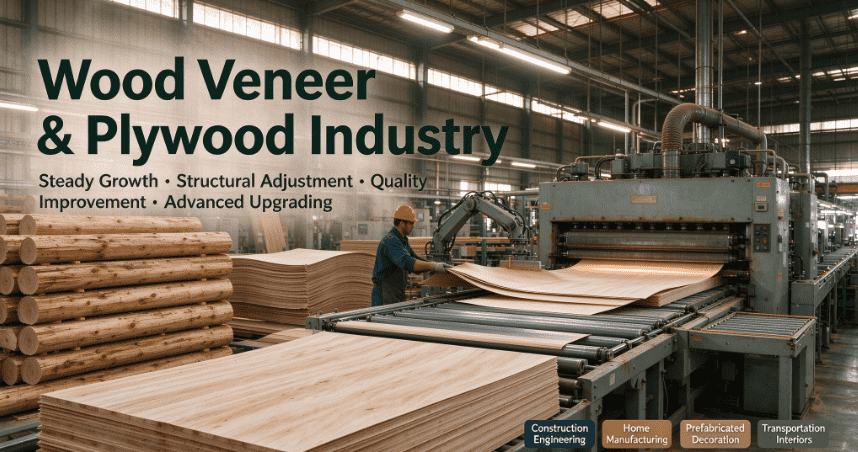
As core segments of the wood-based panel industry, wood veneer and plywood serve as fundamental supporting materials for sectors such as home furnishing manufacturing, construction engineering, prefabricated interior fit-outs, and transportation interiors. Thanks to their uniform texture, structural stability, excellent cost-performance ratio, and high adaptability, these products continue to command a major share of the wood-based panel market. By 2026, driven by factors such as the deepening of "Dual Carbon" policies, upgraded environmental standards, evolving downstream demand, and global supply chain adjustments, the industry has moved decisively beyond the phase of extensive capacity expansion. It has entered a new era of high-quality development characterized by quality upgrades, technological innovation, green transformation, and the expansion of application scenarios, resulting in fundamental shifts in the industrial landscape and competitive dynamics.
I. Industry Status: Steady Scale Expansion And Increasing Market Concentration
In recent years, the global plywood market has maintained steady growth. The global market size reached US$5.227 billion in 2025, with a projected compound annual growth rate (CAGR) of 5.00% for the 2026–2035 period, potentially exceeding US$8.5 billion by 2035. Driven by robust demand in infrastructure and home furnishing manufacturing, the Asia-Pacific region accounts for 57.32% of the global market share, establishing itself as a key hub for both consumption and production. The domestic market is also growing steadily; my country's wood veneer market size is projected to reach RMB 52.15 billion in 2026—a year-on-year increase of 7.2%—with growth drivers shifting entirely from traditional capacity expansion to deep penetration into downstream application scenarios.
Regarding the industrial landscape, trends toward scale and concentration are becoming increasingly apparent. In 2025, the top ten enterprises in the domestic plywood veneer industry held a combined market share of 16.8%, up 0.9 percentage points from 2024. Leading companies continue to squeeze the survival space of small and medium-sized workshops by leveraging advantages in raw material procurement, advanced production equipment, compliant and eco-friendly production capacity, and brand channels. The industry's past fragmented and disorderly landscape—characterized by numerous small, inefficient players—is gradually disintegrating; outdated production capacity is being rapidly phased out, while industry resources increasingly gravitate toward enterprises that are compliant, scaled, and intelligent.
In terms of supply and demand, the market for traditional construction formwork and basic panels used in residential furniture is approaching saturation, with competition driven primarily by price wars. Conversely, there is a supply shortage for high-end veneer and plywood products—specifically those that are formaldehyde-free, eco-friendly, moisture-resistant, flame-retardant, and structurally robust. The gap in high-end panel supply continues to widen across emerging sectors such as new energy vehicle interiors, prefabricated construction, high-end commercial fit-outs, and smart home applications. Consequently, the industry exhibits a structural imbalance: an oversupply of low-end capacity alongside a shortage of high-end products.
II. Core Industry Pain Points: Multiple Bottlenecks Constraining High-Quality Development
Despite the industry's overall steady growth, several development bottlenecks—spanning raw materials, environmental protection, technology, and the market—persist and hinder the pace of industrial upgrading.
1. Tight Raw Material Supply and Volatile Costs
The core raw materials for wood veneers and plywood are various types of logs; however, domestic high-quality timber resources are scarce, creating a heavy reliance on imports. Fluctuations in global timber trade policies, adjustments to cross-border tariffs, and shifts in supply structures from Southeast Asia and Russia cause perennial volatility in log procurement prices. In 2026, panel prices exhibited a fluctuating trend—dipping slightly in the first half of the year and rebounding steadily in the second—with an overall price fluctuation range of 3%–6%. Meanwhile, as high-quality hardwood log resources become increasingly scarce, procurement costs continue to rise; small and medium-sized enterprises (SMEs), lacking the bargaining power that comes with scale, face continuously shrinking profit margins.
2. Escalating Environmental Standards and Surging Compliance Pressure
With the full implementation of mandatory domestic standards for E0-grade (and superior) formaldehyde-free plywood, and the tightening of environmental policies—including "dual carbon" goals, pollutant discharge controls, and clean production mandates—the industry's environmental compliance threshold has risen significantly. Traditional SMEs often struggle with outdated equipment, obsolete gluing processes, substandard waste gas and wastewater treatment, and excessive formaldehyde emissions, making it difficult for them to meet the new environmental and quality standards. The continued shutdown of numerous non-compliant, small-scale production facilities—combined with surging costs for environmental protection equipment and cleaner production upgrades—has further raised the barriers to entry for the industry.
3. Uneven technical standards and low product value-added
Most domestic small and medium-sized enterprises (SMEs) still rely on traditional rotary cutting, hot pressing, and drying processes. These operations suffer from low levels of automation and intelligence, resulting in quality issues such as uneven veneer thickness, surface defects, and poor dimensional stability. The majority of companies focus on basic, commodity-grade panels; products are highly homogenized, lacking differentiation, functionality, or high-end positioning. With insufficient deep-processing capabilities and weak brand premiums, these firms remain trapped in a vicious cycle of low-price competition. In contrast, leading international companies have achieved integrated production featuring precise temperature control, intelligent sorting, and formaldehyde-free bonding, delivering product stability and functionality that far surpass standard domestic output.
4. Evolving downstream demand and insufficient adaptability
Traditional plywood and veneer products primarily serve the residential furniture and standard construction formwork markets—sectors that are nearing saturation. Meanwhile, emerging applications—such as prefabricated construction, new energy vehicle interiors, high-end custom home furnishings, outdoor engineering projects, and wellness/healthcare spaces—are rapidly expanding. These sectors demand superior performance regarding environmental safety, moisture and fire resistance, wear and deformation resistance, and aesthetic texture. Many traditional enterprises have failed to keep pace with these shifting demands; their slow product evolution renders them unable to meet the requirements of high-end, emerging markets, causing them to miss out on opportunities for growth.
III. Core Industry Development Trends For 2026
As industrial upgrading deepens, the sector is moving away from extensive, low-efficiency growth models. Over the next five years, the industry landscape will be reshaped by five core trends: green development, high-end positioning, intelligent manufacturing, application-specific solutions, and brand building.
1. Green, formaldehyde-free production becomes the industry standard
Driven by both the consumer shift toward eco-friendly products and mandatory regulatory standards, "formaldehyde-free," "low-VOC," and "low-carbon" attributes have become key competitive advantages. E0 and ENF-grade formaldehyde-free plywood and natural, eco-friendly solid wood veneers are becoming mainstream market products, while traditional formaldehyde-based adhesives and highly polluting production processes are being progressively phased out. The industry is accelerating the adoption of new bonding materials—such as plant-based adhesives and MDI-based formaldehyde-free glues—while simultaneously promoting energy conservation, waste reduction, and the recycling of wastewater and exhaust gases to build a green, full-chain production system. Low-carbon, eco-friendly production capacity is becoming a core advantage for enterprises regarding regulatory compliance and market competitiveness.
2. Intelligent production replacing traditional, crude manufacturing processes
The intelligent transformation of the industry is rapidly gaining momentum. Equipment for intelligent rotary cutting, automatic drying, precision hot-pressing, AI-based defect detection, intelligent sorting, and digital warehousing is becoming widespread, replacing labor-intensive, crude production methods. Intelligent production not only significantly improves dimensional accuracy, surface flatness, and product stability—thereby reducing defect rates—but also effectively boosts efficiency while lowering labor and energy costs. In the future, digital and intelligent production capabilities will serve as a key barrier to entry, allowing enterprises to differentiate themselves from low-to-mid-end producers and break into high-end markets.
3. Product upgrades toward functionalization, customization, and high-end positioning
The industry is moving decisively away from a landscape dominated by generic, one-size-fits-all products; creating differentiated, functional products tailored to specific application scenarios has become the mainstream trend. Market demand is surging for functional plywood—featuring moisture resistance, flame retardancy, insect resistance, deformation resistance, wear resistance, and high-temperature tolerance—as well as for ultra-thin decorative veneers, custom veneers with unique textures, and high-end pre-finished decorative panels. Simultaneously, specialized panels designed for new energy vehicle interiors, prefabricated building wall panels, high-end custom home furnishings, and outdoor landscaping projects are evolving rapidly. With product value-added significantly increased, high-end niche segments are becoming the industry's primary source of growth.
4. Rising industry concentration and the prominence of leading enterprises
The convergence of multiple barriers—environmental, technological, financial, and brand-related—is accelerating industry consolidation and weeding out small, outdated production capacities. Leading enterprises are capturing market share by leveraging economies of scale, stable raw material supply chains, advanced production technologies, and robust brand and distribution networks; consequently, industry concentration is expected to rise year by year. Furthermore, competition is shifting from a focus solely on products to a comprehensive contest involving supply chains, technology, branding, services, and customization capabilities, with large-scale, branded, and integrated enterprises poised to drive the industry's future development. 5. Continuous expansion of application scenarios and opening of growth potential
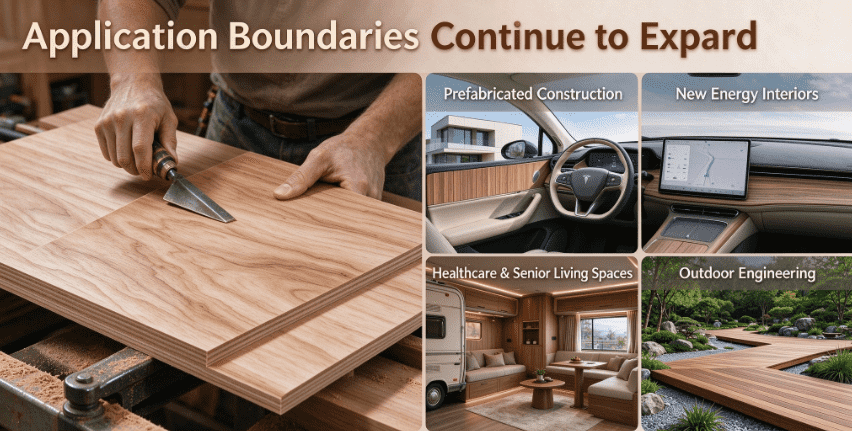
Beyond traditional sectors such as furniture, construction, and interior renovation, the application scope for wood veneers and plywood continues to widen. Emerging application scenarios—including wood interior trim for new energy vehicles (NEVs), interior panels for recreational vehicles (RVs), pre-finished formwork for prefabricated construction, panels for smart home systems, eco-friendly boards for wellness and elderly care facilities, and preservative-treated timber for outdoor landscaping—are rising rapidly, becoming new engines of industry growth. The upgrading of demand structures is driving the industry to shift decisively from a "production-capacity-driven" model to an "application-driven" one, providing the core momentum for continued industry expansion.
IV. Recommendations For The Upgrading And Development Of Industry Enterprises
Faced with industry transformation and market opportunities, enterprises must proactively move beyond the "race to the bottom" of low-price competition and focus on four core dimensions—quality, technology, application scenarios, and branding—to achieve transformation and upgrading. First, enterprises should target the "green" sector by comprehensively upgrading formaldehyde-free bonding processes and eco-friendly production equipment, while strategically establishing production capacity for high-end, ENF-grade eco-friendly boards. Second, they should advance intelligent transformation by introducing digital production equipment to improve product precision and yield rates, thereby reducing costs and increasing efficiency. Third, enterprises should cultivate niche application scenarios by developing functional and customized board products tailored to emerging markets such as high-end home furnishings, new energy vehicles, and prefabricated construction. Fourth, they should strengthen brand building and upgrade sales channels to escape commoditized, low-price competition and establish differentiated product advantages and brand reputation. Fifth, they should optimize supply chain layouts by establishing stable raw material procurement channels to hedge against the risk of log price fluctuations.
V. Future Industry Outlook
Overall, through 2026 and the years beyond, my country's plywood and wood veneer industry is poised to maintain a development trajectory characterized by steady growth, structural adjustment, quality improvement, and industrial upgrading. The era of extensive, low-efficiency growth has come to an end; the industry's development is now defined by a shift toward green practices, intelligent manufacturing, high-end positioning, and scenario-specific applications. Driven by the continued emergence of new downstream demand, ongoing technological innovation, and the continuous optimization of the industrial landscape, the industry is set to move beyond cutthroat competition at the low end. It is advancing toward a modernized wood-based panel sector characterized by high added value, high technological content, and strong brand influence. Poised to become a core global hub for the R&D, production, and export of high-end wood panels, the industry is seeing continuous improvements in its development quality and overall competitiveness.