Español
 Русский
 Francés
 Português
 ภาษาไทย
 Indonesia
 Việt
Việt
 العربية
 Melayu



Deepening Engagement With Furniture Material Needs And Driving Development Through Quality And Efficiency
Industry Optimization Recommendations For Veneer Manufacturers
As a core surfacing and base material for panel furniture and solid-wood veneered furniture, veneer—its quality stability, visual texture, physical properties, and environmental compliance—directly determines the aesthetic appeal, service life, and market reputation of the finished furniture. As the furniture industry moves toward greater refinement, standardization, and high-end positioning—coupled with rising demand for customization and exports—furniture enterprises have shifted their procurement standards from merely "functional" to "high-performance, stable, compliant, and well-matched." In contrast, the veneer industry still grapples with issues such as uneven thickness, inconsistent coloring, excessive moisture content, lax defect control, and poor batch-to-batch stability. These problems result in a mismatch between supply and demand, high rework rates, and significant customer attrition.
Based on current furniture material standards and end-user pain points, and aligning with industry trends toward intelligent manufacturing and green production, we offer the following recommendations for production, quality control, and service upgrades. These aim to help veneer manufacturers precisely meet market demands, enhance core competitiveness, and expand access to high-end clients.

I. Strictly Control Core Quality Indicators to Address Key Furniture Industry Pain Points
The primary requirements for furniture manufacturers sourcing veneer are consistent appearance, stable performance, and processing compatibility. Manufacturers must abandon crude production models, focus on the pain points of downstream processing, and refine quality control across the entire workflow to eliminate quality issues at the source.
Regarding visual quality control, manufacturers should establish detailed grading and sorting standards. Strict controls must be applied to defects such as knots, wormholes, cracks, blue stain, and decay, with clear definitions regarding the appropriate applications for different veneer grades. Veneer intended for high-end integrated furniture and solid-wood lacquered furniture must be free from decay, extensive blue stain, and prominent live or dead knots, featuring straight, continuous grain patterns. For mid-to-low-end cabinetry and internal furniture components, requirements regarding small knots may be moderately relaxed; however, moldy or blackened boards are strictly prohibited. Furthermore, batch-to-batch color consistency is critical; veneer of the same species and batch must exhibit uniform color to prevent uneven coloring in finished furniture sets and the associated need for rework or color correction. To address pain points in the veneering process, it is essential to strictly control the size of loose pores and fissures on the back of the veneer. This prevents issues such as glue bleed-through, blistering, and telegraphing (where the substrate texture shows through) during the subsequent furniture veneering stage, thereby ensuring a smooth, uniform finish.
Regarding dimensional accuracy, the focus should be on standardized, high-precision production. Since the furniture industry typically utilizes veneers ranging from 0.6 mm to 1.7 mm in thickness, manufacturers must rely on high-precision CNC rotary-cutting equipment to minimize thickness variations across individual sheets. This eliminates surface irregularities and wrinkling caused by inconsistent thickness. Furthermore, standards for flatness must be enforced through proper leveling and setting treatments for finished sheets; preventing curling and warping reduces material waste during secondary processing at furniture factories.
Moisture content management requires a strategy of precise, region-specific adaptation. Moisture content is a primary cause of veneer deformation, cracking, and mold growth, making it a critical quality indicator for furniture materials. Manufacturers should move away from a "one-size-fits-all" drying approach and instead tailor moisture content standards to specific sales regions: maintaining 6%–12% for the general domestic market to align with regional equilibrium moisture levels; strictly controlling it at 6%–9% for exports to Europe and North America; and allowing for a slightly wider range for exports to tropical regions. Consistency within batches is also vital; preventing uneven drying within the same roll or batch eliminates the root causes of post-sale issues such as cracking, warping, mold, and delamination in finished furniture.
II. Optimizing Production Processes: Improving Quality, Reducing Costs, and Increasing Yield
Competition in the veneer industry is intensifying, and furniture clients prioritize quality alongside cost-effectiveness and supply stability. Manufacturers must achieve simultaneous breakthroughs in quality enhancement and cost control through process upgrades, equipment modernization, and lean production methods.
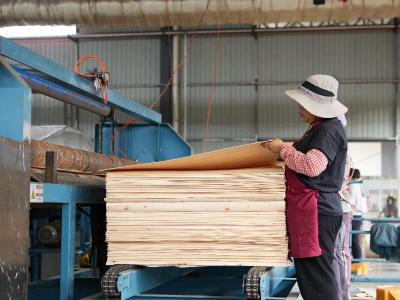
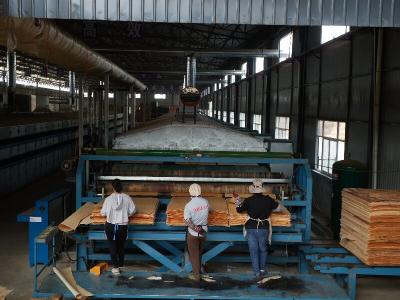
On one hand, manufacturers should advance the intelligent upgrading of equipment to boost production precision and efficiency. Outdated, crude rotary-cutting machinery should be replaced with fully automated CNC spindleless rotary cutters, intelligent leveling machines, and precision sanding equipment. Leveraging digital control systems allows for the automatic adjustment of cutting parameters—such as adapting to log curvature and regulating veneer thickness—and enables the efficient utilization of small-diameter logs, effectively increasing wood utilization rates by over 10%. The introduction of AI-driven veneer selection and layout technologies replaces traditional manual sorting, significantly reducing human error. This enables standardized grading based on grain, defects, and color variations, ensuring highly consistent product quality across batches.
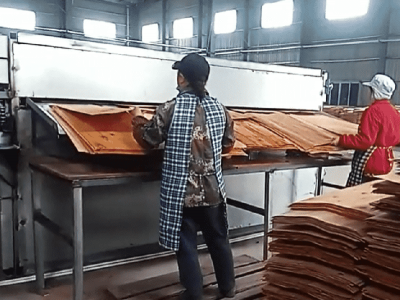
Furthermore, process details are optimized throughout the workflow to minimize processing waste. Log pretreatment procedures—including debarking, impurity removal, and sterilization—are standardized to eliminate bark and debris residues, thereby preventing scratches on furniture topcoats and ensuring a flawless finish. Drying and conditioning processes are refined using a staged constant-temperature drying method combined with natural conditioning; this relieves internal veneer stress and enhances toughness, reducing breakage during subsequent cutting and lamination. Additionally, a closed-loop production data system tracks material loss, defect types, and yield rates, allowing for targeted optimization of layout, rotary cutting, and trimming processes to continuously reduce waste.
III. Benchmarking Industry Standards and Strengthening Environmental Compliance
As domestic environmental regulations tighten and entry barriers for furniture export markets rise, environmental compliance has become a critical prerequisite for veneer manufacturers—and a fundamental requirement for securing contracts with high-end furniture brands and international buyers.
For the domestic market, operations must strictly align with national standards and environmental regulations governing wood-based panels used in furniture. Although raw wood veneers are inherently formaldehyde-free, strict controls are applied to chemical residues from anti-mold agents, preservatives, and cleaning agents. This prevents issues such as pungent odors or excessive chemical residues, ensuring products meet the GB 18580 environmental standard for interior decoration materials and satisfy mainstream demand for whole-home customization and residential furniture.
Export and high-end markets require adherence to rigorous international standards. For veneers destined for furniture markets in Europe, the Americas, and Southeast Asia, the company proactively benchmarks against standards such as CARB P2, EPA, and EU CE certification. Additive formulas are optimized, and formaldehyde-free, low-VOC auxiliary materials are promoted to create an eco-friendly product portfolio. For veneers used in children's furniture and high-end wellness/healthcare furniture, controls on heavy metals and harmful residues are further tightened to meet safety and compliance requirements specific to these market segments. Manufacturers are also advised to refine their quality control systems by establishing a three-tier inspection protocol—comprising mandatory first-piece inspection, in-process patrol inspections, and final product inspections. Each aspect—including thickness, moisture content, flatness, defects, and environmental compliance—should be tested individually, with comprehensive inspection reports issued to ensure product traceability and boost customer confidence.
IV. Tailor offerings to specific furniture segments and provide differentiated customization services
The modern furniture industry features distinct application scenarios; material requirements vary vastly across categories such as whole-home custom furnishing, curved designs, outdoor furniture, and high-end solid wood furniture. Standardized veneers can no longer meet these diverse market needs. Manufacturers must move beyond the mindset of "mass-produced homogenization," focus on specific market segments, and create differentiated products and services.
For standard panel furniture, prioritize high-stability, cost-effective, general-purpose veneers that ensure uniform grain, compliant moisture content, and a lack of major defects, thereby meeting the needs of mass-producing cabinet bodies and door panels. For furniture featuring curved or irregular shapes, offer high-toughness veneers; optimize rotary cutting and conditioning processes to enhance bending performance, ensuring suitability for cold-bending fabrication while minimizing the risk of cracking or spring-back. For humid environments—such as outdoor settings or bathroom vanities—optimize anti-corrosion and anti-mold treatments to improve moisture and weather resistance, meeting the specific material requirements for these environments.
Simultaneously, optimize supporting services to align with furniture manufacturers' processing workflows. Offer customization for thickness, grain, and dimensions, and provide services such as batch-matched coloring and continuous grain patterns across full sheets to reduce the costs associated with splicing and color matching at the factory level. For key accounts and long-term partners, provide technical guidance on moisture content matching and material selection to help reduce processing rework rates, thereby fostering a long-term, mutually beneficial partnership model.
V. Standardize quality control and delivery to build a lasting market reputation
The furniture industry relies on continuous mass production, placing extremely high demands on the stability, consistency, and timeliness of veneer supplies. Many manufacturers lose customers not because their product quality fails to meet standards, but due to issues such as batch mismanagement, unreliable delivery, and inadequate after-sales support.
On the production side, strict batch management must be implemented. Veneers of different species, grades, and moisture content levels should be stored in separate zones and clearly labeled to prevent mixed shipments, ensuring consistent quality for every customer order. In warehousing, measures are taken to prevent moisture, mold, and warping; boards are stored in climate-controlled environments to avoid post-production deterioration or moisture absorption, thereby ensuring quality upon delivery.
Regarding after-sales service, a rapid response mechanism has been established to address issues reported by customers—such as glue bleed-through, cracking, color inconsistency, and excessive moisture content—through quick root-cause analysis and timely resolution. This process runs in tandem with production optimization, creating a "production-feedback-optimization" closed-loop system. Furthermore, the company rejects the mindset of competing on low prices and poor quality; instead, it focuses on stable quality, precise product suitability, and excellent service to build a strong reputation among end-users and break free from commoditized price wars.
Conclusion
Veneer serves as both the "face" and the foundational structure of furniture products. The evolution and upgrading of the furniture industry are compelling upstream veneer manufacturers to transition toward precision, standardization, intelligent operations, and eco-friendly practices. To succeed, veneer manufacturers must deeply understand the pain points associated with end-use materials, strictly control quality details, upgrade production processes, cater to niche market needs, and adhere to compliance standards. Only by doing so can they precisely meet the furniture industry's demand for high-quality development, secure a firm foothold amidst fierce market competition, and achieve comprehensive breakthroughs in quality improvement, cost reduction, efficiency enhancement, and customer base expansion.