Español
 Русский
 Francés
 Português
 ภาษาไทย
 Indonesia
 Việt
Việt
 العربية
 Melayu



Integrating Waste Heat Utilization: Achieving Precise Matching Between Kiln Waste Heat and Veneer Drying
Integrating Waste Heat Utilization: Achieving Precise Matching Between Kiln Waste Heat and Veneer Drying
Faced with the dual pressures of "Dual Carbon" goals and rising energy costs, waste heat from industrial kilns is no longer merely "flue gas" destined for discharge; it has become a revalued energy asset. Meanwhile, veneer drying—a highly energy-intensive stage in plywood production—urgently requires a heat source that is more economical, cleaner, and more stable. As the "waste heat" from the kiln industry meets the "heat demand" of the wood industry, an energy synergy centered on "cascaded utilization and precise matching" is rapidly taking shape. As a specialized manufacturer deeply engaged in veneer drying equipment, we focus on a critical engineering challenge: how to most precisely convert every unit of waste heat discharged from the kiln into a unit of effective thermal energy for the veneer drying line. This article explores the strategies for matching kiln waste heat with veneer drying processes within the context of comprehensive energy utilization projects across diverse kiln-based industries.
I. Kiln Waste Heat: The Discarded "Second Energy Source"
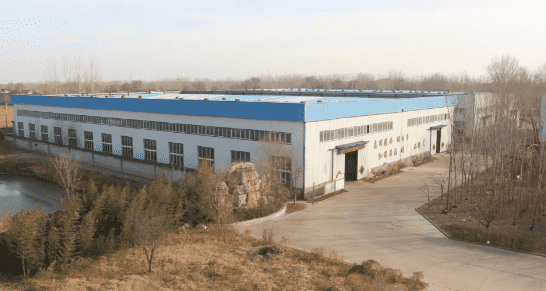
Industries such as brick and tile, ceramics, glass, and lime manufacturing share a core process of "fuel combustion followed by high-temperature firing," continuously discharging large volumes of hot flue gas during operation. Industry data indicates that heat loss carried away by exhaust gas from firing tunnel kilns accounts for approximately 20% to 40% of the total heat input. Domestic tunnel kiln exhaust temperatures generally range from 200°C to 300°C, with some exceeding 400°C. Venting this heat directly into the atmosphere represents a continuous waste; conversely, recovering and utilizing it effectively opens up a stable, cost-free "second energy source" for kiln enterprises.
However, waste heat has its own distinct characteristics. First, it varies in "grade" (temperature level), requiring matching with specific heat demands based on temperature tiers. Second, while the heat flow is continuous, it fluctuates in sync with production cycles, necessitating buffering and regulation. Third, the flue gas contains dust and corrosive components, making it unsuitable for direct introduction into the drying process. Therefore, the core challenge of waste heat utilization is not simply "how much heat is recovered," but rather "delivering heat at each temperature level to the specific station that needs it most"—this is the essence of "temperature-matched, cascaded utilization." Industry practice typically categorizes waste heat into three grades—high, medium, and low—matching them to specific applications such as power generation, process heating, and heat exchange for space heating. The *Guidelines for Cascade Comprehensive Utilization of Industrial Waste Heat* also recommend prioritizing medium-to-high-temperature hot air (above 250°C) for combustion air preheating and waste heat boilers, while utilizing hot air below 250°C for low-temperature processes like drying.
II. Veneer Drying: A Process Demanding Specific Thermal Conditions
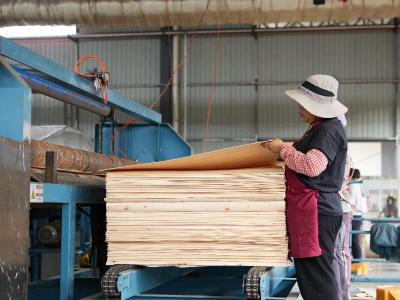
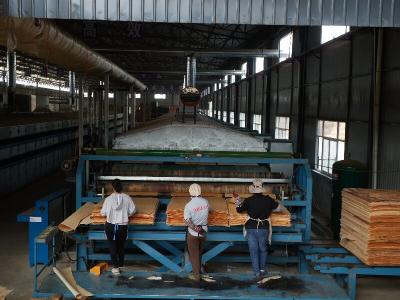
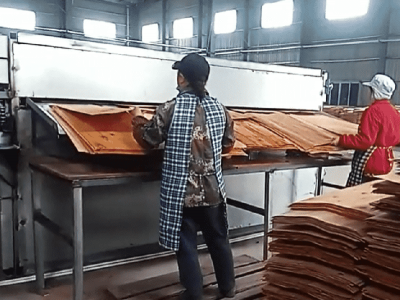
Veneer serves as the fundamental building block of plywood. Freshly rotary-cut veneer typically has a moisture content of 40%–60% (or even higher for certain species); it must be dried to a level of 6%–12% to meet quality standards for gluing and assembly. Mainstream veneer dryers (such as roller and mesh-belt types) generally operate at temperatures between 160°C and 180°C. They feature distinct temperature zones—preheating, drying, equalization, and cooling—arranged along the direction of transport. Precise control of moisture content is achieved by regulating these zones alongside airflow velocity and humidity exhaust.
Contrary to intuition, veneer drying is highly demanding regarding the heat source. Veneers are thin and their fibers are heat-sensitive; excessive temperatures cause cracking, warping, and discoloration, while insufficient heat leads to incomplete drying and compromised bonding quality. The hot air must be clean; dust and corrosive components in flue gas can cause surface contamination and quality defects upon contact. Furthermore, the process requires a heat source that is stable, adjustable, and capable of maintaining distinct temperature zones, rather than relying on a uniform, unvarying heat source. In short, veneer drying requires not merely "higher heat," but rather "precise heat supply tailored to specific temperature requirements."
III. Precise Matching: A Three-Tiered Integration of Kiln Waste Heat and Veneer Drying
In our comprehensive energy utilization projects for diverse kiln industries, we employ a strategy of grading kiln waste heat by quality level and then matching each grade to the corresponding temperature zone of the veneer dryer, creating a "three-stage" precise matching system.
High-temperature stage (typically above 450°C): Waste heat is processed via waste heat boilers or thermal oil heat exchangers to generate steam and high-temperature hot air. This energy meets the high-grade thermal load requirements of the primary drying zone, thereby offsetting energy consumption from existing gas-fired or steam boilers. Medium-temperature stage (250–450°C): Through gas-to-gas heat exchange, clean hot air at 160–180°C is produced to serve directly as the primary heat source for the drying zone. This is the primary stage for integrating kiln waste heat with veneer drying and represents the range with the highest value for waste heat recovery.
Low-temperature stage (below 250°C): Used for gentle heating in the preheating and equalization zones, as well as for auxiliary heating needs such as workshop space heating and makeup water preheating, enabling the on-site utilization of low-grade heat.
Three temperature stages, three heat exchange tiers, and three temperature zones: high temperature for high-load requirements, medium temperature for the primary heat source, and low temperature for auxiliary heating. Furthermore, exhaust air from the dryer can be recovered and reused to preheat combustion-supporting air and makeup water, creating a "kiln-dryer-heat recovery" closed loop. This allows waste heat to circulate multiple times within the system, further minimizing primary energy consumption.
IV. From "Functional" to "High-Performance": The Engineering Capabilities of Dryer Manufacturers
The architecture of cascaded waste heat utilization is not complex; the real challenge lies in effective implementation. As a veneer dryer manufacturer, we provide not merely a standalone piece of equipment, but a comprehensive system solution integrating heat sources, equipment, and processes. The core lies in four types of matching:
Matching temperature zones with heat sources. We customize the dryer's temperature zone structure and hot air distribution scheme based on the kiln's actual temperature profile and flue gas volume. This ensures that the thermal load of each zone aligns precisely with the corresponding grade of waste heat, avoiding inefficiencies caused by mismatched capacities (such as using excessive power for a small load or insufficient power for a large load).
Matching cleanliness requirements. Waste heat does not equate to "dirty" heat. Heat exchangers are selected with corrosion-resistant materials suited to the flue gas composition and equipped with dust removal and dew-point control systems. This ensures the hot air entering the dryer is clean and dry, with absolutely no direct contact between the flue gas and the veneer.
Matching control systems. A closed-loop control system is established using cold-air mixing valves, variable-frequency fans, and online moisture content monitoring. The system automatically adjusts air temperature and volume in response to fluctuations in kiln heat supply and inversely adjusts heat extraction loads when drying requirements change, thereby achieving dynamic balance. Fluctuation matching. By configuring thermal storage buffers and multi-source complementary systems, the drying line maintains stable operation during kiln maintenance, production ramp-ups, or product changeovers, ensuring production schedules remain uninterrupted by fluctuations in the heat source.
V. Benefits and Prospects
In terms of direct benefits, replacing primary energy sources—such as natural gas or steam—with waste heat from kilns significantly reduces fuel costs for veneer drying. Recovering the 20%–40% of firing heat loss that would otherwise be vented [1] translates to lower unit energy consumption and reduced carbon emissions for the same production capacity. Regarding industry prospects, the cross-sector synergy between the kiln industry (energy supply) and the wood industry (energy consumption) is fostering a park-level model of cascaded energy utilization. This involves integrating waste heat from multiple kilns, centralized heat exchange, and unified dispatching, allowing veneer drying, board conditioning, and space heating to draw upon the heat as needed. This represents not only a win-win for both industries but also a crucial component of regional green manufacturing and the development of "zero-carbon industrial parks."
The diversified kiln energy utilization project is, at its core, an engineering initiative to "re-evaluate the value of waste heat." Every unit of waste heat from the kiln deserves to be matched with the optimal temperature zone on the veneer drying line, while every unit of heat consumed in veneer drying should ideally come from a clean, cost-effective, and stable waste heat source. As a manufacturer of veneer dryers, we are committed to leveraging our integrated capabilities—spanning heat source matching, equipment customization, and system integration—to collaborate with partners in the kiln and wood industries in making waste heat utilization a practical, detailed, and long-term success.