Español
 Русский
 Francés
 Português
 ภาษาไทย
 Indonesia
 Việt
 العربية
 Melayu


Preventing Moisture Reabsorption In Veneers During the Rainy Season
Preventing Moisture Reabsorption In Veneers During the Rainy Season
As the rainy season arrives, atmospheric humidity rises significantly. Rain, ground-level moisture, and condensation within the workshop are primary causes of veneers absorbing moisture. Once a veneer absorbs moisture, its moisture content spikes, leading to issues such as surface darkening, mold growth, warping, and uneven moisture distribution. This can subsequently cause bond failure during hot pressing, delamination of plywood, and an increase in defect rates—directly compromising finished product quality and order fulfillment. Preventing moisture reabsorption in veneers is not a task for a single stage; it requires a systematic approach covering five key areas: the drying process, cooling and transport, storage and stacking, the workshop environment, and routine inspections. The goal is to minimize moisture uptake at the source.
Drying serves as the first line of defense and the most fundamental aspect of moisture control. In many factories, the root cause of veneer moisture reabsorption during the rainy season is not a leaking warehouse, but rather a drying process that fails to account for potential moisture uptake. Under normal conditions, veneer moisture content is typically maintained between 6% and 8%. During the high-humidity rainy season, it is advisable to target the lower end of this acceptable range to provide a "buffer" against moisture reabsorption. Furthermore, it is crucial to avoid "case hardening"—a phenomenon where the surface dries and crusts over while the core remains damp. This occurs when temperatures rise too rapidly or hot air distribution is uneven, trapping internal moisture. Over time, this trapped moisture migrates outward, causing the veneer to soften and develop localized dark spots. Ideally, a low-temperature, slow-drying approach with multi-stage temperature control should be employed, supported by intelligent, real-time moisture monitoring to ensure consistent moisture levels throughout the entire veneer. Drying equipment must also feature effective moisture extraction to prevent water vapor from stagnating within the drying chamber, which could otherwise lead to the veneer reabsorbing moisture before it even exits the machine. Veneers derived from species like eucalyptus or rubberwood—which have high sugar content and a high proportion of thin-walled cells—are particularly prone to moisture absorption and mold. Such veneers should be fed into the drying line as soon as possible after rotary cutting; they should never be left stacked in the open for extended periods while awaiting drying. Veneer emerging from the dryer is at a high temperature, making it highly susceptible to condensation and moisture re-absorption—a stage often overlooked during cooling and transport. When hot veneer enters a high-humidity workshop, the temperature differential causes an invisible layer of condensation to form on the surface; this is a primary reason for the unexplained moisture gain in veneers during the rainy season. After drying, veneers should be moved to a dedicated cooling zone—an enclosed, dehumidified space where they can cool down gradually. Never move hot veneers directly into open workshop areas or corridors. During transport, ensure that conveyor belts and handling racks remain dry, and promptly clear any standing water from the floor; also, ensure that the bases of transport carts and storage crates are free of accumulated water. Only after the veneer has cooled and its moisture content has been re-verified as acceptable should it be packed and moved to storage—this prevents the issue of veneers being "dry on the outside but damp on the inside" or entering storage with surface condensation.
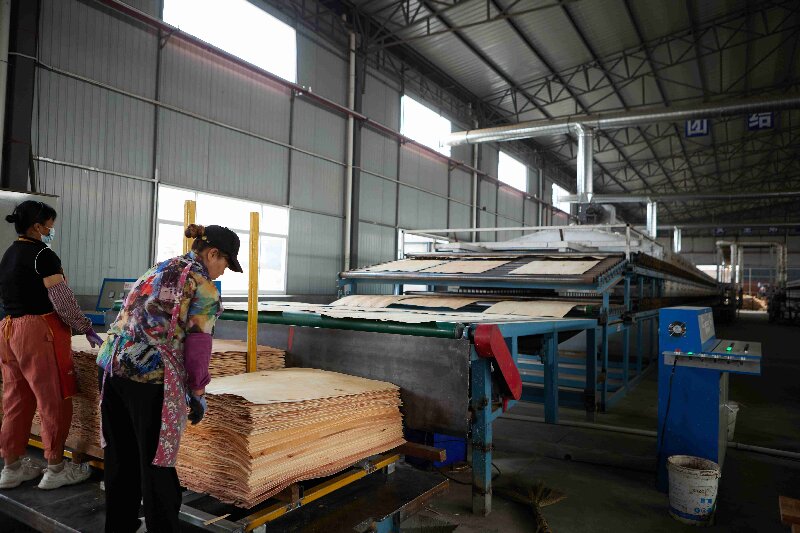
Warehouse management is the most critical aspect of moisture control during the rainy season; proper zoning, stacking methods, and protective isolation are all essential. First, the warehouse must be clearly divided: dry and wet veneers must be stored separately—never mixed. Since the warehouse floor is a major source of moisture, veneer stacks must never be placed directly on the ground; they must be elevated at least 10 cm using wooden dunnage or plastic pallets to prevent moisture from rising via capillary action. Leave ventilation channels at the base of each stack to facilitate airflow and prevent the bottom layers from becoming damp and stagnant. Avoid stacking veneers too tightly or too high; maintain gaps between stacks to allow moisture to dissipate. Additionally, limit the number of veneers per stack to prevent the core of the stack from becoming trapped in a humid, enclosed environment.
Ideally, warehouse humidity should be kept stable at or below 65%. During the rainy season, if outdoor humidity exceeds 75%, keep doors and windows closed and operate dehumidifiers or industrial moisture-removal equipment—do not open windows for ventilation. Keep doors and windows tightly shut during the early morning and evening, on rainy days, or during periods of high ambient humidity. Only open them briefly for ventilation when the outdoor humidity is significantly lower than the humidity inside the warehouse, thereby preventing large volumes of humid outdoor air from entering. The use of rainproof tarpaulins requires careful attention. When covering stacks of veneers during rainy weather, do not seal them completely; a fully enclosed stack will cause condensation to form inside. Ensure the cover provides protection from rain while allowing for airflow. Replace any damaged tarpaulins promptly to prevent rainwater from seeping into the stacks. For long-term storage, finished veneers can be wrapped in PE film, supplemented with anti-mold strips and desiccant packets to block moisture penetration. Pay special attention to protecting the ends and sides of the veneers, as these are the most vulnerable points for moisture absorption.
Environmental control within the production workshop must be maintained throughout the entire process—from rotary cutting and sorting to feeding and hot pressing. During the rainy season, roofs, walls, and pipes in the workshop are prone to leaks and condensation. Proactively inspect for roof leaks or points where condensation might drip, and install drainage or collection systems to ensure water does not fall onto the veneers. Keep the workshop floor dry by promptly clearing any standing water and ensuring that drainage channels remain unobstructed. Store raw logs and wood segments away from the main production area to prevent the moisture they release from increasing the overall humidity of the workshop. Do not leave veneers on sorting tables or buffer racks for extended periods; retrieve them only as needed to minimize their exposure to high-humidity conditions. The workshop can also be equipped with dehumidification units to stabilize humidity levels, reduce the moisture differential between the veneers and the environment, and slow down the rate of moisture absorption.
Effective daily management and emergency response protocols are essential for maintaining moisture control. First, establish a routine moisture content sampling mechanism—testing at the points of discharge, warehousing, and dispatch—and keep detailed records. If moisture content is found to exceed limits, isolate the affected veneers; prioritize them for immediate use or re-drying, and ensure they do not proceed to the next stage of production. Second, enforce strict operational standards for personnel involved in transport and stacking; specifically, prohibit handling veneers with wet hands or wet tools. Third, prepare a contingency plan for mold prevention. For veneers that show minor, early-stage dampness, prioritize low-temperature ventilation to dissipate moisture—avoid rapid, high-temperature drying, which can cause the veneers to crack or curl. Veneers that have already developed mold should be isolated and treated separately to prevent mold spores from spreading and contaminating the entire stack. In summary, the dampening of wood veneers during the rainy season is essentially a process of moisture exchange between the veneers and a humid environment. Effectively controlling the moisture content of veneers requires more than just covering stacks with tarpaulins in the warehouse; it demands a coordinated, end-to-end process. This includes allowing for a moisture margin during drying, preventing condensation during cooling, ensuring moisture-proof and well-ventilated storage, controlling humidity in the production workshop, and maintaining a closed-loop inspection system. By managing humidity differentials and minimizing the exposure of veneers to water vapor, manufacturers can stabilize veneer quality, mitigate issues such as mold growth, warping, and poor bonding, and ultimately reduce production losses during the rainy season.