Español
 Русский
 Francés
 Português
 ภาษาไทย
 Indonesia
 Việt
 العربية
 Melayu



Why Eucalyptus Veneer Drying Requires Higher-Capacity Dryers
Why Eucalyptus Veneer Drying Requires Higher-Capacity Dryers
In the plywood veneer industry, many manufacturers encounter a recurring issue when selecting eucalyptus veneer dryers: equipment chosen based on theoretical veneer surface area often leads to frequent production line jams, inconsistent moisture content, and veneer warping or cracking. Industry best practices dictate that when drying eucalyptus veneer, one should account for a larger capacity margin compared to poplar or mixed-wood species—essentially opting for a dryer with a higher nominal output. This is not merely a sales tactic by equipment manufacturers; it is a necessity dictated by the inherent properties of eucalyptus, the pace of the rotary-peeling production process, and the specific risks involved in drying this wood.
Eucalyptus is notoriously difficult to dry. Its dense fiber structure and the presence of deposits within its pit membranes create significant resistance to internal moisture migration. This often results in the surface losing moisture rapidly while the core remains saturated. The resulting high drying stress frequently leads to defects such as shrinkage, internal cracking, "honeycombing," and wavy deformation. To manage these stresses and ensure a high yield of usable veneer, eucalyptus cannot be subjected to "aggressive" drying—characterized by high temperatures and intense airflow. Instead, a low-temperature, slow-drying process is required. This involves extending the duration of heat exchange and carefully controlling the drying curve, allowing moisture from both the surface and the core to decrease steadily and synchronously. While a dryer might operate at maximum speed for poplar veneer, it must run at a significantly reduced speed for eucalyptus. If a dryer is selected based solely on its nominal capacity, any reduction in operating speed will inevitably cause a bottleneck, leading to material backups throughout the entire rotary-peeling line.
Furthermore, raw eucalyptus logs typically have a high initial moisture content; freshly peeled eucalyptus veneer often contains over 60% moisture—a level significantly higher than that of standard poplar veneer. Consequently, for the same surface area of veneer, eucalyptus requires the removal of a greater total volume of water, placing a higher thermal load on the drying system. Dryers have an upper limit on their effective evaporation capacity. With smaller units, high-moisture input causes the hot air to reach saturation rapidly; the system’s dehumidification capacity fails to keep pace, resulting in veneers with high final moisture content and significant moisture inconsistency. During the rainy season, when ambient humidity rises, this issue is further exacerbated—potentially leading to a counterproductive scenario where the material becomes wetter during the drying process, or ends up molding and spoiling while stacked. Opting for a high-capacity dryer provides a larger heat-exchange surface, more robust airflow circulation, and a greater thermal margin. This ensures that, even when processing high-moisture raw materials or operating in humid, rainy weather, the system can maintain stable temperature and humidity ranges, preserving the integrity of the drying curve.
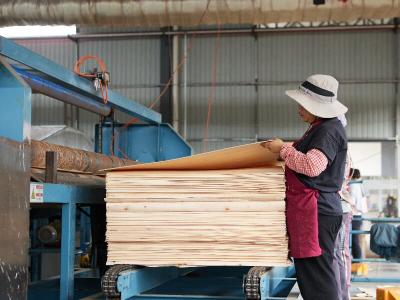
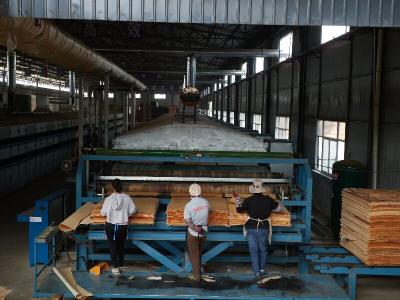
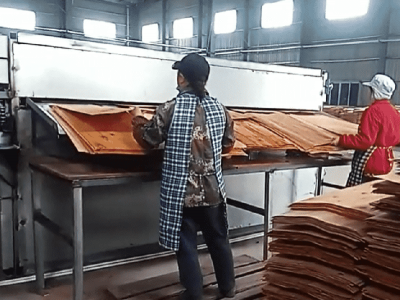
Furthermore, the dryer must align with the continuous production rhythm of the rotary-peeling line. Eucalyptus rotary-peeling lines operate at a steady, continuous pace, with logs constantly being fed in and veneers produced. If the drying stage becomes a bottleneck, wet veneers must be temporarily stacked on the factory floor. Wet eucalyptus veneers are highly sensitive; even short periods of stacking can lead to discoloration, mold growth, or surface darkening, resulting in a downgrade in quality or total loss. Many factories initially select a dryer with a capacity that merely matches their current output; however, during peak production periods, they are forced to slow down the rotary-peeling process. This creates a ripple effect where the upstream equipment—log feeding, veneer splicing, and hot pressing—must all wait for the dryer, severely undermining the utilization rate of the entire production line’s fixed assets. Choosing a dryer with a higher capacity provides a necessary buffer, allowing the rotary-peeling line to run at full, stable speed. Wet veneers can be dried immediately upon production, minimizing the risks associated with intermediate stacking and ensuring high-quality veneer output.
Another often-overlooked benefit is the greater operational flexibility offered by high-capacity drying lines. A roller or tray-type dryer with ample capacity allows for seamless switching between drying programs tailored to different veneer thicknesses or eucalyptus species. When handling more challenging materials—such as thicker veneers or specific, harder-to-dry eucalyptus hybrids—operators can simply reduce the conveyor speed without needing to halt the line for modifications. Moreover, should the factory decide to expand production or add new rotary-peeling machines in the future, the drying system can accommodate the increased load without requiring immediate additional equipment, granting the production line inherent scalability. Conversely, a small-capacity dryer operating at full load leaves virtually no room for process adjustments; even a minor change in the raw material batch can lead to a significant spike in the defect rate of the finished product.
Of course, opting for a higher-capacity dryer does not mean blindly pursuing oversized equipment. The core logic is to leverage excess capacity to ensure drying stability and a higher yield of qualified products. Simply scaling up the equipment without corresponding upgrades to the heat source, thermal insulation, and air circulation systems will not yield the desired results. A well-designed drying solution for eucalyptus—accounting for factors such as raw material moisture content, veneer thickness, and local climate—typically incorporates a 20%–40% buffer in evaporation capacity beyond theoretical requirements. This prioritizes a "low-temperature, slow-drying" process, rather than pushing the equipment to operate at maximum load and speed for extended periods.
In summary, selecting a higher-capacity dryer for eucalyptus is a strategic response to the wood’s inherent challenges: it is difficult to dry, possesses high initial moisture content, and is prone to mold and deformation. Ample capacity provides a buffer for the drying process, ensuring uniform moisture distribution, reducing the rate of shrinkage, cracking, and spoilage, and synchronizing the entire production flow—from rotary cutting to hot pressing. Ultimately, this increases the proportion of high-grade veneers and minimizes raw material waste—a reliable selection strategy validated through long-term practice in numerous plywood factories.