Español
 Русский
 Francés
 Português
 ภาษาไทย
 Indonesia
 Việt
 العربية
 Melayu

Upgrading Veneer Dryers With Automation: Don’t Just Buy An Automatic Feeder
Upgrading Veneer Dryers With Automation: Don’t Just Buy An Automatic Feeder
Many factories begin their automation journey by simply installing an automatic veneer feeder—only to find that their headcount remains unchanged, while the frequency of veneer jams actually increases. The reason? While the feeder can load the veneer, the drying line cannot process it at the same rate, and the unloading/stacking station still requires three workers. Automating only the most visible segment without aligning the throughput of the entire line is a waste of capital.
Successful automation is about ensuring the synchronization of the entire production line; focusing on a single piece of equipment misses the point. Below are some of the most common pitfalls encountered in recent upgrade projects—issues that should be carefully considered from the outset.
I. Align Throughput Rates Before Defining The Equipment List
Before drafting a procurement list, you must first map out the throughput rates for the entire line: the hourly output of the rotary-peeling line, the travel speed of the drying line, and the processing capacity of downstream operations like gluing or panel assembly. Since the dryer is a middle link, increasing its speed without matching the capacity of the preceding and subsequent stages simply shifts where your inventory piles up.
Rule of thumb: The design throughput of the drying line should exceed the peak capacity of the rotary-peeling line by 10%–15%. This provides a necessary buffer for tasks like blade changes, veneer repairs, or unexpected downtime. Exceeding this margin essentially means buying equipment for your warehouse rather than your production line.
II. The Three Areas Most Worth Automating First
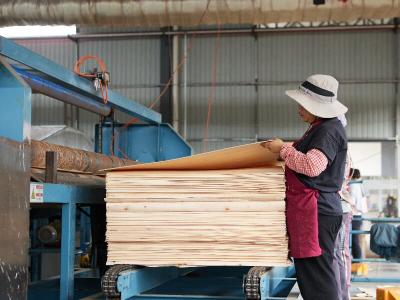
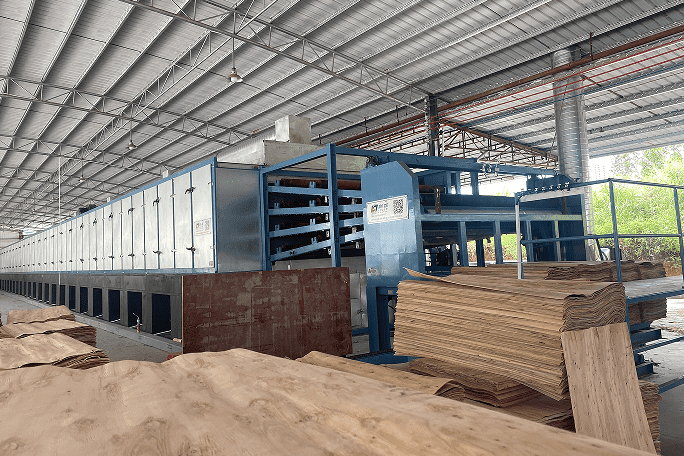
Veneer Feeding: Manual feeding of thin veneers is the slowest and most physically demanding task; it is also the stage most prone to damage, such as scratches, dents, or creases. For thin veneers (0.8–2mm), vacuum-based (suction) automatic feeders offer greater stability and significantly lower damage rates compared to mechanical grippers.
Veneer Transport: Replacing chain drives with a fully servo-driven system allows for adjustable speeds across different sections. This drastically reduces issues like veneer misalignment, stacking, or jamming, and shifts maintenance from managing numerous chain-tensioning points to simply adjusting a set of digital parameters.
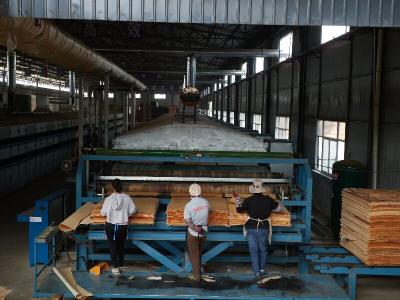
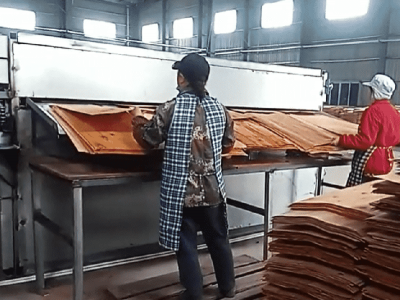
Unloading and Stacking: This stage is frequently overlooked in budget planning, yet it is often the area that requires the most manual labor. Integrating automatic board-turning with automatic stacking is the real key to effectively reducing headcount across the entire production line.
III. Wood Species And Specifications: The True Test For Automation
Automation solutions designed for Europe often struggle when deployed in Southeast Asia or Africa—not because of equipment precision, but because of the raw materials. Eucalyptus and rubberwood have coarse, curl-prone fibers; engineered wood veneers are thin and brittle; birch and oak are sensitive to temperature fluctuations. Furthermore, full-sized 4x8-foot sheets behave differently than spliced panels during transport, and the required moisture content—ranging from 60% to 70% upon entry—varies significantly.
Therefore, automation parameters must be categorized and stored in the system by wood species and specification. Operators should be able to load these settings with a single click, rather than manually readjusting air temperature and conveyor speed every time a new batch of boards is introduced. Otherwise, "automation" merely shifts the time spent on machine adjustments from the factory floor to a digital screen.
IV. True Automation Requires A "Closed-Loop" Data System—Not Just Automated Feeding
Simply automating the board-feeding process is merely semi-automation. Real value lies in a closed-loop system: independent temperature control across different drying zones, variable-frequency speed regulation, and in-line moisture content monitoring at the discharge point—with an automated return mechanism for boards that exceed moisture limits.
Many factories see an increase in output after implementing automation, yet the rate of high-quality (first-grade) products remains unchanged. The root cause is almost always the same: the drying process still relies on the "gut feeling" and visual judgment of veteran operators, while the automation is limited only to the infeed stage.
V. Three Often-Overlooked Items In Automation Budgets
Electrical Systems: An increase in servo motors and variable-frequency drives leads to higher harmonic distortion and inrush currents. In older facilities, power distribution capacity, cable cross-sections, and grounding systems must be re-evaluated—reworking these later is the most expensive part of any project.
Data Interfaces: PLCs must be equipped with communication ports to allow for integration with Manufacturing Execution Systems (MES) and remote monitoring of drying curves. Without these ports, any future attempt to add energy consumption analysis will leave you entirely dependent on the original equipment manufacturer (OEM).
Dust Collection: Higher production output inevitably generates more dust, necessitating a corresponding upgrade to dust-extraction systems (such as wet-scrubber/water-curtain dust collectors). Waiting until an environmental inspection occurs to address this can lead to production stoppages—the costs of which far exceed the price of the equipment itself. VI. Four Prerequisites for Retrofitting Existing Production Lines
First, verify the following: Is there sufficient ceiling height and floor space for the board-loading mechanism and the stacking area? Can the existing foundation support the load, or does it require reinforcement? Is the power supply adequate for the additional servo-driven loads? Can the heat supply—whether steam, thermal oil, hot-air furnaces, biomass burners, or waste heat recovery from kilns—accommodate the increased production output? (All pressure and flow parameters must be re-evaluated.)
If any of these conditions cannot be met, the budget must be revised; you cannot afford to discover that the equipment won’t fit only after it has arrived at the factory.
VII. Don’t Just Calculate Labor Savings
The correct formula for calculating the payback period is: (Labor savings + reduction in losses from product downgrading + gross profit from increased production capacity) / Total investment.
If you only account for labor savings, most projects take three to four years to break even. By including the reduction in downgrading losses and the gains from increased capacity, that period can typically be shortened to 18–24 months. This is the standard methodology we use when preparing projections for our clients; a proposal is only truly robust if you are willing to lay out all these figures transparently.
VIII. Five Hard Criteria For Final Acceptance
The system must meet five specific benchmarks: 72 hours of continuous operation; the rate of veneer/board damage; the compliance rate for moisture content (the percentage of product falling within the 8%–12% range); energy consumption per unit (per cubic meter or square meter); and the frequency of unplanned downtime. Including these five criteria in the contract’s annex is far more effective than any verbal promise.
True automation is not merely about replacing human workers; it is about transforming the most strenuous, hazardous, and skill-dependent tasks—those that traditionally rely on the "intuition" of veteran operators—into standardized, quantifiable parameters. Before taking action, always ask: Are the production rhythms (cycle times) of the upstream and downstream processes properly aligned?