Español
 Русский
 Francés
 Português
 ภาษาไทย
 Indonesia
 Việt
Việt
 العربية
 Melayu


What is a veneer vertical dryer?
What Is A Veneer Vertical Dryer?
In the plywood, block , and wood veneer processing industries, veneer drying is a critical process that determines the quality, stability, and production capacity of the finished product. Traditional methods—such as open-air drying and standard roller drying—often suffer from issues like uneven drying, cracking and deformation, limited capacity, and high susceptibility to weather conditions. The veneer flipping dryer is an automated, high-efficiency drying system specifically engineered for thin wood veneers. It has become the mainstream upgrade choice for medium-to-large wood processing plants looking to replace traditional equipment. By leveraging core features such as flipping drying, hot air circulation, and intelligent temperature control, it effectively resolves long-standing challenges in the industry.
I. Basic Definition Of The Veneer Flipping Dryer
The veneer flipping dryer (also known as a flipping-type veneer dryer) is a continuous, automated wood drying system designed primarily to dehydrate and dry solid wood veneers and engineered wood veneers—such as poplar, eucalyptus, and birch—ranging from 0.6mm to 3mm in thickness. Unlike standard roller dryers that blow air from only one side, this equipment’s defining feature is its automatic flipping mechanism. This system automatically flips the veneer during the drying process; combined with a multi-layer hot air circulation system, it ensures simultaneous and uniform dehydration on both sides of the veneer. This fundamentally prevents issues caused by single-sided drying, such as uneven moisture content, warping, cracking, and surface wrinkling.
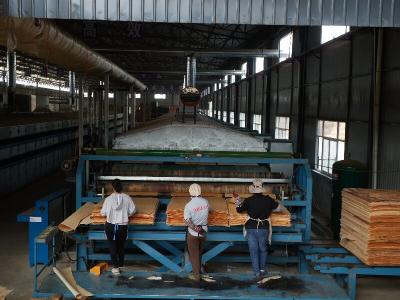
The equipment integrates fully automated functions—including feeding, conveying, flipping, drying, dehumidifying, and unloading—into a single process. Unaffected by rainy or humid weather, it supports continuous 24-hour operation and serves as a core component of modern veneer processing production lines.
II. Core Operating Principles
The operational logic of the veneer flipping dryer centers on three key principles: uniform heating, gradient dehydration, and constant-temperature dehumidification. The process runs as a fully automated, closed-loop system requiring no manual intervention:
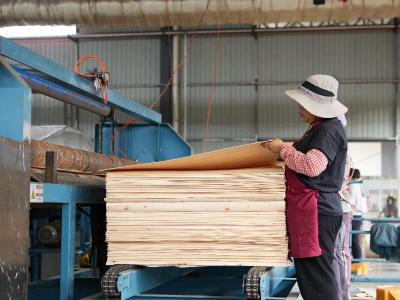
1. Infeed Conveying and Positioning: Wet veneers are fed—either manually or via mechanical assistance—flat into the machine's infeed end. A conveyor chain moves the veneers into the drying chamber at a constant speed, while the equipment automatically identifies the veneer specifications and matches them with the appropriate conveying speed and drying parameters.
2. Sectional Hot-Air Drying: The drying chamber is divided into functional zones—preheating, high-temperature drying, and constant-temperature dehumidification. Multiple sets of hot-air fans evenly direct heat onto the veneer surfaces, gradually evaporating internal moisture. The system supports various heat sources—such as steam, thermal oil, natural gas, and biomass fuel—to accommodate the specific energy configurations of different factories.
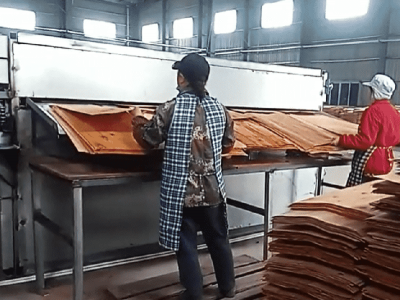
3. Automatic Flipping for Uniform Heating: This is the machine's core process. Midway through drying, a specialized flipping mechanism precisely turns the veneer over. This exposes the side that was previously shielded from the airflow and heat to the hot air, effectively eliminating the "one side dry, one side wet" issue common in traditional drying methods and ensuring the moisture content difference between the front and back surfaces remains minimal.
4. Circulating Dehumidification and Stabilization: The machine features a sealed, insulated structure and a high-efficiency dehumidification system. An 80–100mm thick insulated casing prevents heat loss, while circulating hot air continuously removes water vapor from the veneer surface. Simultaneously, the constant-temperature zone stabilizes the veneer's internal fiber structure, preventing deformation or warping after drying.
5. Automatic Outfeed and Stacking: Once dried to the required standard, the veneers are discharged at a constant speed with stable moisture content. They can proceed directly to subsequent processes—such as stacking, gluing, and hot pressing—enabling a continuous, end-to-end workflow.
III. Core Structural Components
The veneer flipper dryer features a precision, modular design with core components performing specialized functions to ensure efficient, stable, and reliable operation. It comprises five major systems:
1. Intelligent Conveying System
Utilizes a wear-resistant chain-type conveyor structure that ensures smooth operation without tracking errors or surface scratches on the veneer. Conveying speed is infinitely adjustable to accommodate veneers of varying thicknesses and moisture content, effectively preventing issues such as stretching deformation in thin veneers or overlapping/jamming.
2. Automatic Flipping System
A proprietary core component driven by a precision servo mechanism. The flipping angle and timing are precisely controlled to suit various standard veneer sizes. The flipping process is gentle and stable, preventing breakage or misalignment, and is crucial for achieving uniform drying on both sides.
3. Constant-Temperature Hot Air Circulation System
Equipped with independent multi-zone temperature control modules, allowing for precise drying temperature adjustments between 160°C and 180°C. The system employs stratified circulation and multi-directional hot air injection, eliminating temperature dead zones and gradients within the chamber. This significantly boosts heat utilization efficiency, making it more energy-efficient than traditional drying equipment.
4. Sealing, Insulation, and Dehumidification System
The unit features a thickened, insulated housing with excellent sealing properties to minimize heat loss. An independent dehumidification and exhaust unit promptly removes high-humidity vapor from the chamber, preventing moisture backflow that could cause the veneer to reabsorb moisture, thereby ensuring drying efficiency and consistent final moisture content.
5. Intelligent Electronic Control System
Integrates fully automatic temperature control, speed control, and fault warning functions. Drying parameters can be preset based on wood species and veneer thickness, with automatic, coordinated adjustment of temperature, conveying speed, and dehumidification cycles. Operators require only brief training, significantly lowering the technical barrier for personnel.
IV. Key Advantages Over Traditional Dryers
As an upgraded drying solution, the veneer flipper dryer completely overcomes the drawbacks associated with traditional air-drying and single-pass roller drying, offering significant advantages in production capacity, quality, cost-efficiency, and operational stability:
1. Exceptionally Consistent Drying Quality: Automatic flipping ensures uniform moisture removal from both sides, effectively eliminating issues such as cracking, warping, wrinkling, discoloration, and uneven moisture content. Additionally, high-temperature drying kills internal insect eggs and bacteria, preventing future pest damage and mold growth, thereby greatly enhancing the veneer's durability.
2. Doubled Capacity and High Efficiency: The equipment supports continuous 24-hour production with a daily output of 30–90 cubic meters. A single unit matches the capacity of two standard roller dryers, perfectly meeting the scale requirements of small-to-medium wood processing plants while eliminating weather-related production constraints.
3. Energy Efficiency and Low Operating Costs: A combination of efficient hot-air circulation and a sealed, insulated design significantly boosts thermal efficiency and lowers overall energy consumption—actual power usage is just over 20 kWh per hour. Furthermore, the high level of automation allows the entire production line—including veneer loading, unloading, and monitoring—to be managed by just three operators, resulting in substantial labor cost savings.
4. Compact Footprint and High Adaptability: The unit features a compact structure requiring a footprint of only about 140 square meters, eliminating the need for large drying facilities and making it ideal for both new plants and the upgrading of existing ones. It is highly versatile, capable of drying various wood species (such as poplar, eucalyptus, and birch) and veneers of differing thicknesses.
5. Low Failure Rate and Long Service Life: Designed to prevent jams and misalignment, the machine operates smoothly and reliably, effectively minimizing downtime caused by malfunctions. Core components are wear-resistant and corrosion-resistant, ensuring trouble-free continuous operation over the long term and keeping future maintenance costs to a minimum. V. Key Application Scenarios
The veneer turnover dryer is specifically designed for various wood veneer processing scenarios and serves as standard equipment for primary manufacturing plants:
1. Veneer drying processes for manufacturers of plywood, multi-layer s, and block s;
2. Precision drying and setting of decorative veneers, engineered wood veneers, and facing veneers;
3. Dehydration and drying of various thin solid wood sheets and craft s;
4. Standardization and automation upgrades for production lines in small and medium-sized wood processing plants.
VI. Key Considerations for Equipment Selection
When purchasing a veneer turnover dryer, one should look beyond the price and focus on core parameters aligned with specific production needs to ensure the equipment fits the operation and delivers long-term, stable profitability:
1. Specification Matching: Select a model based on the maximum width and thickness of commonly used veneers (standard widths include 2650mm and 2800mm) to avoid limitations on size or inadequate drying;
2. Temperature Control Precision: Prioritize models with independent, intelligent multi-zone temperature control where temperature and speed are linked and adjustable, catering to the drying requirements of different wood types;
3. Heat Source Compatibility: Choose a heating system that matches the factory's existing energy sources (biomass, natural gas, steam, etc.) to minimize energy costs;
4. Build Quality and Configuration: Pay close attention to insulation thickness, conveyor chain material, and the precision of the turnover mechanism; high-quality components are essential for ensuring drying performance and equipment longevity;
5. Production Capacity Matching: Select a model with a capacity that meets daily output requirements, avoiding production bottlenecks caused by insufficient capacity or resource waste due to idle equipment.
The veneer turnover dryer represents more than just a simple upgrade to drying equipment; it is an intelligent, standardized solution for the veneer drying process in the wood industry. By utilizing core automatic turnover technology, it resolves long-standing industry pain points—such as uneven drying, deformation, and low productivity—while offering multiple advantages, including energy efficiency, labor savings, a compact footprint, and high operational stability. For wood processing enterprises, the adoption of a veneer flipper dryer not only stabilizes drying quality and increases the pass rate of finished products but also significantly boosts production efficiency and lowers overall operating costs; it is a key piece of equipment for enhancing a factory's core competitiveness and achieving standardized mass production.