Español
 Русский
 Francés
 Português
 ภาษาไทย
 Indonesia
 Việt
Việt
 العربية
 Melayu



Solving The Problem Of Uneven Moisture Content In Veneer Drying
Solving the Problem of Uneven Moisture Content in Veneer Drying: Industry Pain Points and Shine Machinery's Efficient Solution
In the production of engineered wood products, plywood, and furniture substrates, veneer drying is a core process determining the quality, stability, and lifespan of the finished boards. Uneven moisture content in dried veneers is a long-standing and common production problem plaguing wood processing enterprises. It easily leads to quality issues such as warping, cracking, delamination, and insufficient bonding strength, significantly reducing the yield rate of finished products, increasing material waste and production costs, and hindering efficient mass production. Recent industry technical surveys show that the combined effects of multiple factors, including raw material characteristics, production processes, equipment performance, and operational control, are the key reasons for excessive moisture content deviations in veneers. Shine Machinery, leveraging its deep technical expertise in wood drying, has specifically addressed this industry pain point with its intelligent veneer dryer, providing a superior solution to the problem of uneven moisture content.
Multiple factors combined contribute to the industry's pain point of uneven moisture content in veneer drying.
According to research data on forestry drying technology, the deviation in moisture content after veneer drying stems not only from the natural properties of the wood itself but is also closely related to production equipment, processes, and on-site management. These multi-dimensional issues collectively lead to excessive localized differences in moisture content within the veneer. The specific problems can be categorized into four main types.
First, there are inherent differences in the natural moisture content of the raw materials. Significant variations in moisture content between different tree species and different parts of the same log are a congenital factor causing uneven drying. The sapwood moisture content of most coniferous trees can be up to three times that of the heartwood, generally exceeding 100%, while hardwoods typically exhibit a higher heartwood moisture content than sapwood. In actual production, a single veneer often contains both heartwood and sapwood areas, with differences in wood grain, pore structure, and air permeability. Inconsistent moisture evaporation rates during drying mean that even with uniform drying parameters, localized moisture content deviations will still occur, creating potential problems for subsequent board deformation and cracking.
Second, there are shortcomings in the performance of drying equipment, with imbalances in core drying parameters. Traditional dryers commonly suffer from deficiencies in temperature control and airflow design, which are the core human-induced causes of uneven moisture content. On one hand, the internal temperature distribution is uneven, with excessive local temperature differences within the cavity. High-temperature areas experience rapid moisture evaporation from the veneers, while low-temperature areas dry more slowly, creating obvious wet-dry zones. On the other hand, outdated hot air circulation systems in older equipment fail to evenly cover the drying cavity with varying airflow. Hot air circulation is poor in areas such as veneer edges, interlayers, and stacking gaps, resulting in gradient problems such as "dry surface, damp interior" and "overly dry edges, damp center." Furthermore, most traditional equipment lacks precise segmented temperature and airflow control systems, failing to meet the process requirements of rapid dehydration in the early stages of veneer drying and uniform, stable drying in the later stages, leading to severe residual moisture content gradients in the later stages of drying.
Furthermore, non-standard production processes and stacking operations are problematic. The way veneers are placed during drying directly affects drying uniformity. Some companies exhibit issues such as haphazard stacking, inconsistent thickness, and uneven spacing during production. Excessive stacking of veneers, especially dense, localized piles, prevents internal hot air penetration, resulting in incomplete drying of the core veneer. Conversely, excessively thin stacking and large spacing between veneers create localized hot air redundancy, leading to over-drying. Furthermore, improper practices such as mixing veneers of different specifications and moisture contents, arbitrarily adjusting drying times, and chaotic feeding/unloading rhythms further amplify moisture content deviations.
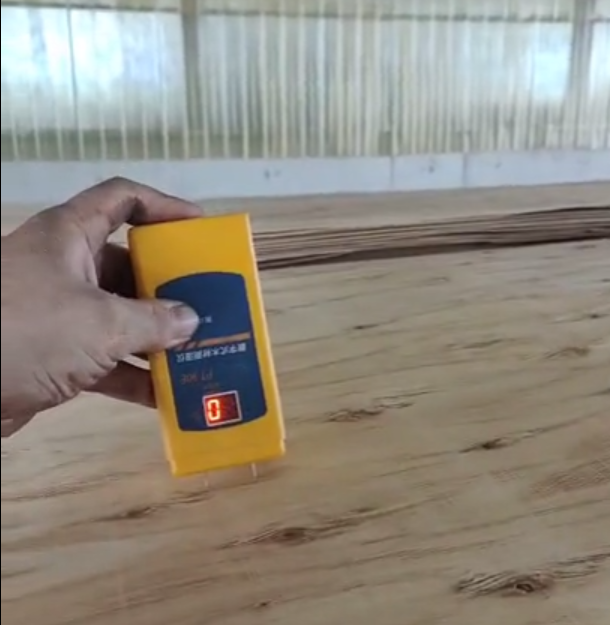
Finally, the monitoring and control system is inadequate. Traditional production lines rely heavily on manual experience to judge drying effectiveness, lacking real-time, accurate online moisture content monitoring equipment. This makes it impossible to dynamically capture real-time changes in veneer moisture content during the drying process. When raw material humidity and ambient temperature and humidity fluctuate, equipment parameters cannot adaptively adjust accordingly. Fixed drying modes are ill-suited to changing production conditions, resulting in persistent moisture content differences between batches and between veneers, compromising product quality stability.
Precisely Addressing Industry Pain Points, Shine Machinery's Dryers Highlight Core Technological Advantages
Addressing the widespread problem of uneven moisture content in veneer drying within the industry, Shine Machinery focuses on core wood drying technologies, deeply investing in equipment R&D and process optimization. Breakthroughs across five dimensions—airflow circulation, intelligent temperature control, segmented processes, precise monitoring, and adaptability design—comprehensively solve various uneven drying problems, helping companies achieve standardized, high-quality mass production in veneer drying and becoming a benchmark for quality and efficiency improvement in the wood drying industry.
Regarding the balanced airflow circulation system, Shine Machinery's veneer dryers feature a self-developed full-area hot air circulation structure, completely eliminating the dead zones in traditional equipment. Through multi-channel symmetrical air delivery and uniform airflow design, the equipment achieves complete coverage of airflow velocity and volume within the drying chamber without dead zones. Hot air can evenly penetrate the gaps between veneer stacks, precisely covering the surface, interlayers, and edges of the boards, thoroughly improving the problem of "inadequate or excessive drying in certain areas," eliminating moisture content deviations caused by uneven airflow at the equipment level. Meanwhile, the equipment employs a high- and low-speed fan matching design to adapt to the dehydration needs of different stages of veneer drying. A large airflow in the early stage quickly removes surface moisture, while a stable airflow at a uniform speed penetrates and dries the veneer in the later stage, ensuring simultaneous dehydration inside and outside the board.
Regarding intelligent segmented temperature and humidity control technology, this equipment overcomes the drawbacks of traditional single-mode drying, incorporating an intelligent PLC segmented control system. Based on the wood drying mechanism, it precisely matches the veneer drying characteristics, setting up a multi-stage intelligent process including preheating, rapid dehydration, uniform drying, constant temperature and humidity, and cooling and shaping. It can automatically adjust the temperature, humidity, and airflow parameters at each stage according to differences in tree species, veneer thickness, and initial moisture content, specifically addressing the inherent problem of uneven drying rates between heartwood, sapwood, and softwood/hardwood. Compared to the fixed-parameter drying mode of traditional equipment, Shine Machinery's intelligent temperature control system can control the temperature difference within the chamber within a very small range, effectively balancing the drying progress of individual veneers and entire batches of boards, significantly reducing moisture content differences.
In terms of standardization and process optimization, Shine Machinery's dryers are adaptable to various veneer specifications and production conditions. The equipment's cavity structure has been meticulously optimized to accommodate neatly stacked veneers. Combined with a matching feeding and arrangement auxiliary system, it avoids drying defects caused by messy and uneven stacking during manual processing. Simultaneously, the equipment supports custom parameter storage, allowing for one-click recall of dedicated drying processes for different tree species and veneer thicknesses. This eliminates uneven moisture content issues caused by mixed drying or improper parameter adaptation, balancing production flexibility and product stability.
Regarding real-time accurate monitoring and adaptive control, the equipment is equipped with a high-precision online moisture content monitoring module that collects veneer moisture content data 24/7 during the drying process, dynamically reflecting changes in operating conditions. Based on real-time moisture content data, the system automatically fine-tunes hot air temperature, airflow, and drying time. It adapts to fluctuations in raw material and environmental humidity without manual intervention, completely eliminating the errors of manual judgment and ensuring that the moisture content of each batch and each veneer meets the standard, precisely controlling the finished product's moisture content within the industry's optimal standard range.
In addition to its superior performance, Shine Machinery's dryers balance quality and energy efficiency. While ensuring uniform drying and improving veneer yield, they reduce production energy consumption through hot air recovery and intelligent energy control technologies. Compared to traditional equipment, their energy-saving effect is significant, helping companies effectively control production costs while improving quality, achieving a dual upgrade in quality and efficiency.
Technology Empowers Industry Upgrading, Supporting High-Quality Development of the Panel Industry
Industry experts state that the uniformity of veneer moisture content is a core indicator for measuring panel quality and a key breakthrough for refined production in wood processing enterprises. The uneven moisture content problem in traditional drying methods not only affects product market competitiveness but also restricts the standardization and high-end development of the industry. Shine Machinery, through targeted technological innovation, precisely addresses four core pain points: raw materials, equipment, processes, and management. It fundamentally solves the problem of veneer drying moisture content deviation, effectively reducing quality defects such as panel deformation, cracking, and delamination, and significantly improving veneer flatness, stability, and bonding performance.
In the future, as the quality upgrading process in the engineered wood products industry accelerates, refined, intelligent, and energy-saving drying equipment will become an industry necessity. Shine Machinery will continue to focus on the research and development of wood drying technology, continuously optimize equipment performance and production processes, empower production with core technologies, help more wood processing enterprises break through quality bottlenecks, reduce costs and increase efficiency, and promote the steady development of the entire board processing industry towards high quality, high efficiency and green development.