Español
 Русский
 Francés
 Português
 ภาษาไทย
 Indonesia
 Việt
Việt
 العربية
 Melayu



Analysis Of Standardized Production Processes For Modern Eucalyptus Flooring Substrates
Analysis Of Standardized Production Processes For Modern Eucalyptus Flooring Substrates
Fast-growing eucalyptus, with its short growth cycle, dense texture, uniform hardness, regular grain, and outstanding cost-effectiveness, has become a core raw material for engineered wood flooring, multi-layer substrates, and engineered wood flooring in China. Compared to traditional hardwoods, eucalyptus has stronger industrial adaptability, allowing for large-scale rotary cutting, shaping, and deep processing, fully meeting the high strength, high stability, and high cost-effectiveness requirements of flooring substrates in both residential and commercial applications. However, eucalyptus has inherent weaknesses: high moisture content, large differences in expansion and contraction between wet and dry states, susceptibility to mold and deformation, and unstable internal stress. If the production process is not properly controlled, quality problems such as blistering, delamination, cracking, warping, and blue staining can easily occur. Combining modern wood industry production technology with academic research results, standardized, refined, and automated full-process production is the core key to overcoming the weaknesses of eucalyptus, upgrading substrate quality, and reducing costs in mass production. This article will systematically analyze the core technology system for the modern production of eucalyptus flooring substrates from five dimensions: raw material pretreatment, veneer drying, molding and gluing, quality control, and innovation and efficiency improvement.
I. Pre-treatment: Controlling Veneer Quality from the Source
The quality of eucalyptus flooring is fundamentally determined from the raw material processing stage. High-quality pre-treatment processes reduce veneer defects at the source, lowering production pressure in subsequent processes and serving as the first core line of defense in standardized production. Traditional extensive production often neglects pre-treatment details, leading to frequent problems such as uneven veneer thickness, cracking, discoloration, and mold, significantly reducing the finished product pass rate.
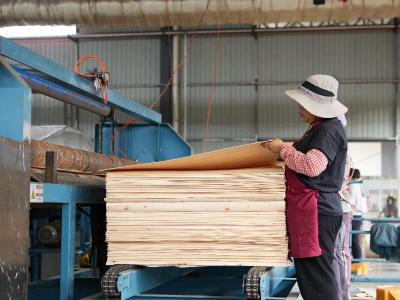
In modern standardized production, eucalyptus raw materials require strict control over two core aspects: arrival time and softening treatment. Post-harvest eucalyptus logs must be processed quickly to avoid long-term open-air storage, preventing oxidation, discoloration, and mold growth at the source. This achieves a clean and uniform veneer appearance without the need for traditional washing processes. Given the dense texture, stiff fibers, and susceptibility to cracking during rotary cutting, the industry commonly uses hydrothermal softening pre-treatment technology. This constant temperature and humidity softening process improves the wood's plasticity, making subsequent rotary cutting smoother and flatter.
Meanwhile, the widespread application of rotary cutting technology has further optimized the quality of veneer forming. This technology can precisely control the uniformity of veneer thickness, reduce problems such as broken boards, rotten boards, and thickness deviations, significantly improve the yield of logs, maximize raw material utilization, and provide uniform and high-quality base veneers for subsequent drying, gluing, and hot-pressing processes, forming a pre-processing quality improvement system of "raw material optimization - precise rotary cutting."
II. Precise Drying: A Core and Essential Process Determining the Stability of the Substrate
Veneer drying is an irreplaceable core process in the production of eucalyptus flooring substrate and a key step in addressing the inherent defects of eucalyptus material. It directly determines the subsequent forming quality and long-term stability of the boards. Fresh eucalyptus veneers after rotary cutting generally have a moisture content as high as 60%–90%, with a large amount of free and adsorbed water locked inside the wood fibers. Furthermore, the difference in the wet and dry shrinkage coefficients of eucalyptus is significant, making traditional methods such as natural sun-drying and simple air-drying completely unsuitable for industrial production standards.
Traditional natural drying methods have three major drawbacks: First, the drying cycle is lengthy, requiring 3-7 days per batch, and is constrained by rainy, temperature, and humid weather, making continuous mass production impossible. Second, drying is extremely uneven, with some veneers being over-dry and others damp, leading to internal stress imbalances and making them prone to warping, deformation, and edge cracking. Third, long-term open-air exposure easily causes blue stain, mold, and insect infestation, resulting in significant raw material waste and high overall costs.
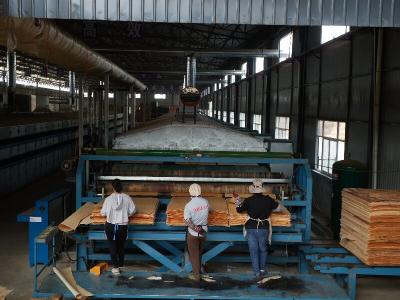
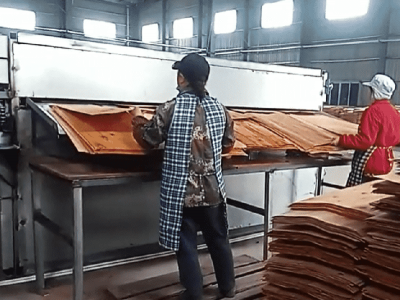
Professional automated veneer drying equipment completely solves these problems and has become standard equipment in modern eucalyptus substrate production. The equipment is equipped with an intelligent temperature and humidity closed-loop control system that can customize a drying curve for eucalyptus, uniformly and evenly removing moisture from the veneer and precisely locking the moisture content within the optimal range of 6%-8%. This standard has also been verified by multiple forestry industry academic studies as the best moisture content for eucalyptus gluing and shaping. Precise drying not only completely eliminates subsequent expansion and contraction of the boards, but also effectively avoids bubbling, delamination, and board bursting caused by moisture expansion during the hot pressing process. It also ensures uniform curing of the adhesive layer, laying the foundation for high-strength bonding of the substrate.
Compared to traditional methods, industrialized drying allows for 24-hour continuous operation, increasing production capacity several times over, while significantly saving on drying space and labor costs, minimizing veneer scrap rates, and truly achieving a dual improvement in quality and efficiency.
III. Intelligent Molding: Standardized Gluing Process Strengthens the Core Performance of the Substrate
After drying to the required standard, the veneers enter the core processes of assembly, gluing, and hot and cold pressing. This stage directly determines the bonding strength, density, and structural stability of the eucalyptus wood flooring substrate. The application of modern automated production lines enables precise control and standardized implementation of the molding process.
In the gluing stage, industry-leading processes are combined with formaldehyde-free environmentally friendly adhesives and high-end adhesives such as water-based epoxy resins. An automated glue control system precisely controls the amount of glue applied, eliminating problems such as glue overflow, insufficient glue, and uneven glue layers. Authoritative research data shows that, provided the veneer moisture content meets standards, precise glue application combined with appropriate hot-pressing parameters can maximize the bonding strength between wood fibers and the glue layer, significantly enhancing the substrate's resistance to peeling and aging, and completely resolving common quality defects such as delamination and separation in finished products.
The cold-hot pressing composite process is the core technology for substrate molding. Standardized production adopts a mature process of "cold pressing and resting + multiple hot pressing": First, multiple cold pressings are performed at room temperature and 0.8MPa pressure to stabilize the glue layer initially, followed by a 6-8 hour resting period to release internal stress in the board; then, segmented hot pressing at 155-170℃ and 2.5-3.5MPa pressure, with precise control of the hot pressing time (1.10-1.5min/mm), allows the glue layer to fully cure and the board to be densely formed. This process effectively balances the density and structural toughness of the substrate, ensuring high flatness, uniform bonding, and stable stress in the finished board, fully meeting the high-strength requirements of flooring substrates.
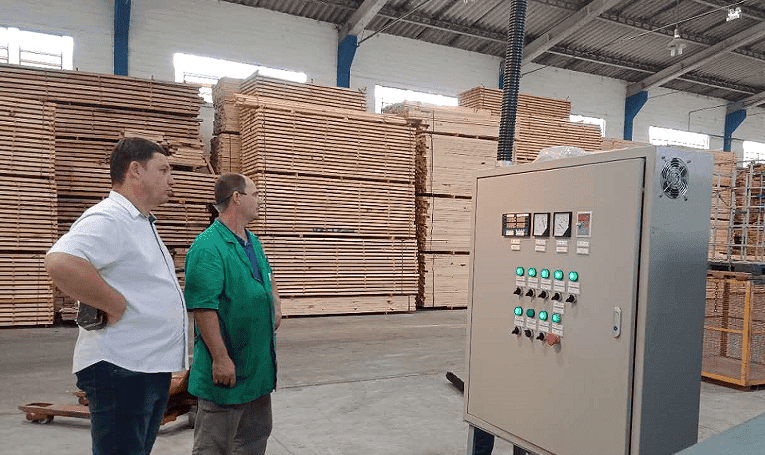
Currently, the fully automated eucalyptus substrate production line has achieved integrated operation of intelligent veneer sorting, defect identification, automatic scar repair, and precise assembly. It can automatically grade and classify veneers according to their appearance, and specifically repair defective boards, significantly improving the overall consistency of the finished product and meeting high-end export-grade substrate production standards.
IV. Refined Quality Control: Multi-dimensional Optimization of Substrate Performance and Service Life
Quality control of eucalyptus flooring substrate runs through the entire production process. In addition to controlling core processes, refined control methods such as post-processing modification, humidity conditioning, and defect optimization further improve the moisture resistance, corrosion resistance, and deformation resistance of the boards, achieving product value enhancement.
Addressing the weakness of eucalyptus in terms of moisture resistance and corrosion resistance, modern processes introduce surface modification technology. By constructing functional protective structures, the surface performance of the boards is optimized, effectively improving the substrate's moisture resistance, insect resistance, and weather resistance, solving the problems of warping, corrosion, and aging of flooring in humid environments. Simultaneously, after the boards are formed, they undergo a specialized humidity-regulating and curing treatment. This involves fine-tuning the moisture content of the boards in a constant temperature and humidity environment to balance internal stress and stabilize the coefficient of thermal expansion and contraction of the substrate. This fundamentally improves dimensional stability and adapts the boards to different regions and temperature/humidity levels.
Furthermore, an innovative scrap recycling process allows for the processing of eucalyptus production waste into insect- and mildew-resistant oriented strand board (OSB). This maximizes resource utilization, reduces costs, and increases efficiency while expanding the product range of eucalyptus substrates to meet diverse market demands.
V. Industry Upgrading: Process Innovation Drives Cost Reduction and Quality Iteration in Mass Production
From an industry development perspective, the core trend in eucalyptus flooring substrate production is the transformation from extensive manual production to refined, automated, and green mass production. Traditional production methods rely on manual control, resulting in unstable process parameters, low product qualification rates, limited capacity, and high losses, making it difficult to meet the high-quality, low-cost, and high-volume demands of the modern market.
The standardized process system encompassing "pre-treatment optimization + precise drying + intelligent molding + meticulous quality control" has completely broken through traditional production bottlenecks. The widespread adoption of automated equipment reduces manual intervention and minimizes quality fluctuations caused by human error; precise control of process parameters ensures stable and controllable product performance, significantly improving the finished product qualification rate; and efficient raw material utilization and low-loss production modes effectively reduce production costs and enhance the company's market competitiveness.
Multiple industry studies and production practices have confirmed that standardized eucalyptus production processes not only solve core quality problems such as deformation, cracking, delamination, and mold, but also significantly improve the mechanical properties, weather resistance, and service life of the substrate. This allows eucalyptus flooring substrates to continue to dominate mainstream markets such as home decoration, commercial decoration, and engineering installations due to their high cost-effectiveness and high stability, becoming a core preferred material in the flooring substrate field.
The quality of eucalyptus flooring substrates does not depend on a single piece of equipment or a single process, but on the standardization and meticulous control of the entire process. Pre-treatment optimizes the raw material base, precise drying locks in board stability, intelligent molding ensures structural performance, meticulous quality control upgrades quality, and innovative processes empower cost reduction and efficiency improvement. These five dimensions complement each other and constitute the core production technology system of modern eucalyptus wood flooring substrates. As the wood industry continues to iterate towards intelligence, greening, and high-end products, continuously optimizing production processes and strictly adhering to core technical standards will become the key for eucalyptus wood substrate companies to solidify their product competitiveness and seize market advantages.