Español
 Русский
 Francés
 Português
 ภาษาไทย
 Indonesia
 Việt
Việt
 العربية
 Melayu



How To Choose The Type Of Dryer?
Precise Selection Guide for Veneer Dryers: Comparative Analysis of Hot-Pressure, Flip-Type, and Roller-Type Veneer Drying Equipment
Veneer dryers are core upstream equipment in the production lines of plywood, blockboard, and decorative veneer. Their core function is to precisely dry wet veneers with a moisture content of 60%-120% after rotary cutting and slicing to a glue-standard moisture content of 8%-12%. The flatness, moisture content uniformity, and surface integrity of the dried veneers directly determine the subsequent gluing quality, finished product grade, and yield rate.
For veneer drying scenarios, the mainstream industrial applications utilize three types of specialized equipment: hot-press veneer dryers, flip-type veneer dryers, and roller-type veneer dryers. These three types are specifically optimized for thin veneer sheets, adapting to different veneer thicknesses, production capacity, quality requirements, and production budgets, exhibiting significant differences. This article focuses on the specific scenario of veneer drying, deeply analyzing the working principles, core advantages, and suitable veneer conditions of these three types of equipment to provide precise selection guidance for panel processing enterprises.
I. Hot-Pressure Veneer Dryer: Dedicated Equipment for High-End Thin Veneer Shaping and Drying
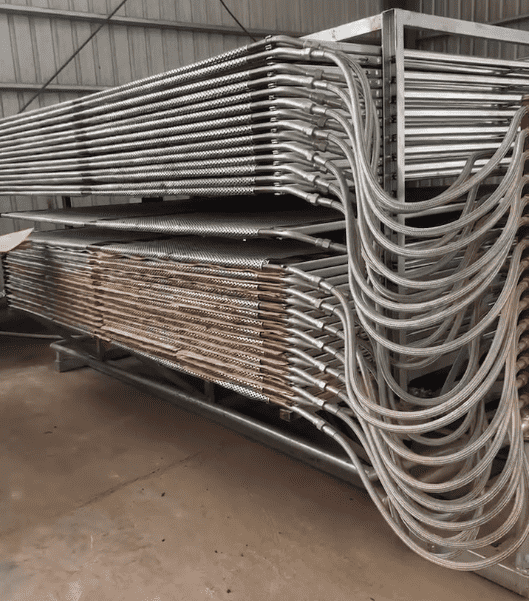
The hot-press veneer dryer is the core equipment of a high-end engineered wood production line and the optimal choice for drying thin veneers and premium veneers. Unlike traditional hot air convection drying, it adopts a contact-type hot-press conduction drying process, integrating dehydration, leveling, shaping, and anti-deformation. It boasts high precision, high flatness, and low deformation, specifically addressing industry pain points such as warping, arching, cracking, and uneven moisture content in veneer drying.
(I) Core Working Principle
The equipment is equipped with a high-precision constant-temperature heat-resistant pressure plate system. During operation, the upper and lower pressure plates precisely fit and gently clamp the flat veneer. Through direct heat conduction via the metal plate surface, both sides of the veneer are heated simultaneously and evenly. Compared to hot air penetration drying, contact-type heat conduction has extremely low heat loss and a faster heating rate, enabling gradient dehydration of the veneer from the surface to the core layer. Simultaneously, the pressure plate continuously outputs constant micro-pressure, constraining the shrinkage and deformation of wood fibers during the veneer drying process, and counteracting the natural bending stress of thin veneers. Drying and shaping are completed simultaneously, eliminating the need for secondary shaping. The equipment can precisely control temperature, pressure, and drying time, adapting to the refined drying needs of high-end veneers.
(II) Core Advantages
1. Zero Deformation and High Flatness, Top-Tier Finished Product: The unique integrated hot-pressing and shaping process completely solves the problems of warping, wrinkling, edge curling, and unevenness after drying of 0.2-1.5mm ultra-thin veneers. After drying, the veneer surface is flat and straight with complete texture, which can be directly used for high-end decorative panels and furniture board veneers, significantly increasing product added value.
2. Precise and Uniform Moisture Content, Strong Bonding Stability: Constant temperature drying throughout the entire process eliminates localized wet-dry deviations, stably controlling the veneer moisture content within the industry's optimal bonding range of 8%-12%, with minimal moisture content error. Effectively avoids subsequent quality problems such as delamination, bulging, cracking, and deformation of the boards, significantly improving the yield rate of finished boards.
3. Energy-saving and highly efficient with extremely high heat utilization: Abandoning the traditional hot air diffusion drying mode, direct contact heat conduction results in almost no heat loss, with thermal efficiency far exceeding that of convection drying equipment. It also supports multiple heat sources such as steam, heat transfer oil, and electric heating. A single heat source system can be linked with multiple pieces of equipment, resulting in lower long-term drying energy costs.
4. Preserves board appearance without secondary damage: The clamping force of the pressure plate is controllable, and the heating is uniform. The drying process is gentle and mild, preventing wear, damage, and carbonization of the veneer surface, perfectly preserving the original wood grain and board integrity, and meeting the production standards of high-end premium veneer.
(III) Exclusive Veneer Application Scenarios
1. High-end ultra-thin veneer drying: Suitable for drying 0.2-2.0mm ultra-thin wood veneers, decorative veneers, and precious wood veneers, it is an essential piece of equipment for the production of high-end furniture boards and decorative panels.
2. High-Quality Plywood Core Veneer: Designed for the face and back panels, and core substrate veneer of high-end whole-house custom boards and engineering boards, ensuring board flatness and bonding stability to meet high-standard delivery requirements.
3. Small-Batch, High-Value-Added Veneer Custom Production: Suitable for high-end veneer custom processing scenarios with stringent requirements for veneer appearance, flatness, and moisture content accuracy.
II. Vertical-Type Veneer Dryer: Preferred Equipment for Small to Medium Capacity and Damage Prevention
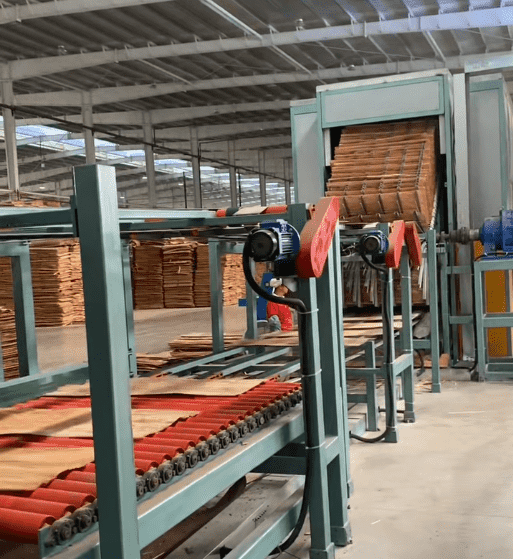
The vertical-type veneer dryer is the mainstream equipment for small and medium-sized board processing plants. It is a hot air circulating static drying equipment designed to avoid veneer damage and reduce equipment investment costs. It adopts a frictionless static drying mode, balancing drying quality and cost-effectiveness. Suitable for large-scale production of veneers of standard thickness, it is an upgraded version of natural air drying and low-end hot air drying.
(I) Core Working Principle
The equipment has a closed box-type multi-layer structure with multiple layers of wear-resistant flip-conveyor plates arranged inside. Wet veneers are laid flat on the flipping plate surface manually or automatically, without dragging, squeezing, or violent vibration throughout the process. During operation, the flipping plate rotates slowly and evenly 180°, smoothly conveying the veneers to the next layer, achieving alternating contact between both sides of the veneer and high-temperature circulating hot air. Hot air circulates and penetrates in all directions within the sealed chamber, eliminating drying dead zones. Continuous hot air convection removes moisture from the veneers, and the multi-layered structure significantly improves space utilization and drying efficiency.
(II) Core Advantages
1. Zero Veneer Damage, Suitable for Soft and Thin Veneers: The entire process involves static laying and smooth flipping, without roller friction or material spillage, completely avoiding tearing, breakage, and edge chipping of thin veneers. It is especially suitable for soft, easily broken mixed wood veneers and thin wood veneers.
2. Excellent Cost-Effectiveness and Low Investment Threshold: The equipment has a simple structure and does not require a high-precision pressure control system. Procurement, installation, and maintenance costs are far lower than those of hot press dryers. The equipment has a low failure rate, universal parts, and is suitable for small and medium-sized factory budgets, with a short payback period.
3. Uniform drying, suitable for conventional mass production: The multi-layer hot air circulation structure ensures uniform airflow to both sides of the veneer, resulting in stable drying speed and minimal moisture content deviation. It meets the production standards for ordinary plywood and construction formwork veneers, achieving a high finished product qualification rate.
4. Compact footprint, suitable for small to medium-sized factories: The vertical multi-layer integrated design maximizes space utilization, requires minimal floor space, eliminates the need for large, structured factory buildings, and simplifies installation and commissioning. Stable mass production can commence immediately upon startup, unaffected by weather or rainy seasons.
(III) Specific Veneer Application Scenarios
1. Mass production of veneers of standard thickness: Suitable for drying 2.0-4.0mm standard poplar, eucalyptus, and mixed hardwood veneers, primarily for the production of substrates for ordinary plywood, construction formwork, and packaging boards.
2. Small to medium-sized board processing plants: Suitable for small to medium-sized board processing enterprises with moderate daily output, limited budgets, and space constraints, replacing traditional natural sun-drying and simple drying equipment.
3. Drying of Fragile Soft Veneers: Designed for soft, easily torn veneer materials, this dryer avoids mechanical damage and ensures the integrity and utilization rate of the veneers.
III. Roller Veneer Dryer: High-Speed Continuous Production Equipment for Large Factories
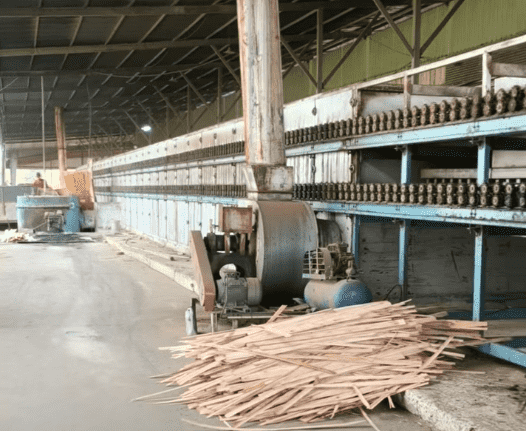
The roller veneer dryer (mesh belt/roller conveyor type) is a supporting equipment for large-scale engineered wood production lines. It emphasizes high-speed, continuous, and automated mass production. Relying on continuous conveying by rollers or mesh belts and hot air jet convection drying, it boasts a high degree of automation and can operate 24 hours a day without interruption. It is a core piece of equipment for large-scale, standardized production in large-scale panel enterprises.
(I) Core Working Principle: The equipment adopts a horizontal continuous conveying structure, consisting of four parts: a feeding zone, a high-temperature drying zone, a constant temperature and humidity zone, and a cooling discharge zone. Multiple sets of parallel wear-resistant rollers (stainless steel mesh belts) form the conveying system. Wet veneers are conveyed forward at a uniform speed, while high-speed, uniform hot air jets from the upper and lower air ducts in the drying zone vertically impact both sides of the veneer, quickly removing surface and internal moisture. The entire process of continuous feeding, drying, and discharging is fully automated, coupled with a gradient temperature control system to achieve continuous dehydration and shaping of veneers. After drying, the veneers undergo constant temperature shaping in a cooling zone, effectively reducing the probability of subsequent deformation.
(II) Core Advantages
1. High Capacity, Suitable for Large Production Lines: Enables 24-hour unattended continuous production. The automated feeding, drying, and discharging processes are integrated, allowing for a large daily veneer processing capacity per unit. This perfectly matches the production pace of large plywood factories, with production efficiency far exceeding that of traditional veneer drying equipment.
2. High Degree of Automation, Saving Labor Costs: Fully mechanized and automated conveying eliminates the need for frequent manual veneer spreading and flipping, significantly reducing labor input and minimizing uneven drying and veneer damage caused by human error. Production standardization is high.
3. Suitable for Drying Thick and High-Moisture Veneers: The hot air jet has strong penetration and uniform airflow, providing rapid dehydration and thorough drying for veneers with high moisture content (over 3.0mm) after rotary cutting, eliminating issues of under-drying or delamination. 4. Stable Operation, Adaptable to Standardized Mass Production: The equipment's transmission system is stable, and temperature control, air speed, and conveyor speed can be precisely and continuously adjusted. Batch drying of veneers results in highly uniform moisture content and flatness, suitable for industrial-scale mass production.
(III) Specific Veneer Application Scenarios
1. Large-Scale Panel Enterprises' Full-Line Mass Production: Adaptable to large-scale plywood and construction formwork production lines, suitable for continuous production scenarios with high daily output and high standardization requirements.
2. Medium-Thick Veneer Drying: Primarily designed for drying medium-thick wood veneers (3.0mm and above) and industrial formwork substrate veneers, offering significant advantages in dehydration efficiency.
3. Standardized Batch Processing: Suitable for large-scale standardized production environments with high requirements for veneer drying consistency, production efficiency, and automation levels.
IV. Core Selection Comparison Table for Three Types of Veneer Dryers
Based on veneer thickness, production capacity, quality grade, and budget, the following precise selection logic is summarized to suit the veneer production needs of different enterprises:
1. Hot-press Veneer Dryer: Prioritized for ultra-thin veneers, high-end premium products, and high-value-added boards. Ideal for high-end production lines with sufficient budgets, prioritizing zero deformation, high-precision moisture content, and top-quality appearance, small-batch premium production.
2. Flip-type Veneer Dryer: Prioritized for standard thicknesses, small to medium production capacity, and limited budgets. Primarily for the production of ordinary plywood and formwork substrates, emphasizing veneer integrity and cost-effectiveness, and ideal for small to medium-sized processing plants with limited space.
3. Roller-type Veneer Dryer: Prioritized for medium to thick veneers, ultra-large production capacity, and automated production lines. Ideal for large-scale production lines of large-scale boards, prioritizing high-speed continuous mass production, lowest labor costs, and standardized production.
The core selection of a veneer dryer is entirely based on veneer thickness, product positioning, and production capacity requirements. Hot-press drying is primarily used for high-end, refined shaping and drying, solving the problem of deformation in thin veneers; flip-plate drying emphasizes high cost-effectiveness and damage prevention, suitable for small to medium-sized routine production; roller drying prioritizes high-speed automation, suitable for large-scale continuous production lines. Board processing companies can precisely match equipment according to their veneer product grade, production scale, and cost budget, ensuring veneer drying quality, improving the grade of finished boards, maximizing production efficiency, and controlling operating costs.