Español
 Русский
 Francés
 Português
 ภาษาไทย
 Indonesia
 Việt
Việt
 العربية
 Melayu


Why Do Mesh Belt Dryers And Roller Dryers Dry Different Veneer Thicknesses?
Why Do Mesh Belt Dryers And Roller Dryers Dry Different Veneer Thicknesses?
The difference in veneer thickness that mesh belt dryers and roller (roller press/roller type) dryers can handle stems from fundamentally different conveying and clamping methods, hot air heat transfer methods, and the ability to constrain the veneer. Therefore, their preferred veneer thickness ranges naturally differ: mesh belt dryers are better suited for thinner veneers; roller dryers are more suitable for medium-thick veneers like 2.2-2.4mm.
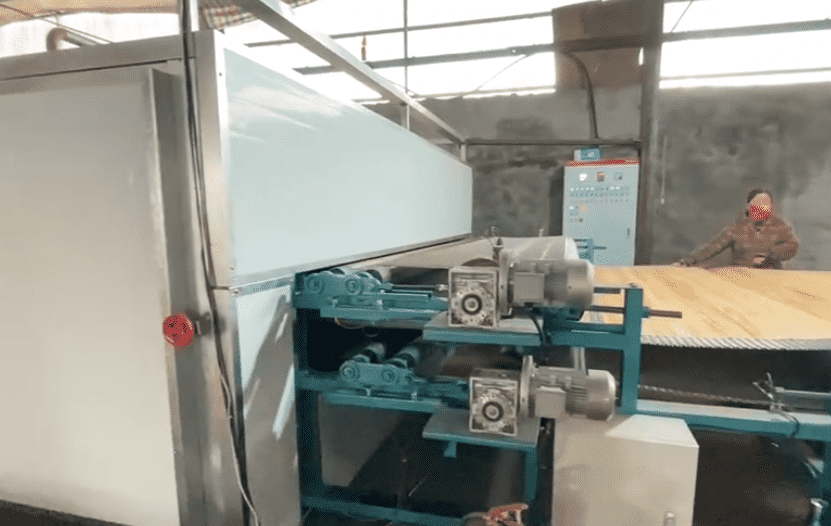
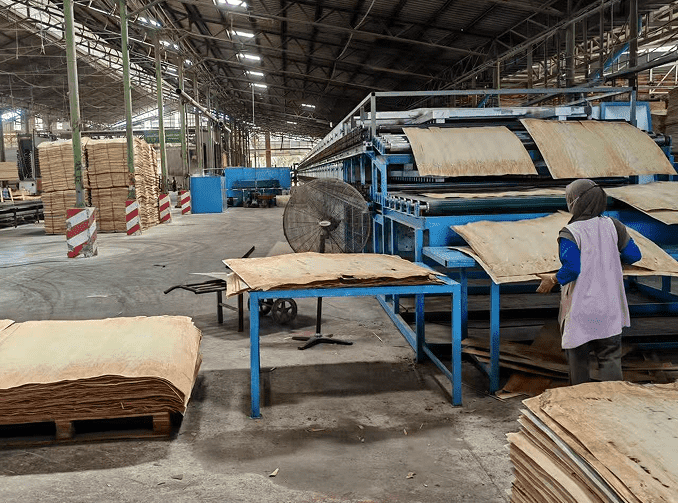
1. Different clamping and veneer constraint methods (the core reason)
Mesh belt dryers: Veneers are laid flat on a metal mesh belt without top or bottom clamping, relying on the belt for forward transport.
Thin veneers (0.8-1.6mm) are lightweight, lay flat and are stable, and are less prone to warping and buckling;
When used with 2.2/2.4mm medium-thick veneers: the veneer thickness is greater, and the internal stress of the wood fibers is higher. During drying and dehydration, without rollers to restrain and limit shrinkage, they shrink freely, making them extremely prone to warping, wavy, bulging, and one-sided curling.
The conveyor belt only "supports" the veneer, not "presses" it down. This results in uncontrolled stress release in thick veneers, drastically increasing the risk of deformation.
Roller dryer: Pairs of rollers continuously clamp and press the veneer forward, providing mechanical clamping throughout the process.
During drying, the veneer is restrained by the rollers, limiting warping and arching. Even with 2.2-2.4mm thick veneers shrinking during dehydration, the surface remains flat.
The rollers' pressing force counteracts the internal stress generated during wood drying, suppressing wave deformation.
The rollers simultaneously convey and restrain the board's deformation, maintaining flatness even for thick veneers.
2. Different hot air transfer and moisture removal paths:
Conveyor belt dryer: Penetrating hot air. Hot air penetrates the veneer from top to bottom and bottom to top to achieve dehydration.
Thin veneers: Hot air easily penetrates the entire layer, drying the surface and core almost simultaneously.
Thick veneers: Increased hot air penetration resistance; heat dries the surface first, making it difficult for heat to reach the core. The result is an overly dry surface and high moisture content in the core. To dry the core, the drying time and temperature must be increased, causing the surface to scorch and become brittle.
The conveyor belt relies on "penetration drying," and the greater the thickness, the more difficult the penetration becomes.
Roller dryer: Conduction + convection combined drying
Part of the heat comes from the heat conduction to the surface of the board by the heated rollers, and part comes from hot air convection.
Heat is input from the surface hot air and also directly conducted to the wood through the roller surface, resulting in higher efficiency in heat penetration.
For thicker veneers, the moisture inside and outside evaporates simultaneously, reducing the likelihood of "dry outside and wet inside," and resulting in better moisture content uniformity.
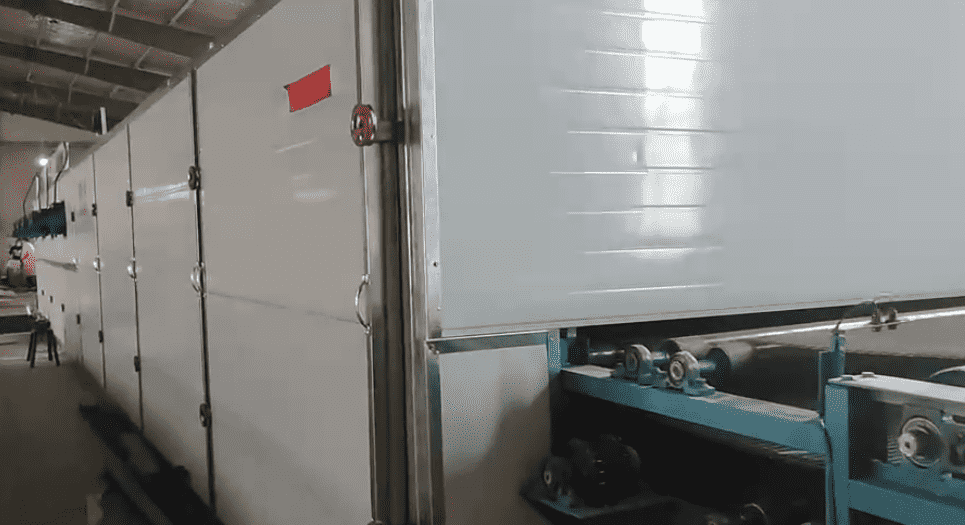
3. Differences in equipment structure and linear speed adaptation
Conveyor belt: The conveyor belt is a continuous plane. Thin veneers can run at high speeds; thick veneers must be dried at lower speeds, extending the drying time, significantly reducing capacity and increasing energy consumption. If thick veneers are forced to run at high speeds, the moisture in the core cannot escape in time, resulting in severely unacceptable moisture content.
Rollers: Multiple sets of rollers with segmented temperature and speed control can match the dehydration rhythm of medium and thick veneers, completing drying at a reasonable speed while balancing capacity and quality.
4. Summary of Applicable Ranges in Actual Industries
Mesh Belt Dryer Advantage Range: 0.8-1.6mm thin veneers. Thin materials experience less deformation, hot air penetration is smooth, and it offers high cost-effectiveness. It is only barely compatible with 2.2/2.4mm veneers, as deformation, uneven moisture content, and high energy consumption are inherent drawbacks.
Roller Dryer Advantage Range: 1.6-2.8mm medium and thick veneers (2.2mm and 2.4mm are mainstream). Relying on roller pressure constraint + conduction + convection combined heat exchange, thicker veneers exhibit better flatness and moisture content uniformity. Very thin veneers (<1.0mm) are easily damaged and wrinkled by the rollers, making mesh belt dryers less suitable.