Español
 Русский
 Francés
 Português
 ภาษาไทย
 Indonesia
 Việt
Việt
 العربية
 Melayu

Automated Veneer Drying Loading System: A Key Factor In Determining Profitability In Timber Processing
Automated Veneer Drying Loading System: A Key Factor In Determining Profitability In Timber Processing
In the timber processing, plywood, and home veneer panel manufacturing industries, competition has long since moved beyond extensive capacity expansion, entering a phase where profitability hinges on refined cost control, standardized quality improvement, and efficient capacity enhancement. Many processing companies are caught in the dilemma of "increased capacity, but thinner profits," not due to weak end-sales, but rather shortcomings in the drying process at the front end of production. Veneer drying, as a core pre-process in timber processing, directly determines the drying yield, energy costs, labor costs, and production capacity ceiling through its loading efficiency, precision, and stability. It can be said that the veneer drying loading process is the first line of defense in controlling a company's profitability, and an automated loading system is the core pre-processing equipment for unlocking profit potential in timber processing.
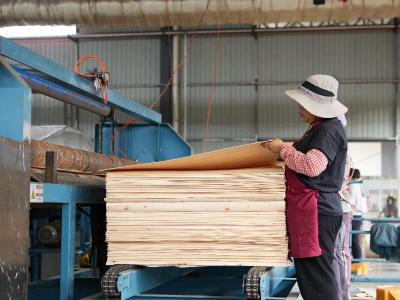
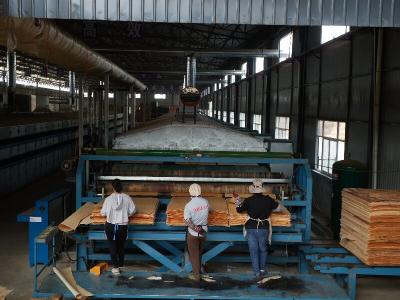
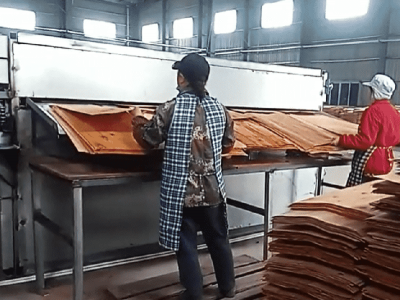
Traditional veneer drying production lines have long relied on manual loading, a major pain point for many companies' profit losses. In the past, most factories required a dedicated loading team of around eight people. Manual sorting, alignment, feeding, and stacking relied entirely on manpower, resulting in high labor costs and industry-wide challenges such as difficulty in recruiting, slow onboarding of new employees, and high staff turnover. The highly random nature of manual operation led to frequent problems like uneven loading density, misalignment, and material leakage during stacking. This directly resulted in uneven heating and moisture removal during veneer drying, causing quality issues such as cracking, warping, uneven drying and wetting, and surface defects, making it difficult to maintain a stable yield. Furthermore, the chaotic loading rhythm made it impossible to match the optimal operating parameters of the drying equipment, leading to high idle and standby times, significant energy waste, limited overall production capacity, and hidden losses that continuously eroded company profits.
More importantly, all the shortcomings in the pre-drying process were passed on to subsequent processes. Substandard veneer loading leading to quality defects causes a surge in rework rates in subsequent processes such as gluing, hot pressing, and molding. This results in material scrap, wasted resources, and wasted labor, significantly reducing the cost-effectiveness of products and putting companies at a disadvantage in market competition. Numerous processing enterprises have proven that even with optimized downstream processes, it's difficult to compensate for the shortcomings in the upstream loading stage. To maintain profits and enhance competitiveness, a breakthrough must be made in this crucial upstream loading and drying process.
Addressing these traditional industry pain points, our automated veneer drying and loading system is deeply compatible with various veneer drying production lines. With its fully automated, high-precision, and highly stable operation, it restructures the upstream production system of wood processing, reducing costs and increasing efficiency across four core dimensions: labor, energy consumption, yield rate, and capacity. It has become an essential piece of equipment for upgrading enterprise profitability.
Regarding reducing labor costs, the entire system incorporates integrated automatic feeding, alignment, stacking, and conveying modules, completely replacing traditional manual loading, sorting, alignment, and straightening operations. After the upgrade, the entire drying production line requires only 2-3 staff members for daily inspections and equipment maintenance, directly reducing frontline labor costs by over 60%. This completely eliminates reliance on skilled workers, avoiding production risks associated with staff turnover, recruitment difficulties, and human error. It can save medium-sized wood processing enterprises hundreds of thousands of yuan in labor costs annually, significantly reducing fixed production costs.
Regarding quality assurance and yield improvement, the equipment is equipped with an intelligent PLC control system that can preset customized loading and drying curves based on different veneer materials, thicknesses, and specifications, ensuring precise and controllable operation throughout the process. The system achieves standardized, uniform loading, precise alignment, and even distribution, completely eliminating problems such as overlapping, misalignment, and inconsistent density caused by manual loading. This ensures that each veneer is heated evenly, thoroughly dehumidified, and maintains consistent moisture content during the drying process. It effectively solves common quality problems such as veneer cracking, warping, color difference, and excessive moisture content, significantly improving the yield of dried veneer and reducing material waste by over 20%, minimizing material waste at the source and maximizing raw material profit margins. For processing precious hardwood veneers, the annual economic benefits from material savings can reach hundreds of thousands of yuan.
In terms of increasing production capacity and efficiency, the automated loading system supports 24/7 stable operation, eliminating issues such as human fatigue, shift handover downtime, and operational errors. The loading rhythm is precisely matched with the drying equipment's operating parameters, preventing idle and standby waste. Compared to traditional manual loading production lines, overall capacity can be increased by 20%-30%. Without adding new factory buildings or drying equipment, it directly revitalizes existing equipment capacity, achieving capacity expansion and helping companies secure more orders and increase market share. Simultaneously, the equipment adopts a compact structural design, occupying only one-third the area of traditional manual loading stations, significantly saving workshop space resources and allowing for the expansion of production or storage space, improving site utilization.
Regarding low energy consumption and minimal maintenance, the entire system uses energy-saving servo drive technology, featuring low power consumption, fast response, and precise matching of production load. Compared to traditional manually assisted production lines, overall energy consumption is reduced by 20%-30%. The system boasts high integration, stable structure, and low failure rate, simplifying daily operation and maintenance without incurring high upkeep costs. The overall drying operating cost is only 30%-60% of traditional processes, offering significant long-term cost-effectiveness advantages and a short return on investment cycle, enabling continuous profit accumulation for enterprises.
The profit competition in the wood processing industry is essentially a competition of refined pre-production processes, standardized procedures, and low-cost operations. The profit ceiling of end products has long been determined by pre-production basic processes such as drying and loading. In today's industry with transparent profits and fierce competition, the extensive production model relying on manual experience is outdated. Only by upgrading to automated equipment and streamlining key pre-production profit-generating processes can a comprehensive breakthrough in cost reduction, quality improvement, and efficiency enhancement be achieved.
Our automated veneer drying and loading system is not just a simple feeding device, but a pre-production profit-generating solution for wood processing enterprises. It replaces manual labor with automation, experience with standardization, and extensive production with high efficiency, plugging profit loopholes, tapping into production capacity potential, and stabilizing product quality from the source of production. This helps enterprises break free from low-profit competition, build standardized, efficient, and low-cost core production competitiveness, and lay a solid foundation for long-term profitability and steady development.