Español
 Русский
 Francés
 Português
 ภาษาไทย
 Indonesia
 Việt
Việt
 العربية
 Melayu



How To Operate A Veneer Dryer Scientifically?
How To Operate A Veneer Dryer Scientifically?
Veneer drying is a pivotal process in plywood production that bridges the preceding and subsequent stages. Drying quality directly determines the rates of veneer cracking, warping, and mold growth, while also influencing downstream gluing and hot-pressing, as well as the strength and flatness of the finished board. When factories experience high veneer scrap rates or board delamination and deformation, the root cause is often not the equipment itself, but rather unscientific operation during the drying process. Mastering the correct operational methods for veneer dryers can improve the veneer pass rate while saving on fuel and electricity costs.
I. Pre-drying: Material Preparation And Equipment Inspection To Mitigate Risks At The Source
1. Grade and Sort Veneers; Avoid Mixed-Batch Drying
Veneers of different wood species, thicknesses, and initial moisture contents have vastly different drying rates; mixing them during drying is strictly prohibited. Species such as eucalyptus, poplar, and Albasia must be kept separate; thick and thin veneers should be sorted; and freshly rotary-cut, high-moisture veneers must be separated from semi-dry veneers that have been stacked for longer periods.
For veneers with excessively high initial moisture content, short-term pre-stacking is recommended to prevent the surface from hardening rapidly—a condition known as "case hardening" (dry outside, wet inside). Damaged or cracked veneers, as well as those containing mud, sand, or bark, should be removed beforehand to prevent impurities from entering the dryer, which could scratch the mesh belts or rollers and even damage blades.
2. Pre-startup Equipment Inspection
Before starting the machine, inspect the heating system, hot air circulation, exhaust and dust removal systems, conveying system, and alignment devices. Check for air leaks in the biomass burner and heat exchange piping; verify the tension of mesh belts or rollers to prevent veneer misalignment; and ensure the water-film dust removal system is functioning correctly to meet exhaust emission standards. Simultaneously, check moisture content monitors and temperature sensors to ensure data accuracy, avoiding blind temperature adjustments based solely on guesswork.
Run the machine without a load for a few minutes to confirm that the fans and drive mechanisms are operating smoothly and without abnormal noise before beginning to feed veneers.
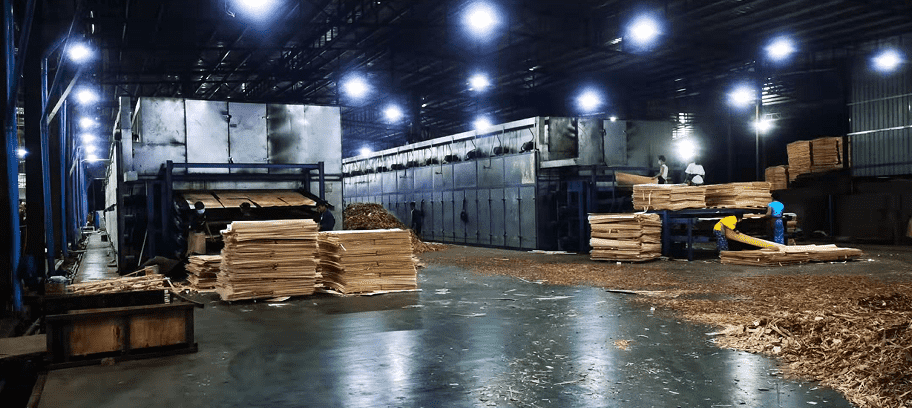
II. During Drying: Controlling The Three Core Parameters—Temperature, Airflow Velocity, And Feed Rate
Veneer drying is essentially a process of slow dehydration at lower temperatures; rapid drying at high temperatures is the primary cause of veneer cracking. Temperature Control
Prioritize a low-temperature, slow-drying process. Avoid abruptly raising the temperature at the inlet section; a sudden spike causes the veneer surface to lose moisture and harden rapidly, trapping internal moisture and creating internal stresses that lead to warping or honeycomb cracking. Maintain a stable hot-air temperature in the middle section, which serves as the primary dehydration zone. Slightly lower the temperature at the outlet section to allow internal moisture to re-equilibrate, thereby reducing post-discharge deformation. Apply specific temperature curves based on wood species: for high-density, hard-fibered species, use lower overall temperatures and extend the drying time accordingly.
Uniform hot-air flow through the veneer layers is crucial for achieving consistent moisture content. Ensure the circulation fans operate correctly and the airflow remains stable to eliminate "dead zones" where air stagnates. The hot air must both carry away evaporated moisture and be vented out promptly via the exhaust system. However, the exhaust vent opening must be carefully regulated; excessive opening leads to massive heat loss and soaring energy consumption, while insufficient venting results in high internal humidity, slowing the drying process and promoting mold growth.
Matching Feed Speed to Target Moisture Content
Do not arbitrarily increase the feed speed. Reduce the conveyor speed and extend drying time for thick veneers or those with high initial moisture content; speed may be increased slightly for thinner veneers. Operators should not focus solely on the surface dryness at the discharge end; instead, they must periodically sample and test the core moisture content to avoid the "dry surface, wet core" scenario.
For plywood production, the final veneer moisture content is typically controlled within the 8%–12% range, with fine-tuning based on local climate and subsequent hot-pressing processes. Minimizing moisture content fluctuations results in a more stable finished product.
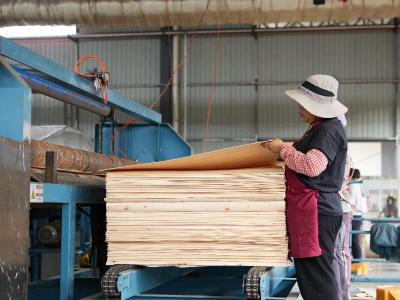
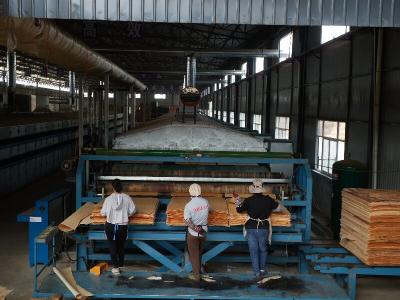
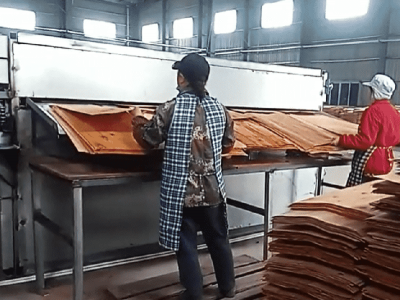
Follow proper veneer loading procedures: lay veneers flat with appropriate spacing between them. Avoid stacking or overlapping, as moisture cannot escape from overlapped areas, leading to uneven drying. Align veneers carefully to minimize lateral offset and prevent them from drifting or jamming inside the machine, which could cause shutdowns or tearing. Maintain a steady feed rate during continuous production; intermittent feeding causes internal temperature fluctuations, which increases the rate of defective veneers.
III. Post-Drying: Cooling, Stacking, Moisture Re-inspection, And Moisture Re-absorption Prevention
Veneers exiting the dryer are hot and cannot be stacked or bundled immediately. They should first be spread out in a cooling area to lower their temperature to near-ambient workshop levels and allow the moisture content to stabilize.
After cooling, sample the veneers to check moisture content; take samples from multiple points within the same batch to observe variations. Veneers exceeding moisture limits require separate re-drying; those with excessively low moisture content are prone to brittleness and cracking and should be isolated.
Stack qualified veneers for storage and cover them to prevent moisture re-absorption. In high-humidity workshop areas, veneers can quickly re-absorb moisture, leading to poor glue adhesion or blistering; it is recommended to place timber supports under the stacks to keep them away from ground dampness.
IV. Routine Maintenance And Troubleshooting
Regularly clean out accumulated sawdust and dust from inside the machine. Sawdust accumulation not only impedes hot air circulation and creates safety hazards but also clogs dust extraction ducts, hindering moisture removal.
Periodically maintain heat exchange pipes and the combustion system to ensure a stable heat source. Dust buildup on heat exchange surfaces significantly reduces thermal efficiency, increases fuel consumption, and lowers drying capacity.
Observe veneer defects and adjust the process accordingly: Surface cracking or curling usually indicates the inlet temperature is too high or the heating rate is too fast; lower the temperature in the initial section and slow down the feeding speed.
Uneven drying (wet/dry spots) or localized blackening suggests hot air short-circuiting, overly dense veneer stacking, or poor moisture exhaust.
Rapid moisture re-absorption after exiting the machine indicates insufficient cooling time or excessive humidity in the storage area.
V. Safety And Energy Consumption Essentials
For biomass-heated veneer dryers, strictly adhere to burner operating protocols and regularly inspect the water-film dust removal system to prevent flue gas emissions from exceeding limits. Do not open maintenance doors in high-temperature zones while the machine is running to avoid burns from hot air.
Efficient drying does not simply mean slow, low-temperature drying; rather, it involves finding the optimal balance between wood species, veneer thickness, and production capacity. A stable process results in lower fuel consumption and reduced veneer waste over the long term, ultimately lowering overall production costs. A veneer dryer is not merely a device for "blowing veneers dry"; it is a comprehensive drying system that coordinates temperature, humidity, airflow velocity, and conveyor speed. Effective operation hinges on key practices: graded material preparation, stable low-temperature drying, uniform moisture removal, and balanced output. Controlling moisture content fluctuations—thereby minimizing splitting, warping, and mold growth—ensures a steady supply of high-quality veneer for subsequent processes such as assembly, gluing, and hot pressing, ultimately increasing the yield of finished plywood.