Español
 Русский
 Francés
 Português
 ภาษาไทย
 Indonesia
 Việt
Việt
 العربية
 Melayu



How To Reduce The Labor Costs In Veneer Production ?
Practical Strategies For Optimizing Labor Costs In Veneer Production
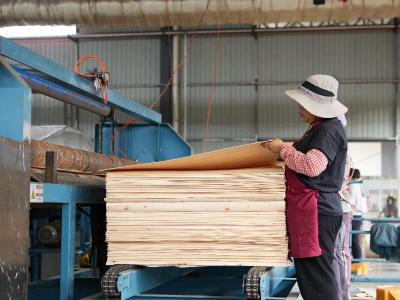
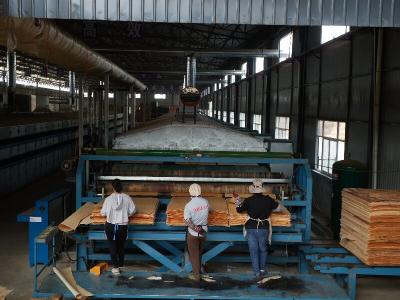
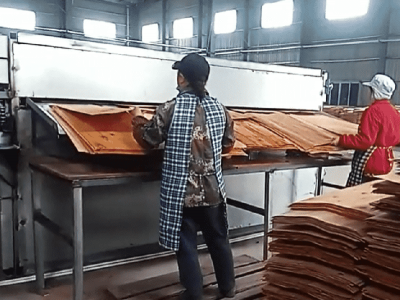
Amidst intensifying competition in the wood processing industry, rising labor costs, and persistent challenges in recruitment and retention, controlling labor costs in veneer production—a core upstream process in engineered wood manufacturing—has become a critical breakthrough for factories seeking to cut costs, boost efficiency, and enhance market competitiveness. Veneer production involves complex, multi-stage workflows—including feeding and alignment, drying and transfer, sorting and grading, flipping and repair, stacking and packaging, and site cleanup. Historically, the process has relied heavily on manual labor, resulting in numerous job roles, high physical exertion, inconsistent labor productivity, and significant labor waste. For veneer manufacturers, a key challenge is how to scientifically streamline the workforce and reduce unproductive labor costs without compromising product quality or disrupting production schedules. Drawing on frontline operational experience, this article outlines an actionable and replicable labor cost-saving strategy across four dimensions: equipment upgrades, process optimization, role management, and management empowerment.
I. Targeting Repetitive Tasks: Replacing Basic Manual Labor with Automation
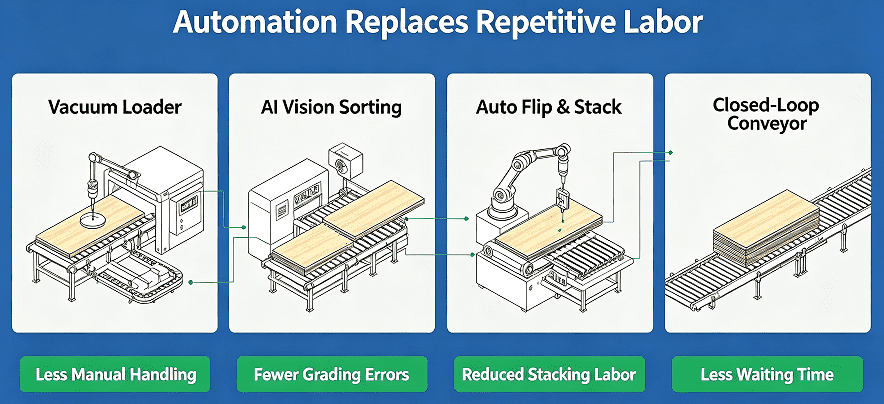
In veneer production, over 60% of frontline labor is consumed by basic, repetitive tasks requiring little technical skill. These roles—characterized by monotonous work, high physical demands, and high turnover—represent a major source of labor cost waste and offer the quickest opportunities for cost reduction. Strategically introducing automation to replace manual labor not only significantly reduces headcount but also mitigates issues such as errors, damage, and inefficiency associated with manual handling, thereby simultaneously driving down costs and improving quality.
Regarding feeding, unloading, and material transfer, traditional production models rely entirely on manual labor to load, unload, and move veneers between processing stages. This approach not only necessitates a large team of dedicated handlers but also leads to issues such as panel impact damage and misalignment, ultimately increasing costs associated with rework. By introducing vacuum-based automatic veneer feeders, fully automated loading and unloading equipment, and closed-loop conveyor lines, the system enables seamless automation across the entire process—from rotary cutting and drying to discharge. This completely eliminates manual tasks such as lifting, arranging, and transporting veneer sheets. A single production line can directly reduce the workforce required for material handling by two to four positions while ensuring neat stacking, stable transport, and reduced material waste.
In the sorting and grading stage, traditional manual methods rely heavily on worker experience and require significant manpower to screen for cracks, holes, and thickness variations. These methods not only incur high labor costs but also suffer from inconsistent grading standards, errors (misclassification or missed defects), and low efficiency. Equipped with an AI-powered visual sorting system, the equipment uses high-definition imaging and intelligent algorithms to rapidly and accurately identify defects and automatically assign grades. A single machine can replace three to six sorters, offering precision and stability far superior to manual labor, thereby minimizing the additional labor costs associated with re-sorting and rework.
In the final stacking and packaging stage, the application of fully automated veneer turners and intelligent stackers replaces manual turning, palletizing, and stacking operations. These systems accommodate various veneer sizes—from large to small sheets—and resolve issues associated with manual labor, such as low efficiency caused by prolonged bending and irregular stacking, while significantly streamlining staffing requirements for downstream operations. Additionally, integrated automatic waste collection systems gather wood chips and scrap material, eliminating the tedious task of manual cleanup and further reducing the need for auxiliary personnel.
II. Streamlining Production Processes And Consolidating Redundant Roles To Unlock Human Productivity
For small and medium-sized veneer factories, the high investment cost of comprehensive automation makes full-scale implementation difficult in the short term. Therefore, process optimization and role consolidation—which do not require massive capital investment—serve as key strategies for rapidly reducing labor costs. Many production lines suffer from overly granular role division, overlapping responsibilities, and uneven workloads; underutilized roles lead to wasted human resources. By streamlining processes and restructuring roles, factories can maximize the efficiency of their existing workforce.
The first step is to optimize role allocation by implementing a model where "one person handles multiple roles" and "one role encompasses multiple skills." Comprehensively break down the tasks for each position on the production line and consolidate fragmented duties—such as inspections, on-site cleaning, semi-finished product transport, and basic equipment assistance—to move beyond the rigid "one person per post" model. Through unified pre-job training, frontline workers can master multiple basic skills, eliminating idle time and wasted manpower, thereby boosting overall operational efficiency without increasing headcount.
Secondly, optimize production scheduling to eliminate wasted labor hours. Shift patterns should be flexibly adjusted based on rotary-cutting capacity, drying cycle times, and order volumes, abandoning rigid fixed schedules in favor of dynamic manpower allocation that responds to production peaks and troughs; this allows for the cancellation of redundant night shifts and idle positions during low-output periods. Simultaneously, streamline process handoffs and identify production bottlenecks. Proactively manage equipment maintenance, material stocking, and process coordination to prevent worker downtime caused by equipment stoppages, material shortages, or disjointed workflows, thereby eliminating wasteful labor costs.
Furthermore, streamline manpower in the repair process at the source. Veneer repair is a labor-intensive task, with much of the workload stemming from defects caused by substandard upstream rotary-cutting processes. By optimizing cutting parameters, standardizing log clamping, and performing regular equipment maintenance, companies can reduce issues such as veneer cracking, uneven thickness, and surface defects. Lowering the rate of substandard boards reduces the repair workload at the source, allowing for a gradual reduction in repair staff and achieving cost savings and efficiency gains.
III. Refine On-site Management To Eliminate Labor Waste In The Details
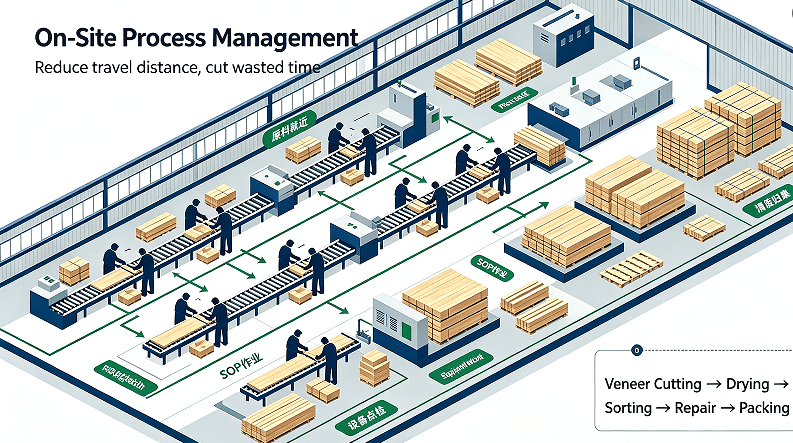
For many veneer factories, high labor costs stem not from an excessive workforce, but from lax on-site management that allows for significant "hidden" labor waste. Issues such as unnecessary movement, non-standard operations, repetitive work, and excessive training costs accumulate over time, resulting in substantial labor loss. Refined on-site management offers a zero-investment, high-return method for reducing costs.
Optimize the on-site layout of materials to ensure they are positioned close to the point of use. Reorganize the material layout along the production line by positioning raw logs, veneers awaiting processing, finished boards, and packaging supplies close to their respective workstations. This minimizes the distance workers must travel to retrieve or deposit materials, significantly reducing non-productive walking time and maximizing the duration of actual, productive work. Simultaneously, establish standardized material stacking protocols to eliminate the need for repetitive tasks—such as searching through or reorganizing materials—caused by a disorganized layout.
Implement standardized operating procedures (SOPs). Establish uniform, standardized guidelines for key manual roles—such as board stacking, sorting, repairing, and packaging—that clearly define operational flows, task requirements, and quality standards, thereby eliminating arbitrary work practices. Standardization not only boosts operational efficiency but also shortens training periods for new hires and mitigates the productivity losses and rework costs associated with staff turnover. Furthermore, uniform standards reduce human error, avoiding the additional labor costs incurred by secondary sorting or repairs.
Strengthen preventive equipment maintenance to ensure production continuity. Develop schedules for regular equipment inspection and servicing, conducting routine maintenance on critical machinery such as rotary lathes, dryers, and conveyor systems. Proactively identify potential faults to minimize the likelihood of unexpected downtime and repair-related interruptions. Stable equipment operation ensures a consistent production rhythm, preventing frequent work stoppages caused by equipment issues or the need for repeated adjustments, and completely eliminating labor wastage attributable to equipment problems.
IV. Optimize Performance Assessment To Unlock The Value Of Human Capital
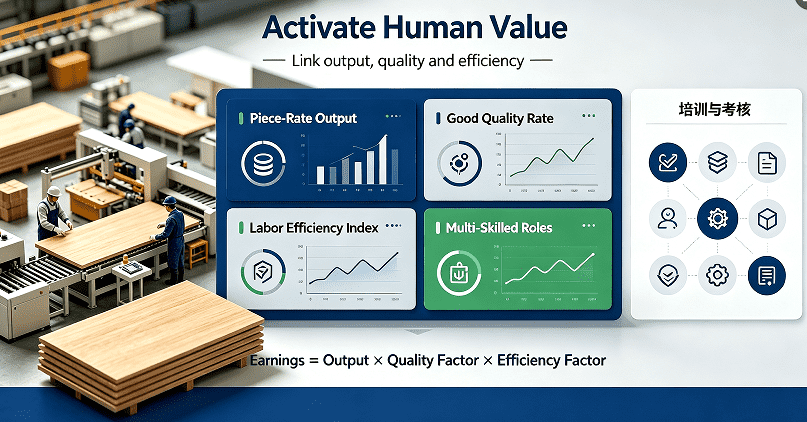
Controlling labor costs is not merely about cutting staff or reducing wages; the core objective is to optimize labor efficiency and ensure that every unit of labor investment generates commensurate value. Flawed compensation and assessment mechanisms can dampen worker motivation and lower efficiency; while labor costs may appear stable on the surface, significant waste of human resources often exists underneath. Refining the performance assessment system effectively stimulates employee initiative, achieving the multifaceted goals of improving quality, boosting efficiency, and reducing costs.
Move away from simple hourly wage models and implement a comprehensive assessment mechanism based on "piecework, quality, and efficiency." Link workers' pay directly to metrics such as veneer output, yield rates (quality), material consumption, and operational efficiency, thereby eliminating the issues of "slacking off" and low productivity often associated with hourly wage systems. At the same time, incentive schemes—rewarding efficiency, quality, and cost savings—should be established to encourage workers to proactively improve operational efficiency, strictly control product quality, and minimize material waste. This addresses the root causes of labor costs associated with rework and inefficiency.
A performance assessment system for specific roles should be established, with regular reviews of labor efficiency data. Roles characterized by insufficient workloads, low efficiency, or redundancy should be promptly adjusted or optimized. Conversely, employees who demonstrate high efficiency and comprehensive skills should be offered opportunities for promotion and salary increases; this optimizes the workforce structure, phases out low-efficiency personnel, and fosters a lean, high-performing production team. Furthermore, routine skills training should be conducted to enhance employees' overall operational capabilities, creating a versatile workforce capable of handling multiple roles and thereby increasing overall labor utilization.
V. Combining Short- And Long-Term Strategies For Sustainable Cost Reduction And Efficiency Improvement
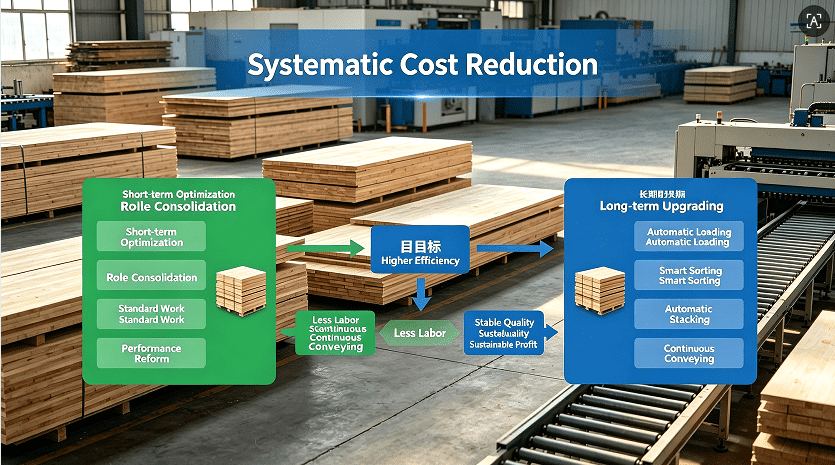
Optimizing labor costs in veneer production is a systematic and ongoing endeavor; it is not merely a matter of upgrading equipment or downsizing staff, but requires a combination of short- and long-term strategies and a multi-faceted approach. In the short term, zero-cost, rapidly implementable measures—such as role consolidation, process optimization, standardized operations, and performance management reform—can be used to revitalize the existing workforce and reduce wasteful losses. In the medium to long term, factories can gradually upgrade to automated equipment based on production capacity and order volume, replacing repetitive or physically demanding manual roles to establish a highly efficient production model where automation plays the primary role and manual labor plays a supporting one.
Amid the industry-wide trend toward refined operations, labor cost management is no longer simply about cutting costs; it is a reflection of production management capabilities and core competitiveness. Only by continuously optimizing production processes, upgrading equipment, refining shop-floor management, and unlocking the value of human capital can enterprises strictly control labor costs while ensuring product quality and boosting efficiency. This enables veneer production companies to achieve steady growth and long-term profitability in a fiercely competitive market.